

The Environmental Cost of Wars
Morning Standard
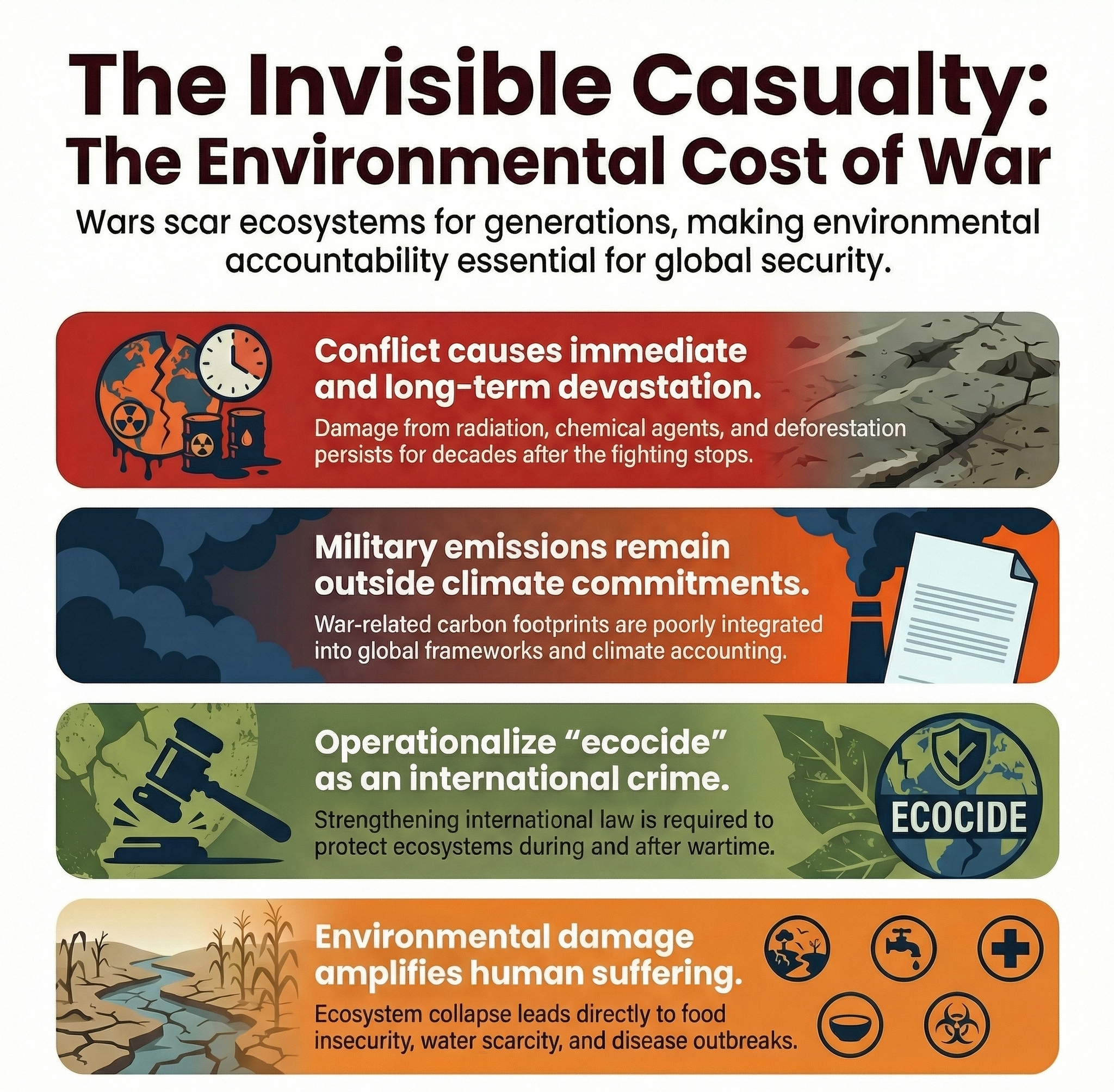
1. Key Arguments
A. War as an Ecological Catastrophe
Conflict devastates land, air, water, and biodiversity.
Examples range from nuclear bombings to chemical agents like Agent Orange and napalm.
B. Long-Term Environmental Consequences
Damage extends beyond immediate destruction.
Radiation, soil degradation, deforestation, and biodiversity loss persist for decades.
C. Modern Conflicts and Climate Impact
Recent wars (Ukraine, Gaza) contribute to emissions and ecological degradation.
Infrastructure destruction leads to pollution, fires, and resource depletion.
D. Underestimation in Climate Accounting
War-related emissions are poorly integrated into global climate frameworks.
Military activities remain outside many climate commitments.
E. Humanitarian–Environmental Nexus
Environmental damage worsens human suffering.
Food insecurity, water scarcity, disease, and displacement are amplified.
F. Selective Global Response
International reactions vary depending on geopolitical interests.
Environmental violations in war zones often escape consistent accountability.
2. Author’s Stance
Strongly critical and normative
Condemns war as ecologically destructive
Positions environmental harm as central, not peripheral.
Implicitly critiques global hypocrisy
Highlights uneven global response to similar environmental damages.
3. Biases and Limitations
Normative Bias
Moral framing dominates analytical neutrality
War is presented largely as an environmental evil without strategic context.
Selective Case Emphasis
Focus on certain conflicts (e.g., US wars, Israel-Gaza)
May reflect geopolitical bias.
Limited Counter-Perspective
Little discussion on security compulsions or mitigation efforts
Ignores complexity of conflict decision-making.
4. Strengths (Pros)
Brings neglected dimension into discourse
Highlights environmental cost of wars, often ignored.
Evidence-based examples
Use of historical (Hiroshima, Vietnam) and contemporary conflicts.
Links environment with human security
Expands understanding beyond traditional security paradigms.
Relevance in climate change era
War-induced emissions add to global warming.
5. Weaknesses (Cons)
Overgeneralisation of conflicts
Not all wars have identical environmental impacts.
Lack of policy depth
Limited discussion on regulatory frameworks or enforcement.
Geopolitical bias risk
Selective examples may affect neutrality.
6. Policy Implications
A. Inclusion of Military Emissions in Climate Frameworks
Accountability under global agreements
Incorporate defence-related emissions.
B. Strengthening International Environmental Law
War-time ecological protection norms
Operationalising “ecocide” as a legal concept.
C. Environmental Impact Audits Post-Conflict
Mandatory ecological restoration plans
Rehabilitation of affected ecosystems.
D. Integration with Humanitarian Response
Link relief efforts with environmental recovery
Sustainable reconstruction.
E. Global Governance Reform
Uniform standards irrespective of geopolitical interests
Avoid selective enforcement.
7. Real-World Impact
Environmental Impact
Long-term ecological degradation
Loss of forests, soil fertility, biodiversity.
Economic Impact
Massive reconstruction costs
Agriculture, fisheries, and livelihoods affected.
Human Impact
Health crises and displacement
Exposure to toxins, radiation, pollution.
Global Climate Impact
Increased emissions and weakened mitigation efforts
Undermines global climate goals.
8. UPSC GS Paper Linkages
GS Paper III (Environment & Disaster Management)
- Environmental degradation
- Climate change
- Pollution
GS Paper II (International Relations)
- Conflict zones
- Global governance
- International law
GS Paper I (Geography)
- Human-environment interaction
- Resource destruction
9. Balanced Conclusion
The article successfully foregrounds the environmental costs of war, compelling a broader understanding of conflict beyond immediate human and strategic dimensions. However, a more balanced approach would integrate security realities with ecological accountability.
10. Future Perspective
Towards ‘Green Warfare Norms’
Minimising ecological damage during conflicts.
Recognition of Ecocide
As an international crime.
Integration of climate and security discourse
Holistic global governance.
Post-war ecological reconstruction frameworks
Sustainable rebuilding.
Final Insight
Wars are not only fought on battlefields—they scar ecosystems for generations, making environmental accountability an essential pillar of global peace and security.
