

The evolving nature of trade agreements
The Hindu
I. Core Context
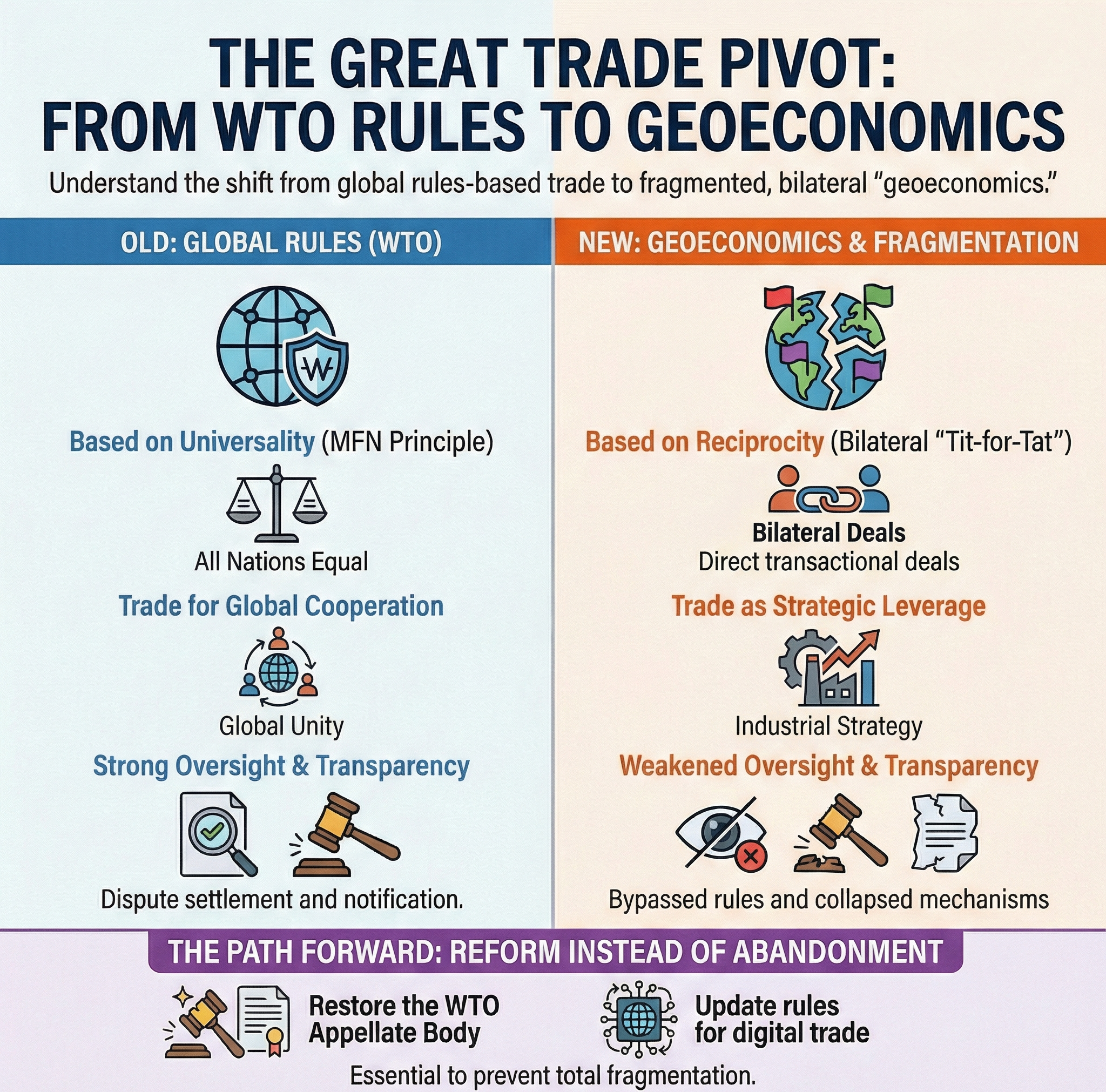
The article analyses a shift in the architecture of global trade agreements, focusing on the emergence of Reciprocal Trade Agreements (RTAs/ARTs) under the U.S. administration that appear to diverge from established multilateral norms under the General Agreement on Tariffs and Trade (GATT) and the World Trade Organization (WTO).
It frames the issue as:
- A challenge to multilateral trade governance
- A shift toward transactional and bilateral trade deals
- A weakening of rule-based global trade order
II. Key Arguments Presented
1. Departure from Multilateral Norms
The article argues that recent U.S. trade agreements:
- Do not conform to WTO requirements
- Depart from the Most-Favoured-Nation (MFN) principle
- Emphasise reciprocity over universality
This signals erosion of the rule-based multilateral system.
2. Emergence of Reciprocal Trade Agreements
These agreements are portrayed as:
- Politically negotiated
- Sector-specific
- Transactional
- Often outside formal WTO notification frameworks
They differ from comprehensive FTAs that align with GATT Article XXIV provisions.
3. Undermining WTO Oversight
The author highlights that:
- Failure to notify such agreements to the WTO limits scrutiny
- Dispute settlement mechanisms weaken
- Transparency reduces
This may accelerate fragmentation of global trade governance.
4. Shift from Globalisation to Geoeconomics
Trade agreements are increasingly instruments of:
- Strategic leverage
- Domestic industrial policy
- Protectionist recalibration
Economic nationalism replaces cooperative multilateralism.
III. Author’s Stance
The tone is critical of the evolving U.S.-led model.
The article clearly supports:
- Multilateral trade governance
- WTO-centred rule enforcement
- Institutional oversight
It views unilateral reciprocal deals as destabilising.
IV. Possible Biases and Limitations
1. Normative Bias Toward Multilateralism
While defending WTO norms, the article may underplay:
- WTO dispute settlement paralysis
- Ineffectiveness in addressing digital trade and subsidies
- Slow reform processes
Multilateralism itself faces structural stagnation.
2. Limited Acknowledgment of Domestic Political Pressures
Trade policy often reflects:
- Domestic employment concerns
- Strategic competition
- Security considerations
The article focuses more on legal legitimacy than political economy drivers.
3. Overgeneralisation of U.S. Approach
Not all bilateral agreements inherently undermine multilateral trade. Some can complement global rules.
V. Pros and Cons of the Evolving Model
Pros
• Greater flexibility for countries
• Faster negotiation timelines
• Strategic alignment in sensitive sectors
• Tailored reciprocity
Cons
• Erosion of WTO authority
• Fragmented global trade architecture
• Reduced predictability
• Weakened dispute resolution
VI. Policy Implications
1. For Global Trade Governance
There is an urgent need for:
- WTO reform
- Restoration of Appellate Body functionality
- Updating rules for digital trade and subsidies
2. For Developing Countries
Developing economies must:
- Safeguard multilateralism
- Avoid asymmetric reciprocal deals
- Strengthen collective bargaining platforms
3. For India
India should:
- Engage strategically in bilateral deals
- Ensure WTO compatibility
- Protect domestic policy space
- Diversify trade partners
4. Trade Diplomacy Recalibration
India must balance:
- Strategic autonomy
- Market access
- Compliance with global norms
VII. Real-World Impact
Short-term:
- Increased bilateral deal-making
- Trade fragmentation
Medium-term:
- Emergence of trade blocs
- Reduced predictability in global supply chains
Long-term:
- Possible decline in WTO centrality
- Institutional realignment of global trade
VIII. UPSC Relevance
GS Paper II
• WTO and global governance
• India–US trade relations
• Multilateral vs bilateral diplomacy
GS Paper III
• Trade policy
• Globalisation vs protectionism
• Impact of tariff measures
Essay Themes
• Crisis of multilateralism
• Economic nationalism
• Rules vs power in global governance
IX. Balanced Conclusion and Future Perspective
The evolving trade architecture reflects deeper geopolitical tensions and dissatisfaction with existing multilateral frameworks. Reciprocal trade agreements offer flexibility but risk weakening institutional stability.
The WTO-led order, though imperfect, provided:
- Predictability
- Transparency
- Universal standards
Reform, not abandonment, is essential.
For India, the path forward lies in strategic engagement—leveraging bilateral opportunities while defending a rules-based multilateral system that protects developing country interests.
The future of trade will likely be hybrid: layered networks of bilateral, regional, and multilateral frameworks. The challenge will be to ensure that flexibility does not descend into fragmentation.
