

The India–Canada turnaround is about deliverables
The Hindu
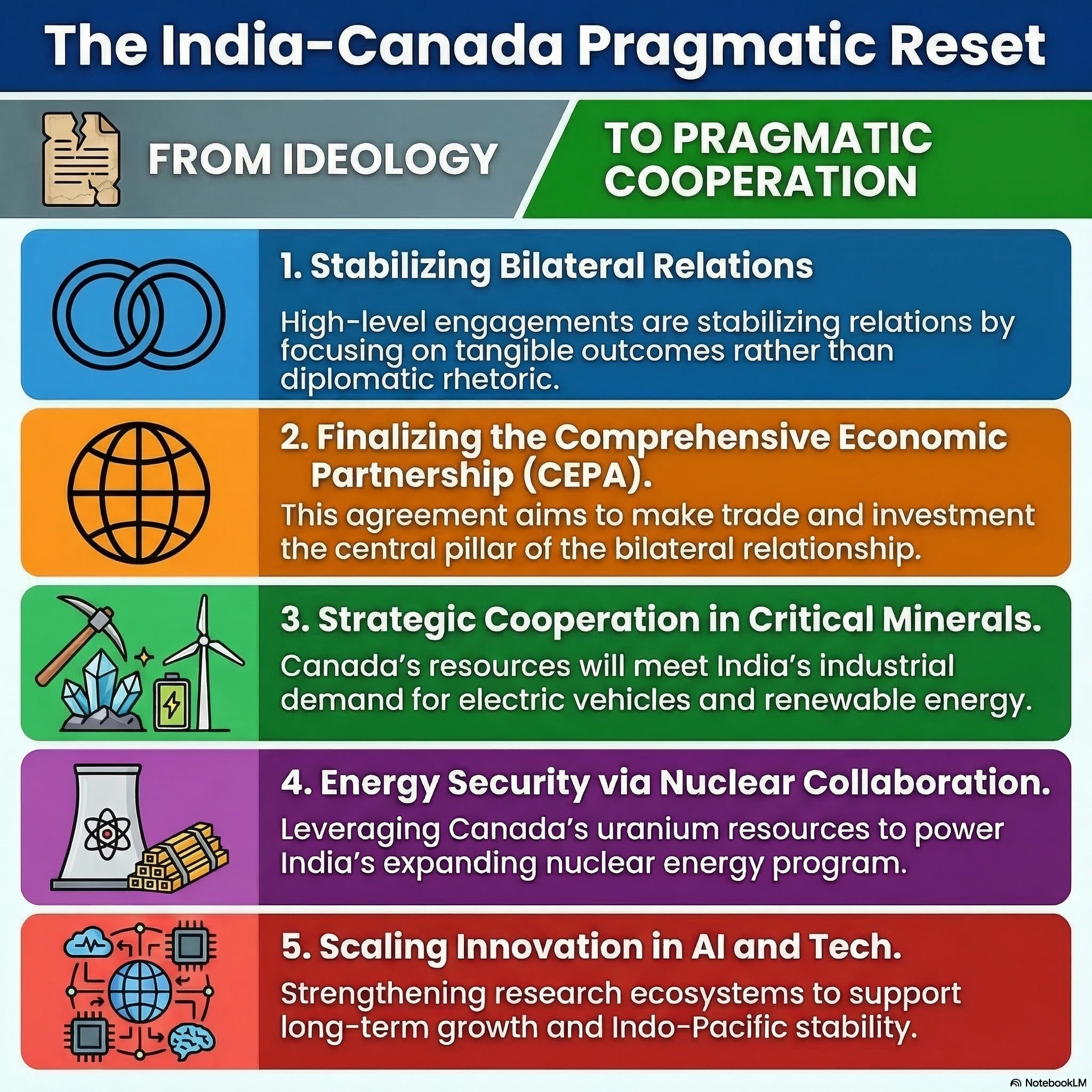
Key Arguments of the Article
Reset in India–Canada Relations
The article notes that the relationship between India and Canada had experienced strains due to political controversies and diplomatic disagreements. However, recent high-level engagements have helped stabilise the bilateral relationship.
The current approach emphasises pragmatic cooperation rather than ideological alignment.
Focus on Economic and Trade Cooperation
A major element of the renewed engagement is the progress toward the Comprehensive Economic Partnership Agreement (CEPA). This agreement aims to enhance trade, investment flows, and market access between the two economies.
The article suggests that economic cooperation could become the central pillar of bilateral relations.
Strategic Cooperation in Critical Minerals
Critical minerals, essential for technologies such as electric vehicles, renewable energy systems, and advanced electronics, form an important component of the partnership.
Canada’s resource base and India’s industrial demand create natural complementarities.
Collaboration in Technology and Innovation
The article highlights initiatives related to artificial intelligence, innovation ecosystems, and technological research partnerships. Strengthening collaboration in emerging technologies can support long-term economic growth in both countries.
Such partnerships also align with broader Indo-Pacific strategic cooperation.
Energy Security and Nuclear Cooperation
Energy cooperation, particularly in nuclear fuel supply and clean energy, is another major area of collaboration. Canada’s uranium resources and India’s expanding nuclear power program create opportunities for long-term cooperation.
This partnership contributes to India’s broader strategy of diversifying energy sources.
Author’s Stance
The author adopts a pragmatic and optimistic stance regarding the renewed India–Canada partnership. The article suggests that focusing on tangible economic outcomes rather than diplomatic rhetoric can strengthen bilateral relations.
The tone emphasises mutual economic interests and strategic complementarity.
Possible Biases
Economic Pragmatism
The article prioritises economic cooperation and may underplay lingering political or diplomatic tensions.
Strategic Partnership Perspective
The narrative supports the idea that closer engagement between India and Canada is beneficial, potentially overlooking areas of disagreement.
Limited Domestic Context
The article focuses largely on bilateral cooperation and may not fully examine internal policy constraints in either country.
Advantages of Strengthening India–Canada Relations
Trade Expansion
Enhanced trade agreements can improve market access for businesses in both countries.
Energy Security
Reliable energy partnerships contribute to long-term energy stability.
Technology Collaboration
Joint research and innovation initiatives can accelerate technological advancement.
Strategic Alignment
Cooperation between democracies in the Indo-Pacific can strengthen regional stability.
Challenges and Limitations
Political Sensitivities
Domestic political issues in both countries can affect diplomatic relations.
Trade Negotiation Complexities
Finalising trade agreements often involves difficult negotiations over tariffs, regulatory standards, and market access.
Geopolitical Pressures
Global strategic competition may influence bilateral cooperation.
Economic Competition
Certain sectors may face competitive pressures despite overall cooperation.
Policy Implications
Strengthening Bilateral Economic Frameworks
Progress on trade agreements such as CEPA can institutionalise economic cooperation.
Expanding Technology Partnerships
Joint innovation initiatives can strengthen research ecosystems in both countries.
Securing Critical Mineral Supply Chains
Diversified access to critical minerals will support energy transition and industrial growth.
Enhancing Indo-Pacific Cooperation
Strategic partnerships in the Indo-Pacific region can support regional stability.
Real-World Impact
If cooperation strengthens:
• Increased bilateral trade and investment
• Improved energy security for India
• Stronger technological collaboration
• Greater geopolitical cooperation in the Indo-Pacific
If tensions re-emerge:
• Disruption of economic partnerships
• Slower progress on trade agreements
• Reduced strategic cooperation
Alignment with UPSC GS Papers
GS Paper II
India’s foreign policy, bilateral relations, Indo-Pacific diplomacy.
GS Paper III
Energy security, trade agreements, critical minerals, economic diplomacy.
GS Paper IV
Ethics in diplomacy, balancing national interests with international cooperation.
Balanced Assessment
The renewed engagement between India and Canada reflects a pragmatic shift toward economic and strategic cooperation. By focusing on tangible deliverables such as trade agreements, technology partnerships, and energy collaboration, both countries aim to move beyond past tensions.
However, sustaining this momentum will require careful diplomatic management and consistent policy engagement.
Future Perspective
In an era of shifting global alliances and supply chain realignments, partnerships based on economic complementarity and strategic interests are increasingly important. India–Canada cooperation has the potential to evolve into a significant pillar of economic and geopolitical collaboration.
For policymakers and civil services aspirants, the relationship illustrates how economic diplomacy and strategic interests shape contemporary international relations.
