

The Indo-Pacific: A Structural Reality Beyond U.S. Policy
The Indo-Pacific: A Structural Reality Beyond U.S. Policy
Source: The Indian Express (01-07-2026)
Why in News?
Japanese Prime Minister Sanae Takaichi's visit to India has reaffirmed that the Indo-Pacific remains the central geopolitical framework for regional security and economic cooperation, irrespective of changes in U.S. strategic terminology.
Core Argument
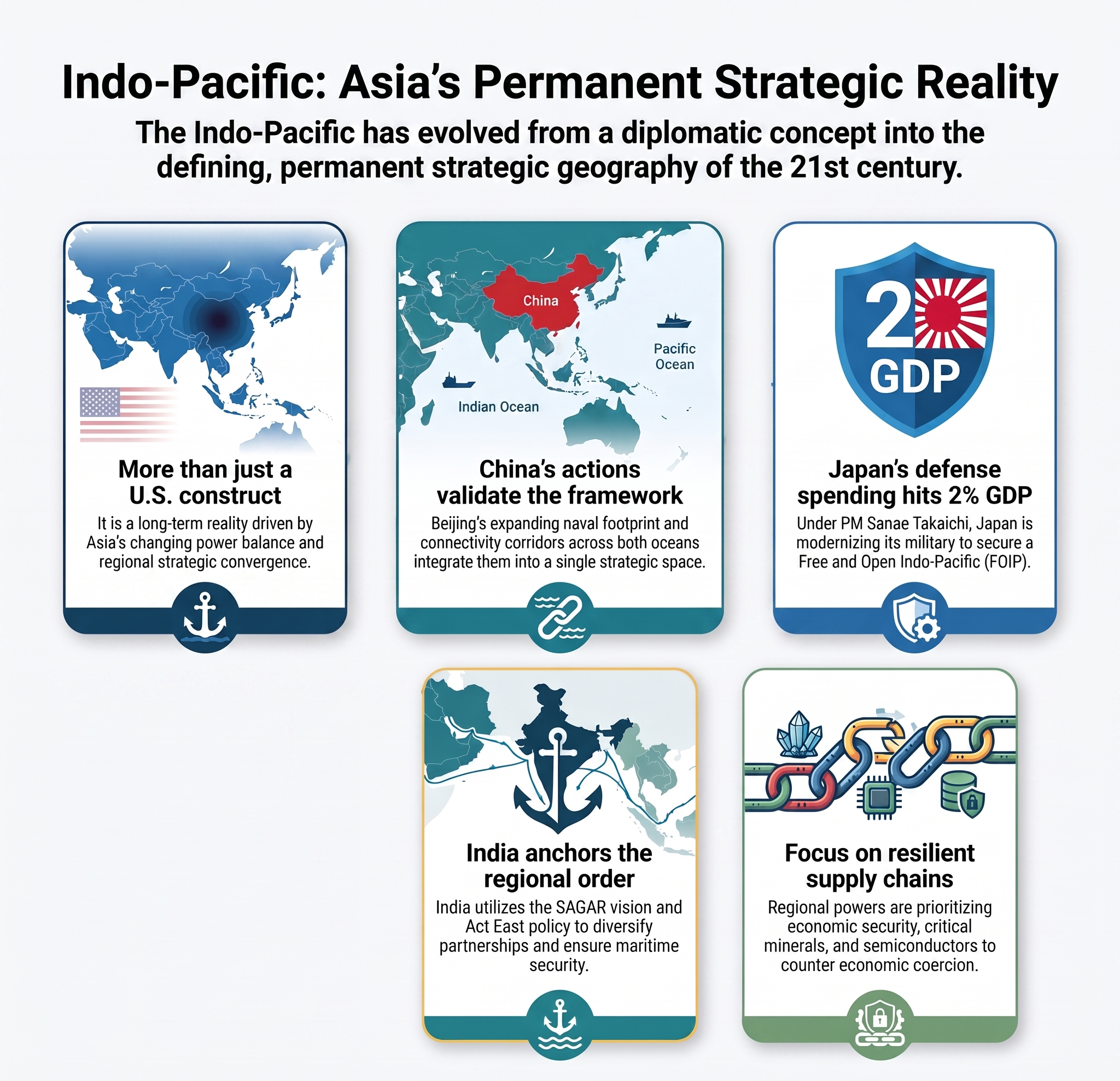
The Indo-Pacific is not merely an American strategic construct, but a long-term geopolitical reality driven by Asia's changing balance of power, China's expanding influence and the growing strategic convergence among regional democracies.
Evolution of the Indo-Pacific Concept
- The term gained prominence after Shinzo Abe's 2007 address to the Indian Parliament on the "Confluence of the Two Seas."
- The United States formally adopted the Indo-Pacific framework in 2017 during the first Trump Administration.
- India has since incorporated the Indo-Pacific into its national security, maritime and economic strategy.
Why the Indo-Pacific Will Endure
- Reflects the strategic integration of the Indian and Pacific Oceans.
- China's expanding military, economic and maritime footprint spans both oceans.
- Regional powers such as India, Japan, Australia, ASEAN countries and European partners increasingly view the region as a single strategic theatre.
- The concept is driven by Asian geopolitical realities, not merely U.S. policy preferences.
Japan's Expanding Strategic Role
Under Prime Minister Sanae Takaichi, Japan has strengthened its Free and Open Indo-Pacific (FOIP) strategy by focusing on:
- Economic security.
- Resilient supply chains.
- Critical minerals.
- Maritime security.
- Clean energy cooperation.
- Stronger partnerships with India, Australia, ASEAN, South Korea and the Philippines.
Defence Modernisation
- Defence spending crossed 2% of GDP.
- Acquisition of long-range strike capabilities.
- Expansion of maritime, space and defence-industrial capabilities.
- Greater strategic autonomy alongside the U.S. alliance.
India–Japan Cooperation
The two countries are expected to deepen cooperation in:
- Economic security.
- Semiconductors.
- Critical minerals.
- Clean energy.
- Maritime security.
- Supply chain resilience.
- Countering economic coercion.
China's Role in Reinforcing the Indo-Pacific
Although China rejects the Indo-Pacific concept, its own policies validate it by:
- Expanding naval presence across the Indian Ocean.
- Developing overseas facilities, including Djibouti.
- Building connectivity corridors linking western China to the Indian Ocean.
- Increasing dependence on Middle Eastern energy and African resources.
- Integrating the Indian and Pacific Oceans into a unified strategic space.
Significance for India
- Supports India's Act East Policy and SAGAR (Security and Growth for All in the Region) vision.
- Strengthens maritime security and freedom of navigation.
- Diversifies strategic partnerships.
- Enhances resilience against economic coercion.
- Supports secure supply chains and emerging technologies.
- Reinforces India's role as a leading Indo-Pacific power.
Challenges
- Strategic competition between the U.S. and China.
- Maritime disputes and regional security tensions.
- Economic coercion and supply chain vulnerabilities.
- Balancing strategic autonomy with expanding partnerships.
- Diverse priorities among Indo-Pacific countries.
Way Forward
- Continue strengthening India's maritime and defence capabilities.
- Deepen strategic partnerships with Japan, Australia, ASEAN and other Indo-Pacific democracies.
- Promote resilient supply chains, critical mineral partnerships and technology cooperation.
- Strengthen regional institutions while preserving strategic autonomy.
- Advance a free, open, inclusive and rules-based Indo-Pacific grounded in international law and UNCLOS.
Conclusion
The Indo-Pacific has evolved into a structural feature of Asian geopolitics, shaped by geography, economic interdependence and China's expanding strategic footprint. Its relevance no longer depends on American rhetoric but on the enduring interests of regional powers, particularly India and Japan.
Final Takeaway
The Indo-Pacific is not a transient diplomatic slogan but the defining strategic geography of the 21st century. India's long-term security and economic interests require sustained engagement with like-minded partners while preserving strategic autonomy and supporting a rules-based regional order.
