

The invisible denotified tribes of punjab

The invisible denotified tribes of punjab
Who are the "Invisible" Tribes?
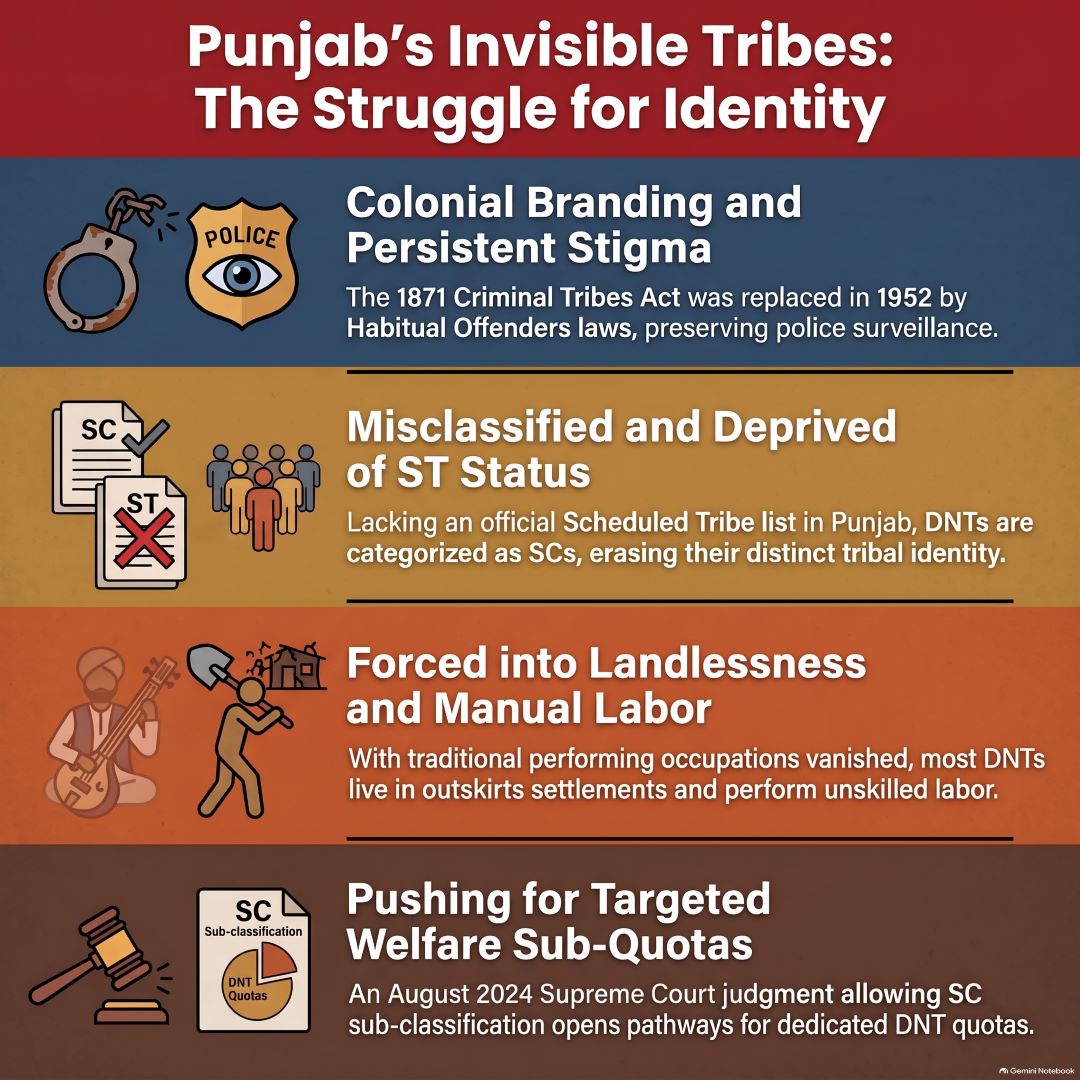
In Punjab, the DNTs comprise seven primary communities that were once branded as "born criminals" under the colonial Criminal Tribes Act (CTA) of 1871.
- Major Communities: Sansi, Bazigar, Bauria, Barar, Bangali, Gandhila, and Nat.
- The Transition: In 1952, the CTA was repealed, and they were "denotified." However, they were soon replaced by the Habitual Offenders Act (1952), which many activists argue merely changed the legal label while keeping the police surveillance and social stigma intact.
The "Invisible" Status: A Classification Paradox
Unlike many other states, Punjab and Haryana were created without an official Scheduled Tribes (ST) list. This has led to a unique form of invisibility:
- Taxonomic Bind: To provide them benefits, the Punjab government classified most DNTs as Scheduled Castes (SCs).
- The Competition Gap: Within the SC category, DNTs must compete for resources and quotas with more politically organized and educationally advanced groups like the Ad-dharmi or Mazhabi Sikhs.
- Identity Erasure: By being labeled SC, their distinct tribal identity, nomadic history, and specific cultural needs are often ignored in policy-making

Recent Developments (2024–2026)
As of October 2026, there is renewed focus on these communities due to significant legal and administrative shifts:
- Supreme Court Judgment (August 2024): In the State of Punjab v. Davinder Singh case, a 7-judge bench upheld the validity of sub-classification within SCs. This has paved the way for DNT leaders to demand specific sub-quotas, ensuring that benefits aren't cornered by dominant SC groups.
- Caste Socio-Economic Survey (2026): The Punjab government launched its first-ever comprehensive caste and drug-use survey on April 1, 2026. This exercise is expected to finally provide reliable data on the living standards of "invisible" communities to guide targeted welfare.
- Census 2027 Debate: In March 2026, the Supreme Court declined a PIL seeking a separate enumeration for DNTs in the upcoming Census, terming it a policy decision. This remains a major point of contention for DNT activists who argue that "what isn't counted, doesn't count."
Socio-Economic Realities
Despite state-level schemes like the Mai Bhago Istri Shakti Scheme or the central SEED (Scheme for Economic Empowerment of DNTs), the ground reality remains harsh:
- Landlessness: Most DNTs in Punjab are landless, often living in deras (settlements) on the outskirts of villages or on encroached panchayat lands.
- Livelihood: Traditional occupations (like the Nat’s acrobatics or Bazigar’s performance) have vanished, forcing them into unskilled manual labor or rag-picking.
- The Stigma: Even in 2026, these tribes face disproportionate police questioning during local thefts, a legacy of the "habitual offender" tag.
Way Forward
For a Mains answer, focus on the Triple Burden of DNTs:
- Historical Burden: The legacy of the Criminal Tribes Act.
- Administrative Burden: Lack of tribal status (ST) in Punjab.
- Societal Burden: Continued stigmatization as "habitual offenders."
