

The judicial push for environmental CSR
The Hindu
1. Key Arguments
A. Judicial Expansion of CSR Mandate
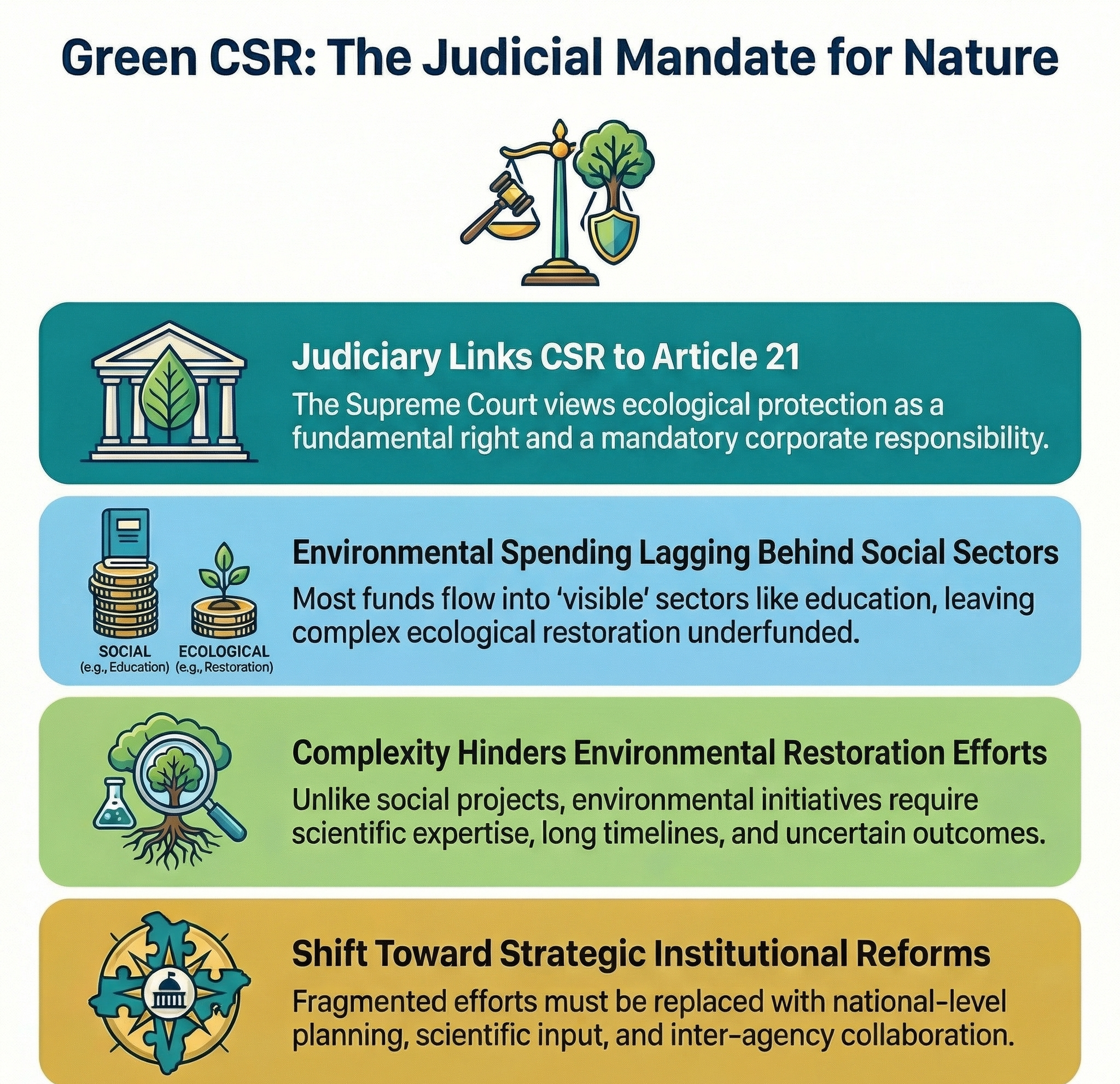
Supreme Court links CSR with environmental protection under constitutional principles.
Invoking Article 21 and Directive Principles, the Court emphasises corporate responsibility in ecological restoration.
B. Environmental Degradation Despite CSR Framework
CSR spending has not adequately addressed ecological challenges.
Corporate contributions remain skewed towards social sectors like education and healthcare.
C. Skewed Allocation of CSR Funds
Environmental initiatives receive a disproportionately small share.
Major funds flow into easier, visible sectors rather than complex ecological restoration.
D. Practical Challenges in Environmental CSR
Restoration requires expertise, long timelines, and coordination.
Unlike social projects, environmental initiatives involve scientific complexity and uncertain outcomes.
E. Need for Strategic and Institutional Reforms
Fragmented efforts must be replaced with coordinated frameworks.
Calls for national-level planning, scientific input, and inter-agency collaboration.
2. Author’s Stance
Supportive but critically evaluative
Endorses judicial intent
Recognises the importance of environmental CSR.
Advocates structured implementation
Highlights need for strategy, expertise, and coordination.
3. Biases and Limitations
Judicial optimism bias
Assumes courts can effectively drive policy change.
Limited corporate perspective
Challenges faced by firms (cost, compliance, expertise) are underexplored.
Underrepresentation of market-based solutions
Focus remains on CSR rather than broader environmental economics.
4. Strengths (Pros)
Highlights critical policy gap
Brings attention to underutilised CSR potential.
Strong constitutional linkage
Connects environment with fundamental rights.
Focus on long-term sustainability
Emphasises restoration and ecological balance.
5. Weaknesses (Cons)
Limited operational clarity
Does not provide detailed frameworks for implementation.
Overreliance on CSR mechanism
CSR alone may not suffice for large-scale environmental challenges.
Insufficient discussion on monitoring and accountability
Evaluation mechanisms are not deeply explored.
6. Policy Implications
A. Strategic Allocation of CSR Funds
Prioritising environmental restoration projects
Setting minimum allocation thresholds.
B. Institutional Coordination
Collaboration between government, corporates, and scientific bodies
Integrated planning mechanisms.
C. Capacity Building
Developing expertise in ecological restoration
Training and knowledge-sharing platforms.
D. Monitoring and Accountability
Outcome-based evaluation of CSR projects
Ensuring effectiveness and transparency.
E. Complementary Policy Tools
Beyond CSR to regulatory and market-based mechanisms
Carbon markets, green taxes, and incentives.
7. Real-World Impact
Environmental Outcomes
Potential improvement in restoration efforts
If effectively implemented.
Corporate Behaviour
Shift towards sustainability-oriented practices
Integration of ESG principles.
Governance
Enhanced role of judiciary in environmental policy
Expanding scope of constitutional interpretation.
Challenges
Implementation gaps and inefficiencies
Risk of tokenism without strategic planning.
8. UPSC GS Paper Linkages
GS Paper III (Environment)
- Environmental governance
- Corporate responsibility
- Sustainable development
GS Paper II (Governance)
- Role of judiciary
- Policy implementation
GS Paper IV (Ethics)
- Corporate ethics
- Environmental responsibility
9. Balanced Conclusion
Judicial push has elevated environmental CSR, but effectiveness depends on structured implementation.
Without strategic planning and institutional coordination, CSR risks becoming symbolic rather than transformative.
10. Future Perspective
Towards integrated environmental governance
Combining CSR with regulatory and market mechanisms.
Strengthening institutional capacity
Scientific and administrative expertise.
Ensuring accountability and impact
Outcome-driven evaluation systems.
Balancing judicial activism with policy design
Collaborative approach between judiciary, executive, and corporates.
Final Insight
Environmental CSR must move from compliance to commitment—only then can it contribute meaningfully to ecological sustainability.
