

The Land Remembers

The Philosophy: Land as a Living Witness
In tribal and indigenous worldviews, land is not a mere commodity; it is a living entity and a witness to history.
- Reciprocity: Indigenous communities (like the Gonds or Lakota) believe in a "give-and-take" relationship. They refrain from over-exploitation, believing the land sustains those who respect it.
- Spiritual Connection: For many Indian tribes, specific geographical features (hills, rivers) are the abodes of deities. The land "remembers" the rituals, stories, and stewardship of generations.
- Historical Memory: Even when people are displaced, the ecological health (or degradation) of a region serves as a memory of how it was treated.
Ecological Manifestation: Sacred Groves
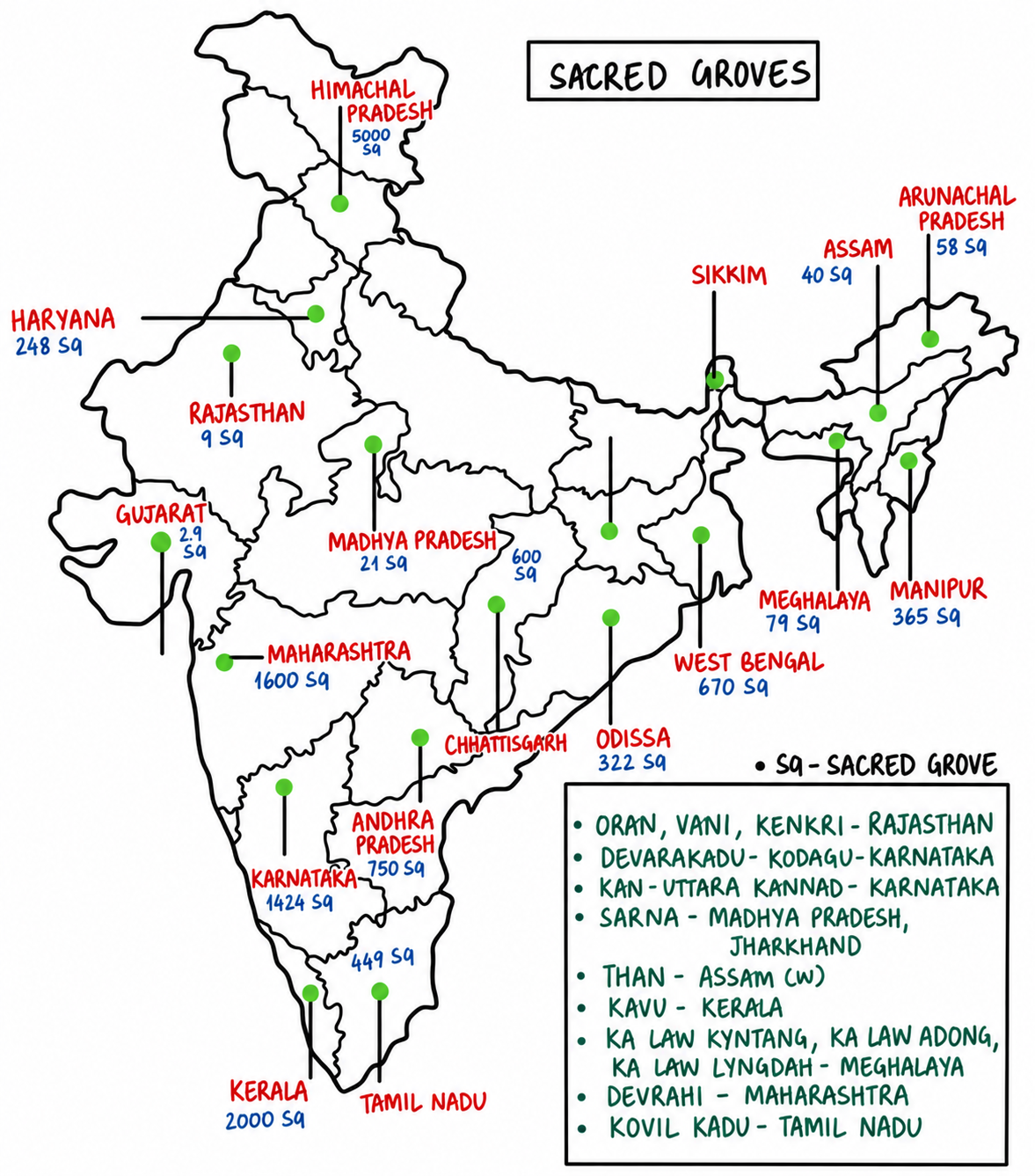
The most visible Indian example of "the land remembering" its traditional protectors is the Sacred Grove. These are patches of virgin forest protected by local communities due to religious beliefs.
- Conservation Hubs: They harbor rare, endemic, and medicinal species that have often disappeared from surrounding degraded areas.
- Water Security: Groves are often associated with perennial springs or ponds, acting as natural water recharge zones.
- Naming across India: Known as Sarnas in Jharkhand, Kavus in Kerala, and Devarakadu in Karnataka.
Modern Relevance: Traditional Ecological Knowledge (TEK)
Modern conservation is shifting from "exclusionary" models to "inclusive" ones that value how the land was traditionally managed.
- Global Recognition: The Kunming-Montreal Global Biodiversity Framework (2022) explicitly calls for upholding the rights of indigenous peoples as essential land stewards.
- Indian Legal Framework:
- Forest Rights Act (FRA), 2006: Recognizes the "Community Forest Resource" rights, acknowledging that the land's health is tied to tribal management.
- PESA Act, 1996: Empowers Gram Sabhas to manage local resources, honoring the traditional bond with the land.
Challenges: The Memory Fading
The bond is currently threatened by:
- Pressures on Land: Urbanization and industrial mining often lead to the displacement of the very people whose "memory" keeps the land healthy.
- Cultural Erosion: As younger generations lose touch with oral traditions and rituals, the "social fencing" that protected these lands weakens.
5.India’s Tourism Potential vs. Weak Foreign Tourist Arrivals
Current Scenario
India’s foreign tourist arrivals (FTAs) are expected to remain broadly flat in 2026 amid geopolitical tensions, higher airfares and weak international promotion.
- 9.15 million foreign tourists visited India in 2025.
- Arrivals were 8.1% lower than 2024 and 16.3% below the 2019 pre-Covid level.
- April 2026 recorded around 5.34 lakh arrivals, 31% below April 2019 and 14.3% below the previous year.
- FAITH estimates only 8–9 million foreign tourists in 2026.
Major Challenges
- Geopolitical conflicts in West Asia and Ukraine → higher oil prices and airfares.
- Weak or inadequate international marketing and promotion of India as a tourism destination.
- Visa-related issues, including disruption of inbound tourism from China.
- India remains below its pre-pandemic tourism performance despite strong domestic tourism.
- Competition from destinations that invest heavily in global tourism branding.
Why Tourism Matters?
- Generates foreign exchange and employment.
- Supports hospitality, transport, handicrafts and local economies.
- Promotes cultural diplomacy and India’s soft power.
- Can provide livelihood opportunities across rural and less-developed regions.
Way Forward
- Relaunch sustained global campaigns such as destination branding and targeted digital marketing.
- Simplify visa procedures and improve tourist facilitation.
- Develop niche tourism: heritage, spiritual, medical, eco, adventure and MICE tourism.
- Improve connectivity, cleanliness, safety and tourist infrastructure.
- Use international events such as BRICS to showcase India’s tourism potential.
- Coordinate Centre, States and the tourism industry for destination promotion.
Conclusion
India possesses enormous tourism potential, but weak international promotion and external geopolitical pressures are limiting foreign tourist arrivals. A sustained global marketing strategy, easier travel facilitation and better tourist infrastructure are essential to make India a more competitive global tourism destination.
