

The legality of U.S.-Israel strikes on Iran
The Hindu
Key Arguments of the Article
Debate on Pre-emptive Self-Defence
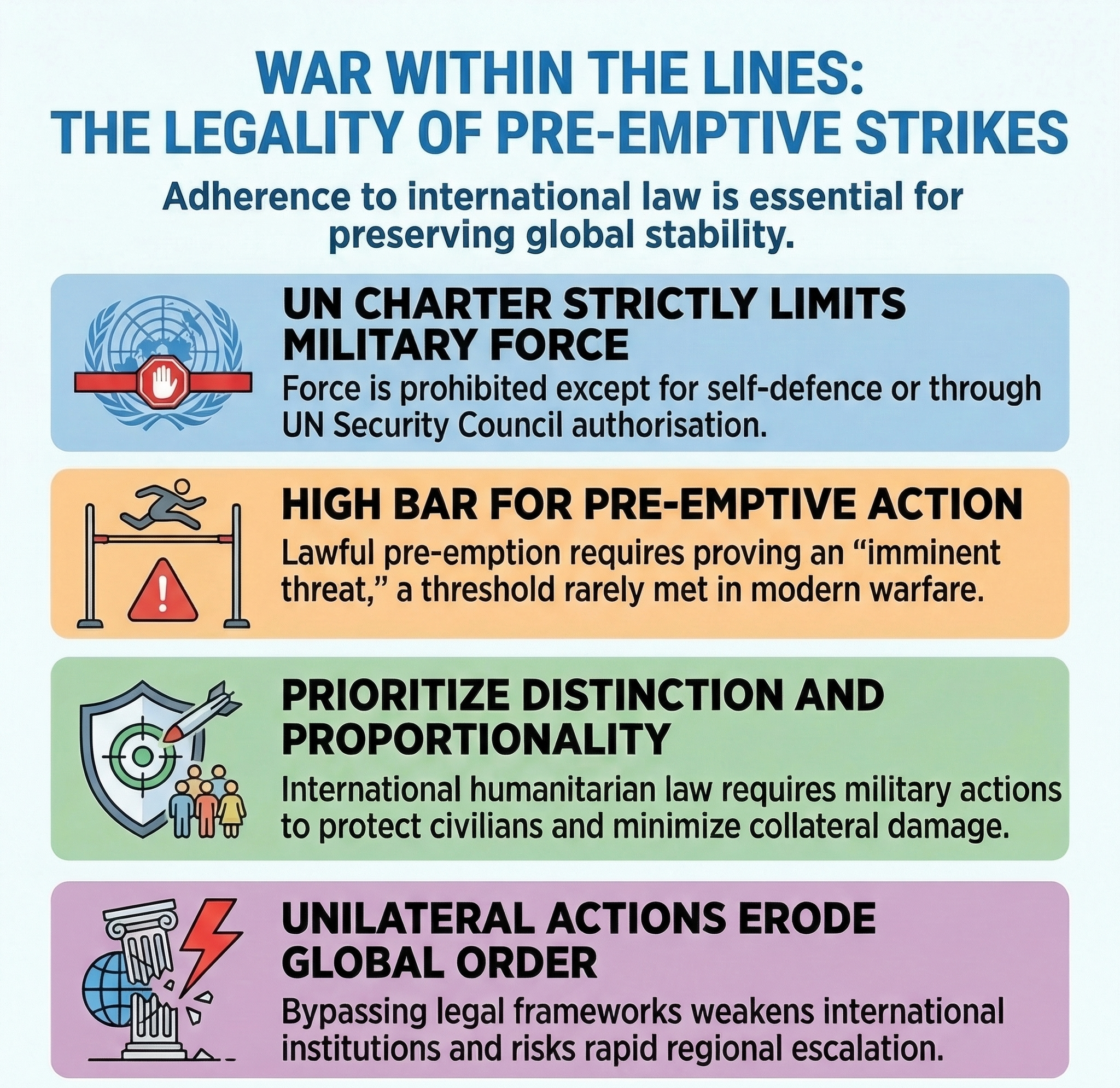
One of the main arguments revolves around whether the strikes can be justified as pre-emptive self-defence. Under international law, states may use force if they face an imminent threat.
However, the threshold for proving such imminence is extremely high. The article questions whether the conditions for lawful pre-emptive action were clearly met.
Role of the UN Charter
The article emphasises that the UN Charter generally prohibits the use of force except in two situations:
• Self-defence against an armed attack
• Authorisation by the UN Security Council
The strikes raise legal questions because they were not authorised by the Security Council.
International Humanitarian Law
Another key focus is compliance with humanitarian law principles such as distinction and proportionality. Military actions must distinguish between civilian and military targets and minimise collateral damage.
The article suggests that civilian casualties and destruction raise concerns about adherence to these principles.
Legal Ambiguity in Modern Warfare
The author argues that contemporary conflicts increasingly test the boundaries of international law. States often justify military action using expansive interpretations of self-defence.
This creates legal ambiguity and weakens established norms governing the use of force.
Global Implications for International Law
The article warns that if powerful states bypass established legal frameworks, it could undermine the global legal order. Precedents set in such conflicts may erode the authority of international institutions.
Author’s Stance
The author adopts a critical and legalistic stance. The analysis emphasises the importance of adhering to international law and raises concerns about unilateral military actions.
The narrative reflects a rules-based international order perspective that prioritises legal legitimacy and multilateral decision-making.
Possible Biases
Legal Normative Bias
The article strongly emphasises legal principles and may underplay the security concerns or strategic calculations that motivate military actions.
Institutional Perspective
The discussion assumes that international institutions such as the United Nations remain effective arbiters of global security, which some analysts contest.
Limited Strategic Context
While focusing on legality, the article gives relatively less attention to the geopolitical context and security dilemmas faced by states involved.
Advantages of the Legal Perspective
Protection of International Order
Adhering to international law helps maintain stability and predictability in global relations.
Civilian Protection
Humanitarian law prioritises minimising civilian casualties and protecting non-combatants.
Prevention of Escalation
Legal frameworks discourage unilateral military actions that may trigger wider conflicts.
Concerns and Challenges
Enforcement Limitations
International law often lacks effective enforcement mechanisms when powerful states are involved.
Ambiguity in Self-Defence Doctrine
The concept of “imminent threat” is subject to varying interpretations.
Geopolitical Realities
States sometimes prioritise national security considerations over legal constraints.
Risk of Escalation
Military actions in sensitive regions can trigger wider regional conflicts.
Policy Implications
Strengthening International Institutions
Reinforcing the authority of global institutions is essential for maintaining a rules-based international order.
Clarifying Self-Defence Norms
International law may need clearer definitions regarding pre-emptive and preventive military action.
Diplomatic Conflict Resolution
Diplomacy and multilateral negotiations should remain the primary tools for managing international disputes.
Protection of Civilian Populations
Military operations must prioritise humanitarian safeguards and minimise civilian harm.
Real-World Impact
If legal norms are upheld:
• Greater stability in international relations
• Reduced risk of unilateral military actions
• Stronger protection of civilians
If legal norms weaken:
• Increased militarisation of international disputes
• Erosion of global governance institutions
• Escalation of regional conflicts
Alignment with UPSC GS Papers
GS Paper II
International relations, role of international organisations, global governance, and India’s foreign policy.
GS Paper III
Security challenges, defence strategy, and evolving nature of warfare.
GS Paper IV
Ethical issues in international relations, responsibility to protect civilians, and morality in the use of force.
Balanced Assessment
The article raises important questions about the legality of military actions in an increasingly complex geopolitical environment. While states may claim self-defence, adherence to international law remains essential for preserving global stability.
Balancing national security concerns with legal obligations continues to be one of the central challenges in contemporary international relations.
Future Perspective
The future of global security will depend heavily on the ability of international institutions to adapt to evolving forms of warfare while maintaining legal norms.
For policymakers and UPSC aspirants, the debate highlights the tension between power politics and rules-based order—an enduring theme in global governance and international law.
