

THE MAHATMA AS A FUTURIST IN DISGUISE

THE MAHATMA AS A FUTURIST IN DISGUISE
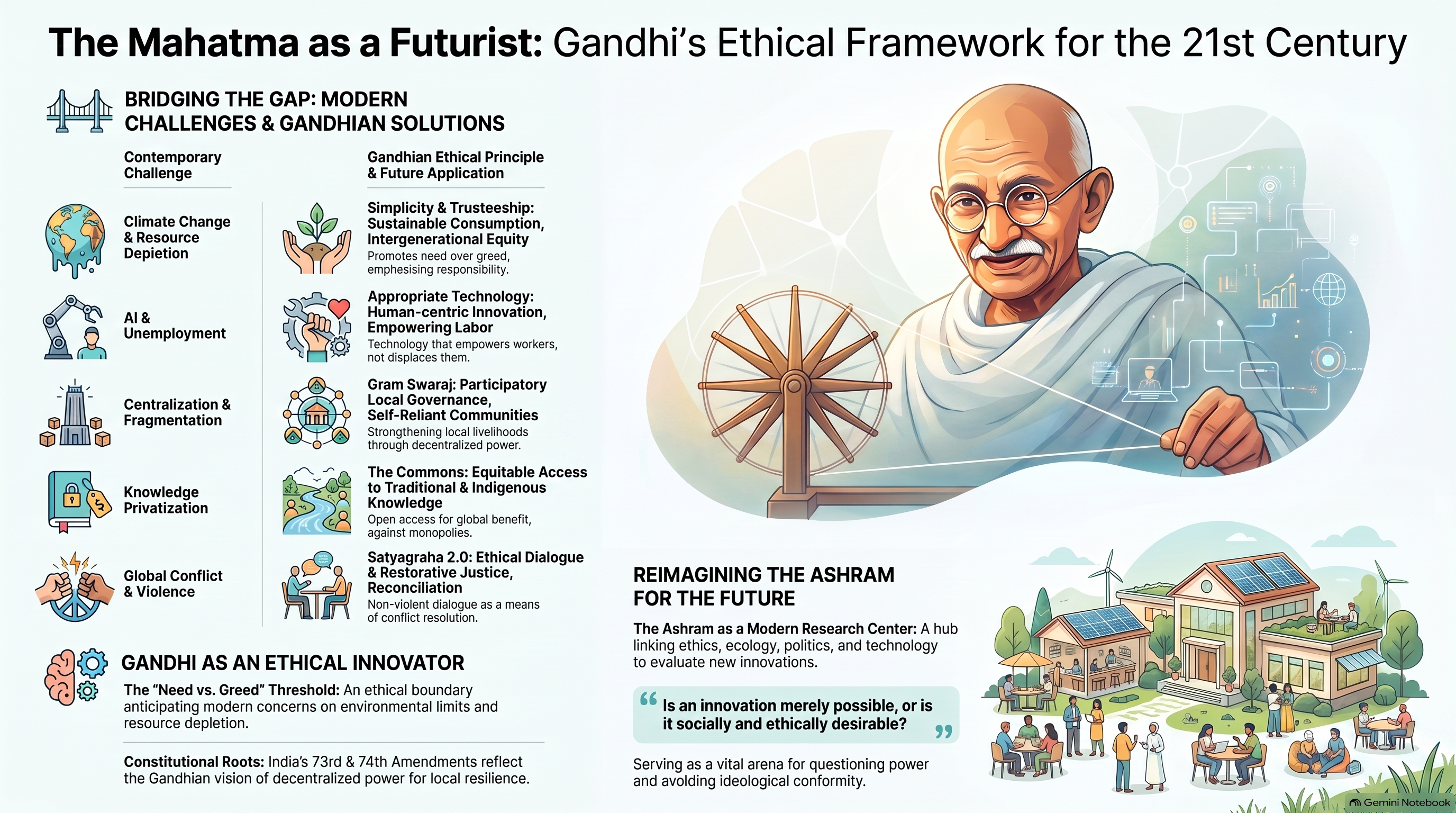
Context
The article argues that Gandhi should not be viewed merely as a historical figure or a fixed set of moral rules. His ideas can be reinterpreted for contemporary challenges such as climate change, AI, inequality, violence and democratic fragmentation.
Why Gandhi Remains Relevant?
|
Contemporary Challenge |
Gandhian Idea |
Present Relevance |
|
Climate change |
Simplicity & Trusteeship |
Sustainable consumption, intergenerational equity |
|
Unemployment & AI |
Appropriate technology |
Human-centric, inclusive innovation |
|
Centralisation |
Gram Swaraj |
Decentralisation, participatory democracy |
|
Privatisation of knowledge |
Commons |
Open and equitable access to knowledge |
|
Violence & conflict |
Satyagraha |
Dialogue, reconciliation and restorative justice |
Gandhi as an Ethical Innovator
- Sustainability: Gandhi's distinction between need and greed anticipated concerns over resource depletion and unsustainable consumption. His Trusteeship places wealth under a social responsibility.
- Technology: Gandhi was not against machines per se; he opposed technology that displaced workers and concentrated wealth. His idea of appropriate technology is relevant to AI, automation and employment.
- Gram Swaraj: Decentralised, self-reliant communities can strengthen local governance, livelihoods and resilience. Article 40 and the 73rd/74th Amendments reflect this broader vision.
- Commons: Traditional knowledge and community innovation should not be treated purely as private commodities. This is relevant to debates over patents, indigenous knowledge and equitable innovation.
- Non-violence: Satyagraha can be reimagined beyond physical protest—as an ethical approach based on dialogue, resistance to injustice and reconciliation. The Truth and Reconciliation Commission of South Africa offers a useful contemporary example.
Reimagining the Ashram
|
The article proposes transforming the ashram into a research centre linking ethics, ecology, politics, aesthetics and technology. Its central question should be: “Is an innovation merely possible, or is it socially and ethically desirable?” Such an approach can help evaluate the consequences of AI, development projects, ecological interventions and emerging technologies. Democratic Dialogue The article highlights informal spaces such as tea shops, barber shops and university cafés as arenas of democratic conversation. Gandhi's relevance lies in encouraging open-ended dialogue, experimentation and the questioning of established power rather than ideological conformity. |
Conclusion
Gandhi's importance today lies not in mechanically reproducing his methods but in reinventing his ethical framework for new problems. From climate change and AI to violence and inequality, his principles of non-violence, sustainability, decentralisation, human dignity and trusteeship can provide a foundation for a more humane and sustainable future.
