

The Missing Pillar of Swachh Bharat: Citizen Behaviour

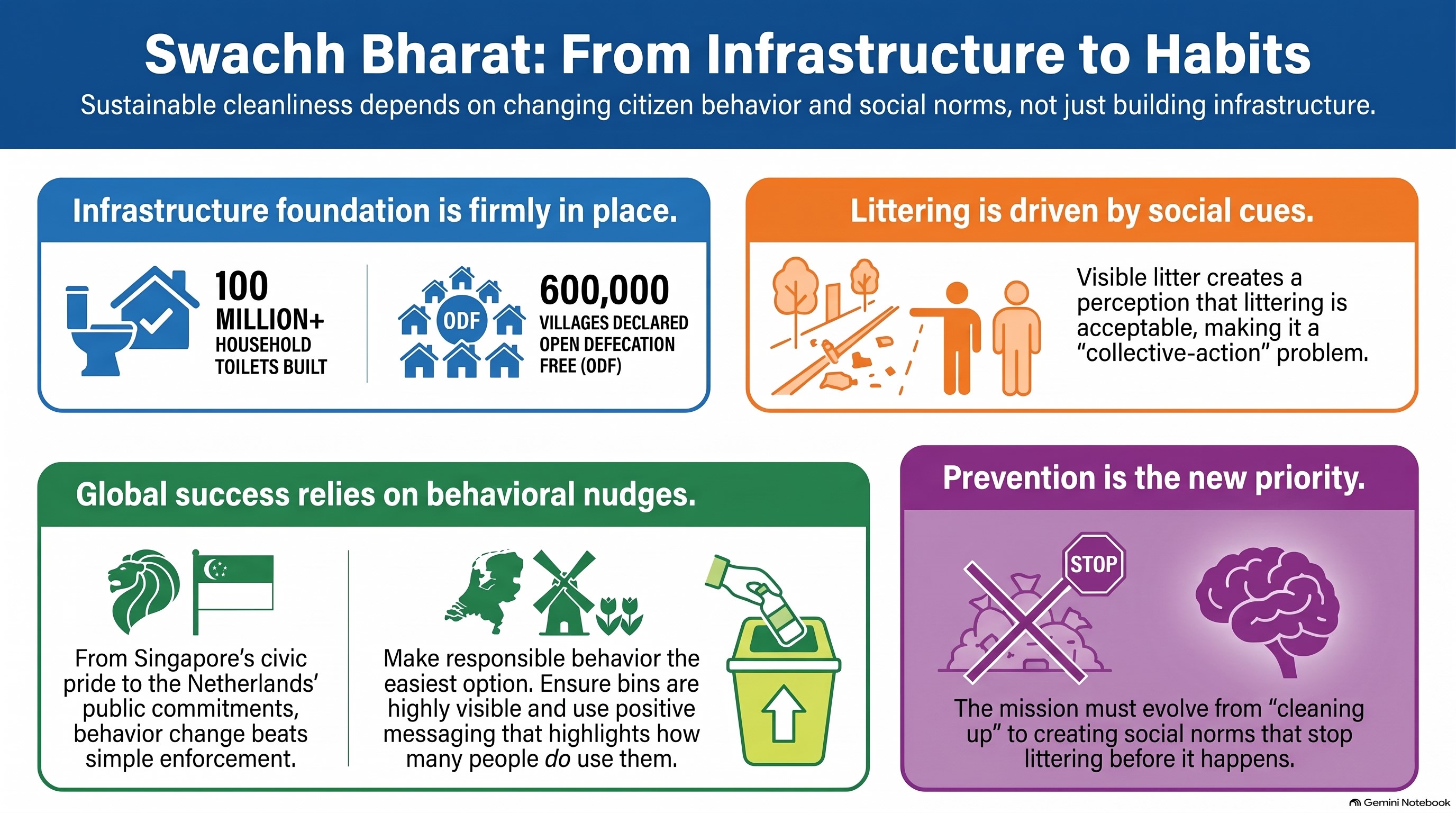
Swachh Bharat Mission: From Infrastructure to Behaviour
- Swachh Bharat Mission (SBM), launched in 2014, has significantly improved India’s sanitation infrastructure and coverage.
- SBM-Gramin led to the construction of more than 100 million household toilets; rural India was declared Open Defecation Free (ODF) in 2019 after over 600,000 villages achieved ODF status.
- Phase II has shifted focus towards ODF sustainability and solid and liquid waste management; nearly 570,000 villages have attained ODF Plus status.
- Under SBM-Urban, over 4,500 wards have achieved sanitation certifications.
- Despite large public investments, persistent littering shows that the challenge has shifted from merely providing sanitation infrastructure to sustaining cleanliness.
- SBM-Gramin Phase II has an outlay of about ₹0.4 trillion, highlighting the scale of public investment.
Why Littering Persists: Behavioural Economics
- Earlier sanitation challenges were largely infrastructural: inadequate toilets, drainage, waste-collection systems and sanitation personnel.
- Today, many locations have regular cleaning and waste-collection systems, but public spaces become littered again due to citizen behaviour.
- Littering is generally not caused by lack of awareness; people often know that it is undesirable but continue because behaviour is shaped by habits, convenience and social cues.
- Clean surroundings tend to discourage littering, while visible litter can create a perception that littering is socially acceptable.
- This reflects the role of social norms: people often judge acceptable behaviour by observing what others are doing.
- Littering is also a collective-action problem: the convenience of disposing waste improperly is individual, while the environmental and social cost is borne collectively.
Lessons from Global Experiences
- Singapore: Its cleanliness strategy combines enforcement with public education, infrastructure and community participation.
- The “Keep Singapore Clean” campaign, launched in 1968, helped establish cleanliness as a social norm.
- Competitions and community initiatives leveraged civic pride and social status to encourage responsible behaviour.
- Japan: Clean public spaces are strongly associated with early socialisation and civic discipline, with citizens encouraged to treat public spaces as an extension of their homes.
- United States – Petrified Forest Experiment:
- Robert Cialdini’s experiment demonstrated the influence of social-norm messaging on behaviour.
- Messaging that inadvertently suggested widespread undesirable behaviour increased such behaviour, showing that people can follow perceived norms.
- Netherlands:
- A Rotterdam field experiment found that encouraging residents to make public commitments to neighbourhood cleanliness significantly reduced illegal garbage disposal.
- These examples suggest that behavioural interventions, community participation and social norms can complement conventional enforcement and infrastructure.
Policy Lessons for Swachh Bharat
- Make responsible behaviour the easiest option by ensuring visible, accessible and well-maintained public bins and reliable waste collection.
- Use positive social-norm messaging, such as highlighting the proportion of citizens who dispose of waste properly, rather than relying only on “Do not litter” warnings.
- Publicise cleanliness rankings and SBM achievements through municipal displays, billboards and media to encourage healthy competition among communities.
- Encourage public commitments and community-level participation in maintaining neighbourhood cleanliness.
- Combine behavioural nudges with enforcement, awareness campaigns and adequate sanitation infrastructure.
- The next phase of SBM should focus not only on cleaning public spaces but on creating social norms that prevent them from becoming dirty again.
- Governments can provide sanitation workers, waste-collection systems and bins, but cannot place a cleaner behind every citizen; sustainable cleanliness ultimately requires millions of responsible individual choices.
Conclusion
- India’s sanitation challenge has evolved from an infrastructure deficit to a behavioural and institutional challenge.
- The success of Swachh Bharat therefore depends on integrating infrastructure with behavioural economics, social norms and civic participation.
- Sustainable cleanliness requires a shift from “cleaning after littering” to “preventing littering through behaviour change”.
