The 'NEET'that India needs to address

The 'NEET'that India needs to address
Context:
The Dual Crisis: 2024 and 2026
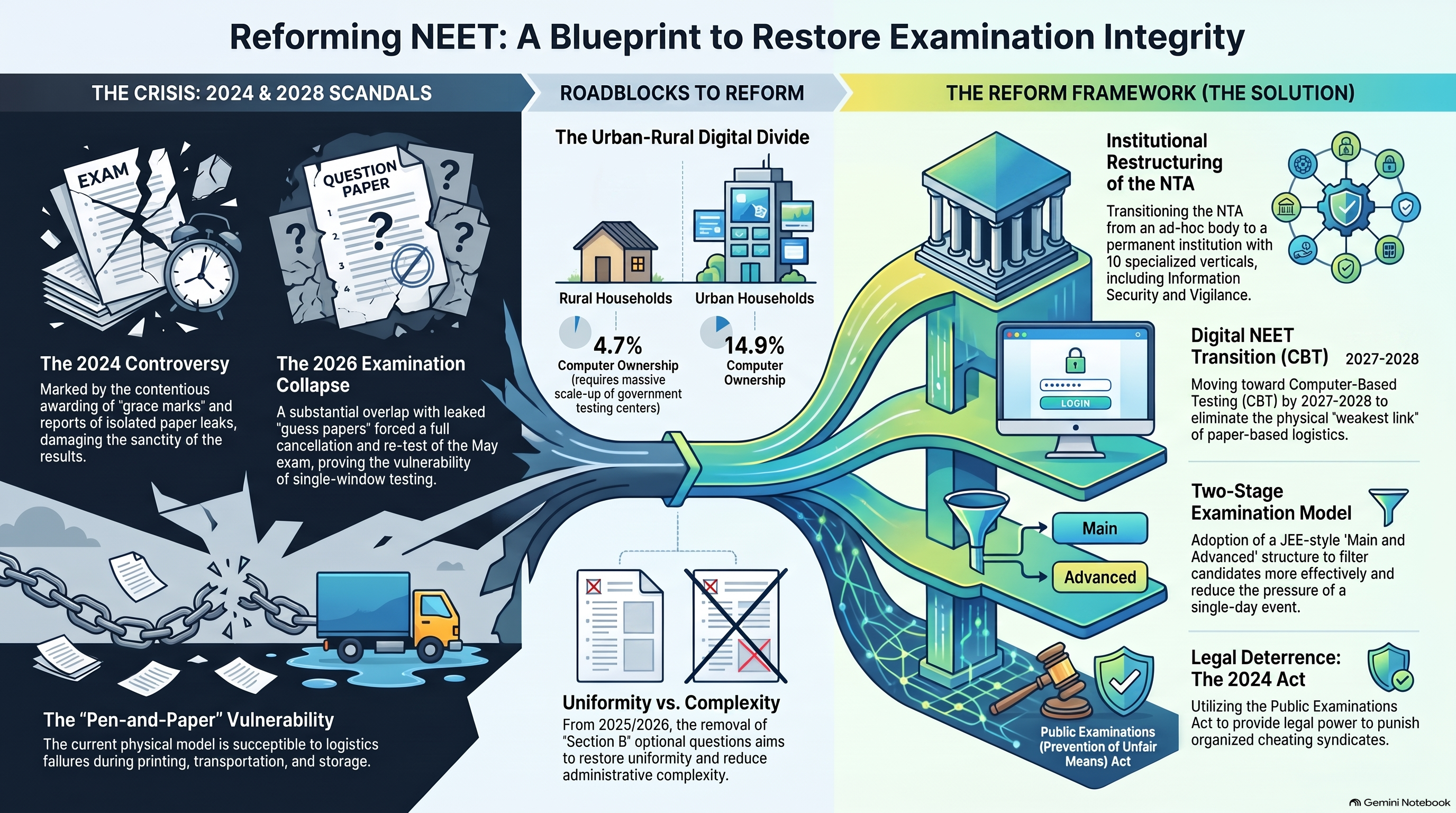
While the NEET-UG 2024 controversy was marked by grace marks and isolated leaks, the 2026 examination scandal led to a full cancellation and re-test of the May exam after a substantial overlap was found with leaked "guess papers." These recurring failures have highlighted that the current "pen-and-paper" model in a single window is highly vulnerable.
Core Reforms Needed (The "NEET" Framework)
To restore the sanctity of the exam, the government is moving toward a multi-pronged reform strategy based on the K. Radhakrishnan Committee and the Nandan Nilekani-led Task Force recommendations:
1. Institutional Restructuring of NTA
The Supreme Court has emphasized that the National Testing Agency (NTA) must be "institutionalized" rather than managed by ad-hoc measures.
- Specialized Verticals: Creating 10 dedicated institutional units including Nationwide Testing Centre Infrastructure, Information Security, and Vigilance & Forensics.
- Leadership Overhaul: Appointing a Director General not below the rank of Additional Secretary to ensure administrative weight and accountability.
2. Technological Transition (Digital NEET)
The government is actively examining a shift to Computer-Based Testing (CBT), likely by 2027-2028.
- Security: Digital delivery eliminates the "weakest link" of physical logistics—printing, transportation, and storage.
- Challenges: A significant digital divide remains; only 4.7% of rural households own a computer compared to 14.9% in urban areas, necessitating a massive scale-up of government-run testing centers.
3. Examination Pattern Changes
- Reversion to Basics: From 2025/2026, the Section B (optional questions) introduced during COVID has been removed to ensure uniformity and reduce complexity.
- Two-Stage Model: Discussions are ongoing to adopt a JEE-style two-stage exam (Main and Advanced) to filter candidates more effectively and reduce the burden of a single-day, high-stakes event
4. Legal Deterrence
The Public Examinations (Prevention of Unfair Means) Act, 2024 (and its 2026 amendments) provides the legal teeth to punish organized syndicates.

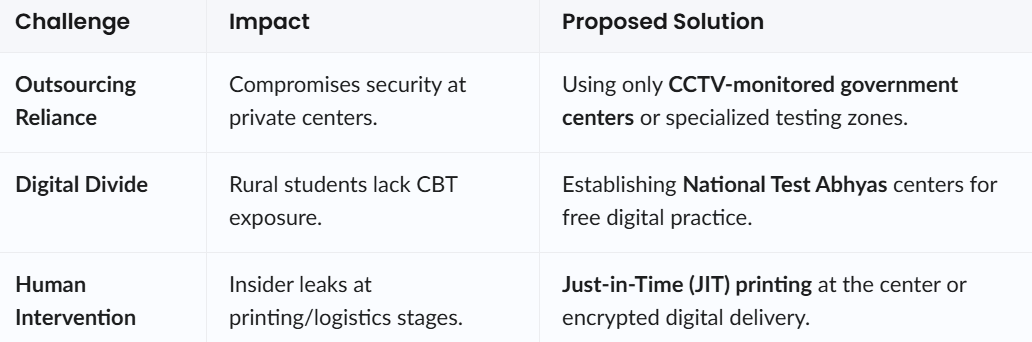
Major Roadblocks to Address