

The new Canada–India economic alignment emerges
The Hindu
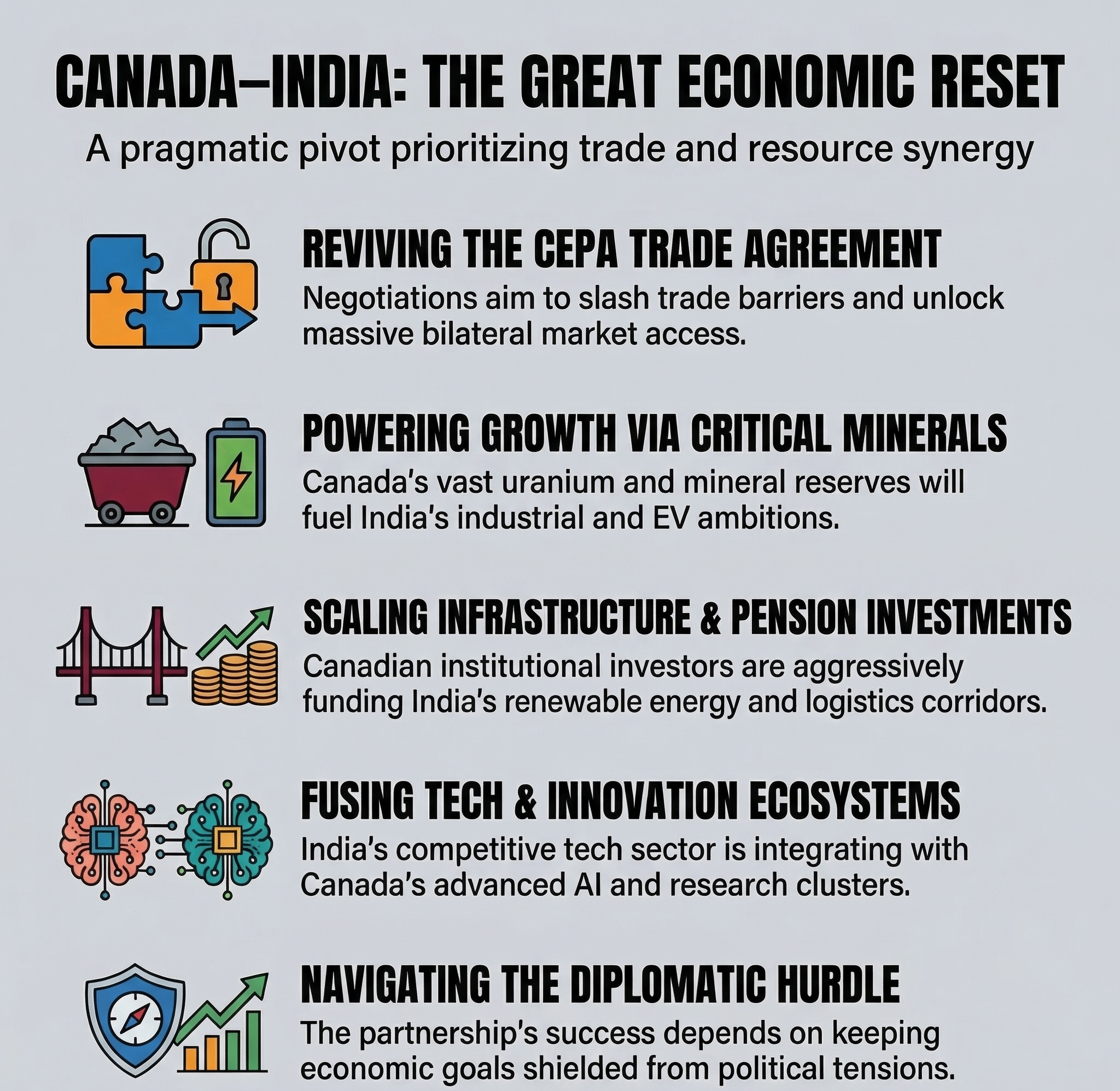
Key Arguments of the Article
Reset in Bilateral Economic Relations
The article argues that recent diplomatic engagement has reopened opportunities for deeper economic cooperation. Political willingness at the leadership level is presented as a crucial factor in reviving stalled economic ties.
The renewed dialogue signals a strategic shift toward pragmatic economic engagement.
Importance of the CEPA Negotiations
A major focus of the article is the revival of negotiations on the Comprehensive Economic Partnership Agreement. The agreement aims to reduce trade barriers, facilitate investment flows, and expand market access for businesses in both countries.
The article suggests that successful implementation could significantly increase bilateral trade in the coming years.
Energy and Critical Minerals Cooperation
The article highlights strong complementarities between the two economies in energy and mineral resources. Canada possesses large reserves of oil, gas, uranium, and critical minerals essential for advanced manufacturing and electric vehicles.
India’s expanding industrial base and growing energy demand create opportunities for long-term supply partnerships.
Technology and Innovation Collaboration
India’s technology sector is presented as globally competitive, with potential to expand operations in Canada’s innovation ecosystem. Access to advanced research clusters and artificial intelligence development centres could enhance collaboration.
This partnership may strengthen technological capabilities in both countries.
Infrastructure and Investment Opportunities
Canadian pension funds and institutional investors are already significant investors in India’s infrastructure projects. The article notes opportunities in sectors such as renewable energy, logistics corridors, urban development, and industrial parks.
Conversely, Indian firms may find opportunities in Canada’s digital infrastructure and advanced manufacturing sectors.
Agricultural and Food Security Cooperation
Another area of cooperation identified is agriculture. Canadian agricultural exports can complement India’s food security needs, creating mutually beneficial trade opportunities.
Author’s Stance
The author adopts a strongly optimistic and pro-engagement stance. The article presents the renewed Canada–India economic alignment as a major strategic opportunity driven by economic complementarity and geopolitical shifts.
The narrative emphasises economic potential and downplays political tensions.
Possible Biases
Business-Oriented Perspective
The article is written from a business community viewpoint, emphasising trade and investment opportunities while giving limited attention to political disagreements between the two countries.
Optimistic Economic Projection
The narrative assumes that political alignment will translate smoothly into economic outcomes, which may not always occur.
Limited Domestic Concerns
Issues such as regulatory barriers, labour mobility restrictions, or trade disputes are not extensively discussed.
Advantages of the Proposed Alignment
Expansion of Bilateral Trade
Trade agreements could significantly increase trade flows and diversify export markets.
Strategic Energy Cooperation
Canada’s energy and mineral resources can support India’s industrial and energy needs.
Investment Opportunities
Greater cross-border investment can accelerate infrastructure development and technological innovation.
Supply Chain Diversification
Partnerships can help both countries reduce dependence on limited trade partners.
Challenges and Risks
Diplomatic Tensions
Political disagreements or diplomatic disputes may disrupt economic cooperation.
Trade Negotiation Complexity
Finalising comprehensive trade agreements involves complex negotiations over tariffs, regulatory standards, and market access.
Regulatory Differences
Differences in regulatory frameworks may create obstacles for businesses.
Global Economic Uncertainty
External economic conditions may influence investment flows and trade patterns.
Policy Implications
Strengthening Bilateral Trade Frameworks
Completing trade agreements such as CEPA could provide structured frameworks for economic cooperation.
Strategic Resource Partnerships
Long-term agreements in energy and critical minerals can support industrial growth and energy security.
Investment Facilitation
Simplified regulatory frameworks can encourage cross-border investment.
Technology Collaboration
Joint research initiatives and technology partnerships can enhance innovation capacity.
Real-World Impact
If the partnership strengthens:
• Increased bilateral trade and investment
• Stronger energy and resource cooperation
• Expansion of technology collaboration
• Improved economic diversification for both countries
If challenges persist:
• Delays in trade agreements
• Limited economic gains from diplomatic engagement
• Continued uncertainty for businesses
Alignment with UPSC GS Papers
GS Paper II
India’s foreign relations, trade diplomacy, bilateral partnerships, and economic diplomacy.
GS Paper III
International trade, energy security, industrial policy, investment flows, and supply chain diversification.
GS Paper I
Global economic geography and regional economic cooperation.
GS Paper IV
Ethical governance in international economic relations and responsible global partnerships.
Balanced Assessment
The emerging Canada–India economic alignment presents significant opportunities for expanding trade, investment, and technological collaboration. Complementary strengths in energy resources, technology, and infrastructure development provide a strong foundation for economic cooperation.
However, the success of this partnership will depend on sustained political engagement, successful trade negotiations, and effective management of diplomatic differences.
Future Perspective
As global supply chains evolve and geopolitical competition intensifies, economic partnerships between democratic and resource-rich economies are likely to gain importance. India and Canada have the potential to build a mutually beneficial partnership that contributes to economic resilience and strategic cooperation.
For policymakers and civil services aspirants, the issue illustrates how economic diplomacy increasingly shapes international relations in a globalised economy.
