

The quiet crisis of adolescent mental health in India
The Hindu
I. Core Context
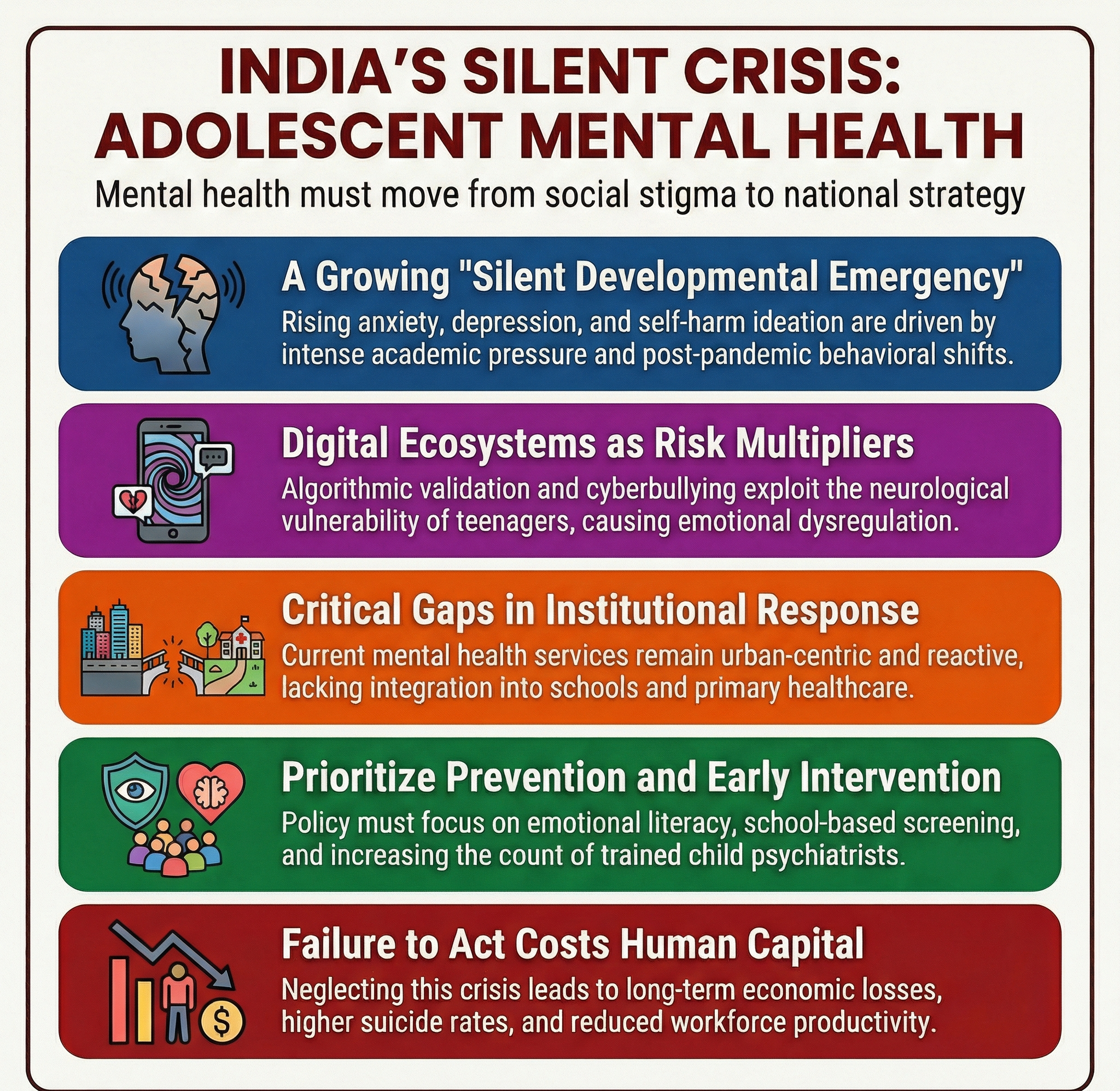
The article highlights a growing but under-recognised crisis in adolescent mental health in India. It links rising emotional distress among teenagers to digital exposure, social pressures, academic stress, family dynamics, and inadequate institutional response.
It frames the issue as:
- A structural public health concern
- A silent developmental emergency
- A governance and policy gap
II. Key Arguments Presented
1. Rising Mental Health Burden Among Adolescents
The article points to:
- Increasing anxiety, depression, self-harm ideation
- Social media–induced stress and comparison culture
- Academic pressure and performance anxiety
- Post-pandemic behavioural changes
Adolescents are portrayed as navigating an unprecedented psychological landscape.
2. Digital Ecosystem as a Risk Multiplier
Excessive screen exposure, cyberbullying, algorithm-driven content, and social validation pressures are identified as significant triggers.
The argument suggests:
- Neurological vulnerability during adolescence
- Emotional dysregulation amplified by online environments
3. Institutional and Systemic Gaps
The article stresses:
- Shortage of trained child and adolescent psychiatrists
- Weak school-based counselling systems
- Limited integration of mental health into primary healthcare
Mental health services remain urban-centric and reactive rather than preventive.
4. Role of Families and Schools
The piece advocates:
- Open communication
- Reduced stigma
- Emotional literacy
- School-based screening
The approach is multi-stakeholder.
III. Author’s Stance
The tone is empathetic and reform-oriented.
The author strongly emphasises:
- Early intervention
- Policy alignment
- Preventive mental healthcare
- Systemic investment
There is a normative push for integrating mental health into public policy.
IV. Possible Biases and Limitations
1. Emphasis on Digital Causation
While digital media is influential, the article may overstate its role relative to:
- Socio-economic stress
- Urbanisation
- Family structure shifts
- Substance abuse
Mental health is multi-causal.
2. Limited Data Depth
The article refers to trends and surveys but does not deeply engage with:
- National Mental Health Survey data
- NCRB suicide statistics
- Comparative international benchmarks
More quantitative grounding would strengthen the case.
3. Implementation Complexity
While advocating school screening and community integration, the article underestimates:
- Resource constraints
- Teacher training limitations
- Rural health infrastructure gaps
V. Pros and Cons of the Argument
Pros
• Recognises mental health as developmental issue
• Advocates preventive framework
• Emphasises community and school role
• Aligns health with digital governance
Cons
• Limited fiscal feasibility discussion
• Digital focus may oversimplify causes
• Underdeveloped legal and regulatory lens
• Less focus on adolescent agency
VI. Policy Implications
1. Strengthening National Mental Health Programme
India must:
- Expand district-level mental health services
- Increase child psychiatry training
- Integrate mental health into primary care
2. School-Based Interventions
Policies should include:
- Mandatory counsellors in schools
- Emotional education curriculum
- Peer-support systems
3. Digital Governance
Regulation may consider:
- Age-appropriate platform design
- Online safety protocols
- Algorithmic accountability
Digital well-being policies must align with mental health priorities.
4. Community and Family Engagement
- Parent education programs
- Public awareness campaigns
- De-stigmatisation initiatives
Mental health must be mainstreamed.
VII. Real-World Impact
Short-term:
- Increased awareness
- Demand for counselling services
Medium-term:
- Policy reform debates
- Institutional capacity building
Long-term:
- Improved human capital
- Reduced suicide rates
- Enhanced workforce productivity
Failure to act may result in:
- Long-term economic losses
- Social fragmentation
- Public health burden escalation
VIII. UPSC Relevance
GS Paper II
• Public health governance
• Social justice and vulnerable groups
• Education policy
GS Paper III
• Human capital development
• Role of technology in social outcomes
• Demographic dividend
GS Paper IV
• Ethics of digital platforms
• Care and compassion in governance
• Public service responsibility
Essay Themes
• Youth and nation-building
• Mental health as public policy
• Technology and human vulnerability
IX. Balanced Conclusion and Future Perspective
The adolescent mental health crisis in India is neither sudden nor isolated; it reflects deeper structural changes in society, technology, and education systems.
The article rightly underscores that mental health must move from stigma to strategy. However, translating awareness into institutional reform requires:
- Sustained funding
- Workforce expansion
- Cross-ministerial coordination
- Measurable outcomes
India’s demographic dividend depends not merely on population size but on psychological resilience and emotional well-being.
Mental health is no longer a private concern—it is a national development imperative.
