

The role of online education in bridging the urban-rural talent gap
The Statesman
Key Arguments of the Article
Unequal Access to Quality Education
The article begins by highlighting a persistent educational divide between urban and rural India. Urban students generally benefit from better schools, coaching institutions, and exposure to career opportunities, while rural students face shortages of teachers, infrastructure, and career guidance.
Online education is presented as a mechanism to bridge this structural gap.
Digital Platforms as Equalisers
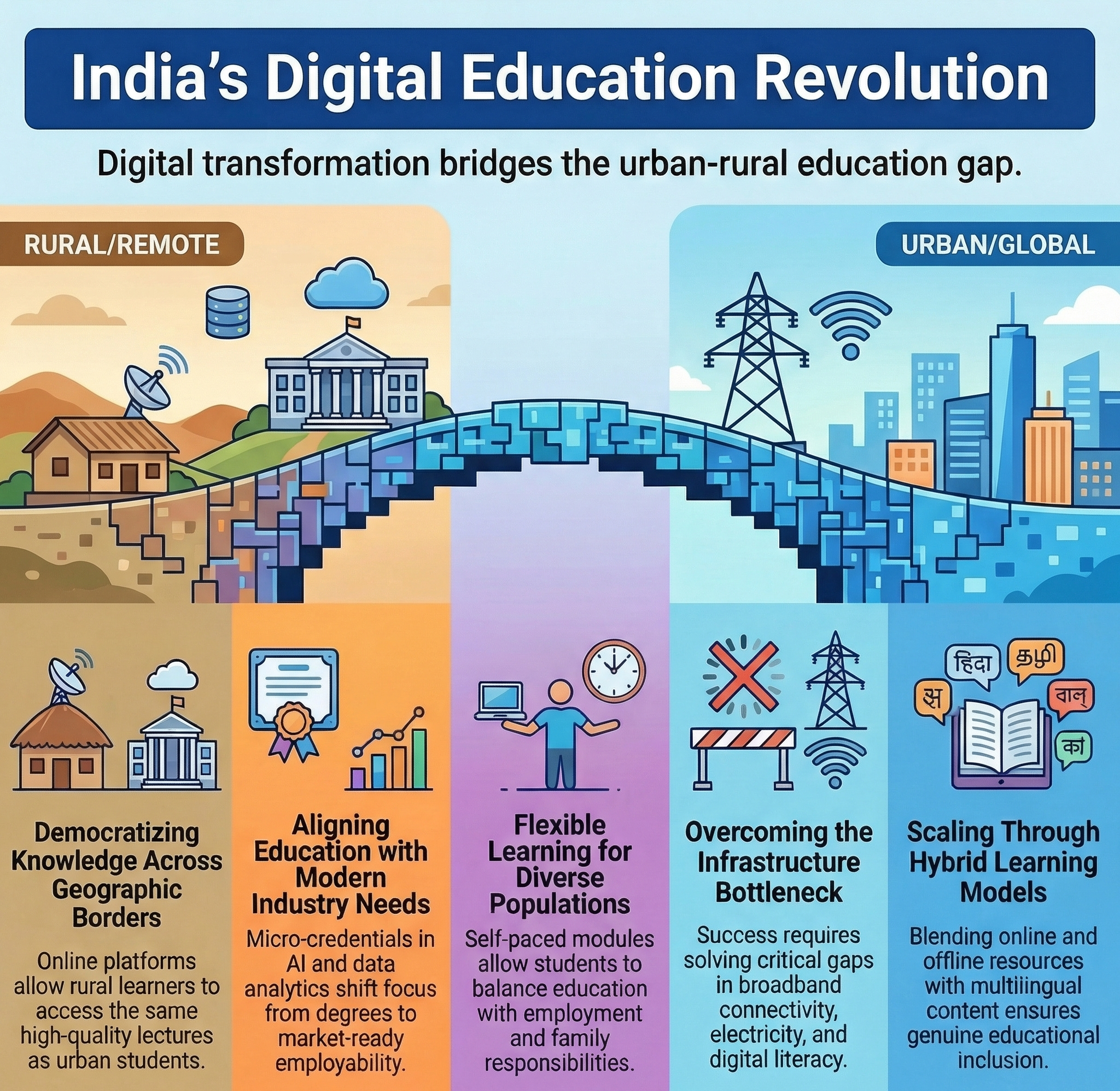
The author argues that digital learning platforms can make high-quality educational content accessible across geographic boundaries.
Recorded lectures, live classes, and skill-based modules enable students in remote areas to access the same content as urban learners.
This can democratize access to knowledge.
Industry-Aligned Skills and Employability
Another central claim is that online learning platforms are increasingly aligned with industry requirements. Courses in data analytics, artificial intelligence, digital marketing, and entrepreneurship equip students with market-relevant skills.
Thus, online education is framed not just as academic learning but as employability enhancement.
Micro-Credentials and Lifelong Learning
The article highlights the growing importance of short-term certifications and micro-credentials that allow individuals to upgrade skills continuously without leaving employment.
This reflects the transition from traditional degree-based systems to flexible learning ecosystems.
Economic Growth through Talent Inclusion
The article links digital education with broader economic outcomes. By unlocking rural talent and integrating it into the knowledge economy, India can enhance productivity, innovation, and inclusive growth.
The argument suggests that bridging the education gap directly contributes to balanced regional development.
Author’s Stance
The author takes a strongly optimistic and reform-oriented stance toward digital education. Online learning is portrayed as a powerful tool for social mobility and national development.
While challenges are acknowledged, the article largely emphasises the transformative potential of technology-driven learning systems.
Possible Biases
Technological Optimism
The article assumes that digital platforms can substantially solve the rural education gap. This perspective may underestimate structural barriers such as internet access, electricity, digital literacy, and socio-cultural constraints.
Market-Oriented Approach
There is a noticeable emphasis on employability and industry relevance, reflecting a skill-market perspective rather than a broader educational philosophy.
Limited Attention to Pedagogical Quality
The article focuses on accessibility but gives less attention to issues like learning outcomes, student engagement, and quality assurance in online education.
Advantages Highlighted
Expanded Access
Online education allows rural students to access resources previously limited to urban institutions.
Flexible Learning
Students can learn at their own pace and combine education with employment or family responsibilities.
Industry-Relevant Skills
Digital platforms often provide courses designed in collaboration with industry.
Reduced Geographic Inequality
Knowledge access becomes less dependent on physical location.
Concerns and Limitations
Digital Divide
Large parts of rural India still face limited internet connectivity and device availability.
Learning Quality
Online education cannot fully replicate the mentoring, peer interaction, and practical exposure available in physical classrooms.
Language Barriers
Many online courses are delivered in English, limiting accessibility for rural learners.
Credential Recognition
Short-term online certifications may not always be recognised by employers or institutions.
Policy Implications
Digital Infrastructure Expansion
Government investment in broadband connectivity, especially under initiatives like BharatNet, is essential for enabling online education.
Digital Literacy Programmes
Students and teachers must be trained to effectively use digital platforms.
Hybrid Education Models
Blending online and offline learning may provide the best outcomes.
Regional Language Content
Developing multilingual digital educational resources is crucial for inclusivity.
Quality Regulation
Accreditation and quality assurance mechanisms are necessary to maintain credibility in online education.
Real-World Impact
If effectively implemented:
• Increased educational access in rural areas
• Improved employability of youth
• Reduction in regional educational disparities
• Greater participation in the digital economy
If poorly implemented:
• Widening of digital inequality
• Growth of low-quality online education providers
• Skill mismatch between courses and labour market needs
Alignment with UPSC GS Papers
GS Paper II
Education policy, digital governance, inclusive development, role of technology in public service delivery.
GS Paper III
Human capital development, digital economy, innovation, skill development, and employment generation.
GS Paper I
Urban-rural disparities, social development, demographic challenges.
GS Paper IV
Ethical considerations in technology access, fairness in educational opportunity.
Balanced Assessment
The article rightly highlights the transformative potential of online education in addressing India’s urban-rural educational divide. Digital platforms can significantly expand access to knowledge and skills.
However, technology alone cannot overcome structural inequalities. Infrastructure gaps, socio-economic disparities, and institutional quality must also be addressed.
Online education should therefore complement—not replace—traditional educational systems.
Future Perspective
India’s education system is entering a hybrid phase where digital and physical learning will coexist. The future lies in integrating online education with public schooling, skill missions, and higher education reforms.
For policymakers and UPSC aspirants, the key challenge will be ensuring that technological innovation translates into genuine educational inclusion rather than creating a new digital hierarchy.
If supported by strong infrastructure, regulatory frameworks, and inclusive policies, online education can indeed become a powerful instrument for bridging India’s urban-rural talent gap and advancing equitable development.
