

THE RUPEE, GDP GROWTH AND INDIA’S TERMS-OF-TRADE CHALLENGE

THE RUPEE, GDP GROWTH AND INDIA’S TERMS-OF-TRADE CHALLENGE
Context
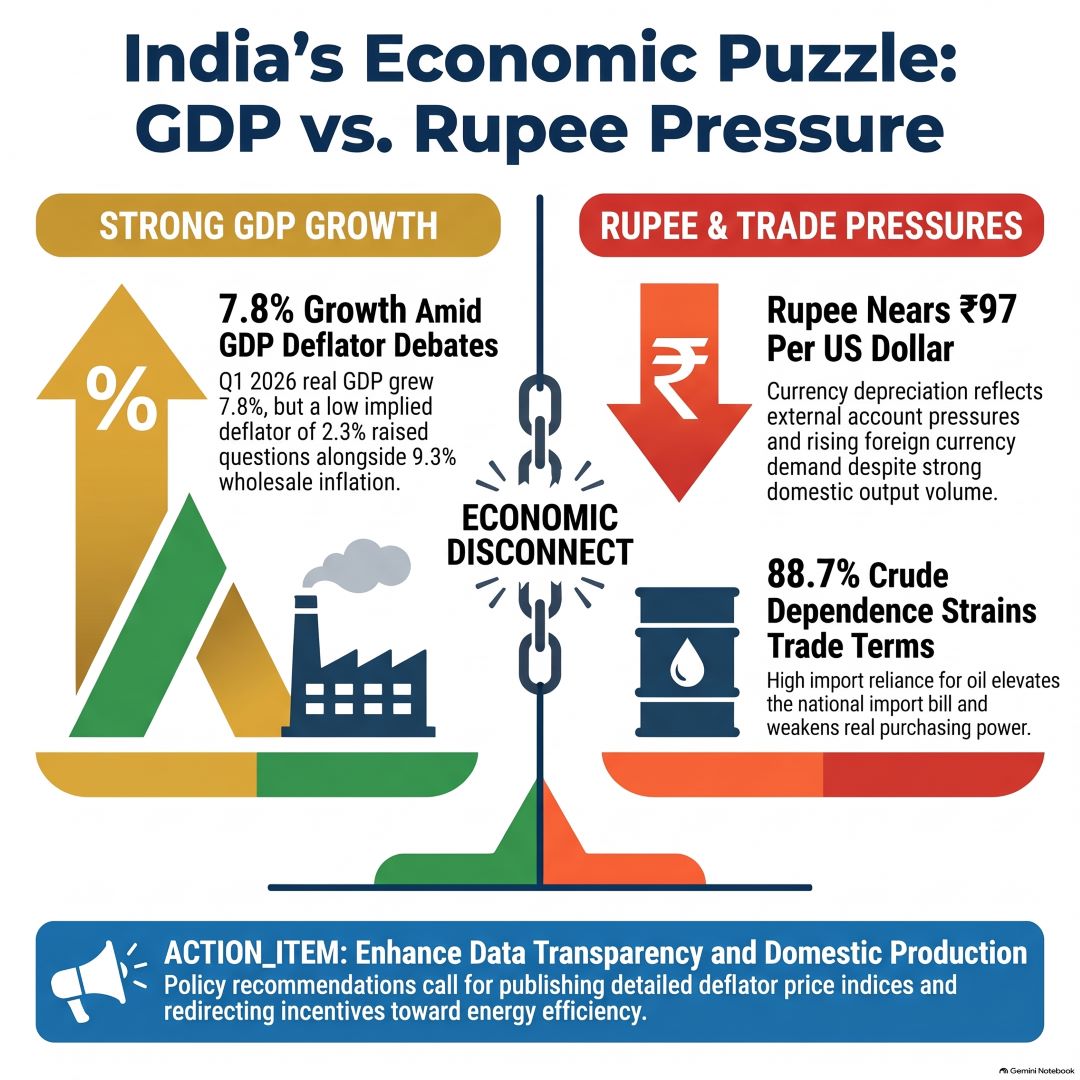
The article examines the apparent disconnect between India's reported economic growth and the depreciation of the rupee, which was trading close to ₹97 per US dollar according to the article. It argues that strong real GDP growth may not fully reflect the pressure on India's purchasing power caused by rising oil import costs, weak manufacturing margins and currency depreciation.
The central argument is that real GDP measures the volume of economic output, whereas the rupee also reflects the purchasing power of national income in the global economy.
Understanding the GDP Deflator Debate
- Real GDP: Measures the volume of goods and services produced after adjusting for price changes.
- Nominal GDP: Measures economic output at current prices without removing the effects of inflation.
- GDP Deflator: Measures the price change of domestically produced final goods and services. It is calculated as the ratio of nominal GDP to real GDP, multiplied by 100.
- Double Deflation: A method that separately adjusts the value of industrial output and intermediate inputs for price changes to estimate real value added more accurately.
According to the article, India's real GDP grew by 7.8% in April–June 2026, while nominal GDP grew by 10.3%, implying a GDP deflator of approximately 2.3%.
The article highlights a discrepancy between this implied deflator and other inflation indicators:
- Consumer inflation averaged 3.9% during the quarter.
- Wholesale inflation averaged 9.3%.
- Manufacturing real value added reportedly increased by 9.2%, while nominal value added rose by 7.7%, implying a negative manufacturing deflator.
These differences have raised questions about the price data and methodology used in India's revised national accounts.
Why the GDP Estimates Are Being Debated?
- Concerns About the Deflator: Critics argue that a low GDP deflator alongside elevated wholesale inflation requires greater transparency about the underlying price indices.
- Impact of Double Deflation: When input prices increase faster than output prices, real value added can rise even as nominal value added and business margins weaken.
- Concerns About Growth Measurement: A March 2026 Peterson Institute working paper by Abhishek Anand, Josh Felman and Arvind Subramanian estimated that India's growth may have been overstated during 2012–2023. The article notes that this assessment did not evaluate the new GDP series.
- Limited Employment Gains: Questions have also been raised about whether strong reported growth is translating into adequate employment, private investment and foreign direct investment.
However, the article also presents counterarguments. Government officials contend that comparisons between the old and rebased GDP series are not directly comparable, while industrial production, steel consumption and purchasing managers' indices provide evidence of continuing economic activity.
The broader issue is therefore the transparency and interpretation of national accounts, rather than proof that the reported figures are fabricated.
Why the Rupee Is Under Pressure?
- High Crude Oil Dependence: The article reports that India's crude oil import dependence reached 88.7% in 2025–26. Higher international oil prices increase the country's import bill and demand for foreign currency.
- Terms-of-Trade Shock: When import prices rise faster than export prices, a country must spend more to purchase the same volume of imports. This reduces its real purchasing power.
- External Account Pressure: A higher oil bill can widen the trade deficit and increase pressure on the current account, depending on export performance and other international receipts.
- Exchange-Rate Adjustment: Rupee depreciation makes imports more expensive in domestic currency and can contribute to imported inflation.
- Foreign Exchange Intervention: The RBI can intervene to moderate excessive volatility, but sustained pressure from external imbalances cannot necessarily be eliminated through intervention alone.
Fiscal and Structural Challenges
- Fuel Tax Reductions: The article states that the Centre reduced excise duty on petrol and diesel by ₹10 per litre from 27 March 2026 to moderate the domestic impact of higher oil prices.
- Revenue Pressure: Lower fuel taxes, rising subsidies and increased expenditure can place additional pressure on the fiscal deficit.
- Manufacturing Constraints: The article places manufacturing at 14.8% of gross value added in 2025–26, highlighting the need to strengthen domestic production and reduce import dependence.
- PLI Implementation: It reports that ₹36,754 crore had been disbursed under Production Linked Incentive schemes by 30 June 2026, raising questions about the pace and effectiveness of incentive utilisation.
Policy Measures Suggested in the Article
|
1. Improve GDP Transparency: The Ministry of Statistics and Programme Implementation (MoSPI) should publish the input and output price indices used in deflator calculations, explain revisions to GDP estimates and provide a terms-of-trade-adjusted measure of real domestic income alongside real GDP. 2. Enhance Foreign Exchange Transparency: The RBI should disclose more information about its forward foreign-exchange position and the maturity profile of related transactions. Greater transparency would help markets assess the country's effective reserve position. 3. Recalibrate Fuel Taxation: The government could restore part of the fuel excise reduction when international crude prices fall below a specified threshold, while protecting vulnerable households through targeted LPG and fertiliser support. 4. Redirect Underutilised Incentives: A portion of unutilised industrial incentive allocations could be redirected towards energy efficiency and domestic production of import-intensive goods, with funding linked to verified outcomes. 5. Strengthen Manufacturing: Improving domestic capabilities in energy, industrial inputs and capital goods can reduce exposure to external price shocks and support more sustainable economic growth. |
Conclusion
The rupee's depreciation and India's reported GDP growth measure different aspects of economic performance. Real GDP captures domestic output, while the exchange rate reflects external demand, capital flows, import costs and confidence in the currency. The article's central recommendation is to improve transparency in GDP measurement while addressing oil dependence, fiscal pressures and manufacturing weaknesses. A more resilient economy requires both credible national accounts and stronger domestic income-generating capacity.