

Theatre Commands: Ending the Turf War to Build Jointness

Theatre Commands: Ending the Turf War to Build Jointness
GS Paper: GS-III (Internal and External Security, Defence Reforms) | GS-II (Civil-Military Relations) |
Source: Editorial analysis (28 October 2026)
Why in News?
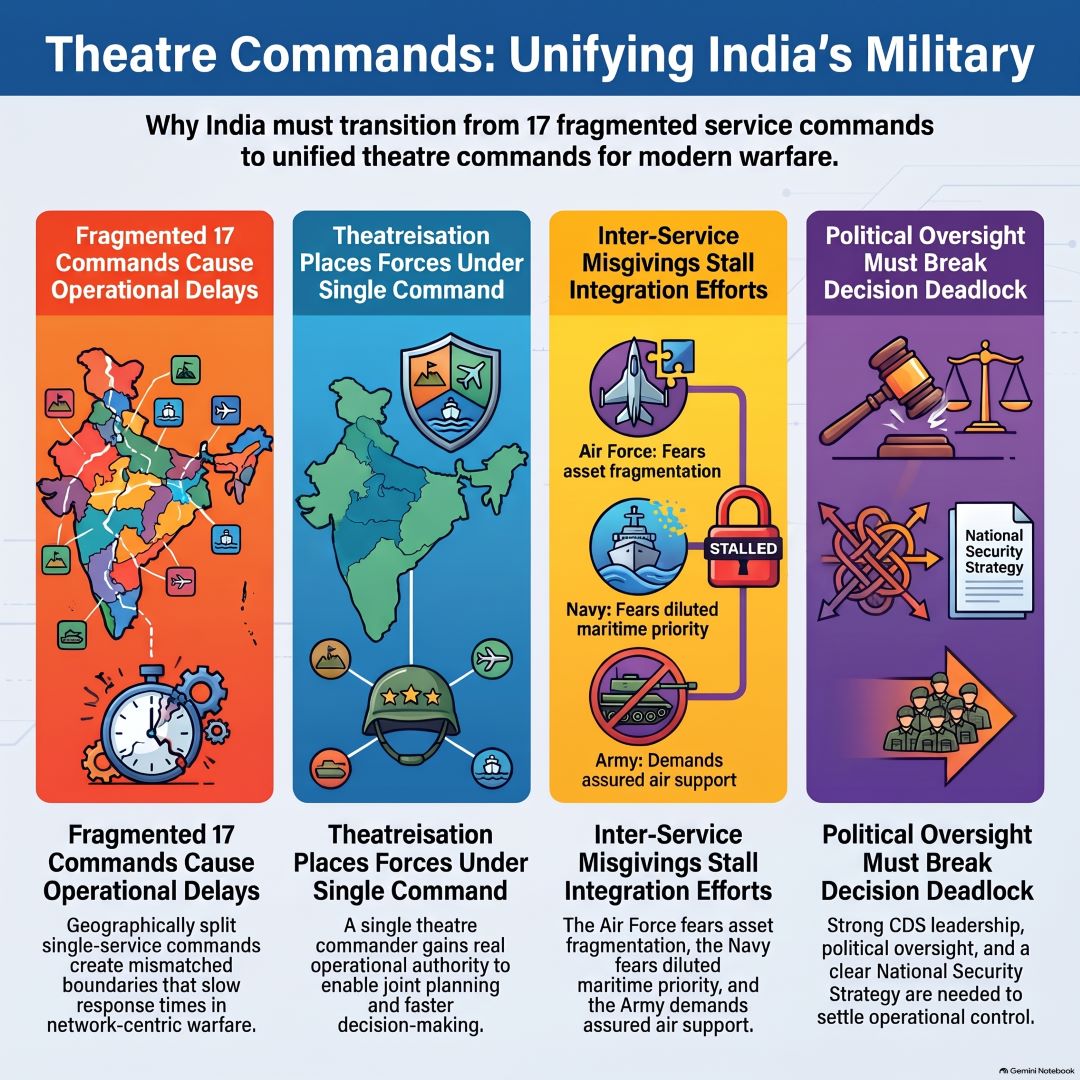
Seven years after the government tasked the Chief of Defence Staff (CDS) with restructuring military commands and creating theatre commands, India is still stuck in inter-service disagreement. The Army wants assured air support, the Air Force fears fragmentation of scarce air assets, and the Navy fears maritime priorities will be lost under a land-centric approach.
Why the Status Quo Is Unsustainable
• India has 17 single-service commands, spread out geographically, each reporting to its own Service Headquarters, with areas of responsibility that do not match.
• In a conflict on the western or northern borders or at sea, operations could cross several command boundaries. Poor coordination causes delay when AI-enabled, network-centric warfare demands speed.
• Theatreisation places the forces for a theatre under one theatre commander with real operational authority. It aims at jointness, integrated planning, faster decisions and coordinated use of force, not just administrative reshuffling.
• The air power debate: the IAF's doctrine is "centralised control and decentralised execution". Critics fear squadrons would be split among theatres. The article argues that air assets can stay at existing bases, central control can continue, tasking can be decentralised, and a senior IAF Component Commander can advise the theatre commander. The real issue is who exercises operational control, not doctrine.
Lessons from Abroad
• US Key West Agreement (1948): after the Air Force became independent, Defence Secretary James Forrestal made the Joint Chiefs negotiate roles: Air Force for strategic air warfare, Navy for carrier aviation, Marine Corps for amphibious operations, Army for land combat. Roles and missions are settled by negotiation under civilian authority.
• 1966 Army-Air Force agreement: the Army gave up most fixed-wing aircraft in return for responsibility for combat helicopters.
• Changing warfare: Ukraine's missiles and drones damaged Russia's Black Sea Fleet; Iran's missiles and drones offset limits in air power. This shows that multi-domain, unmanned, precision and networked warfare blurs land, sea, air, space and cyber boundaries.
• UK flexibility: Sir Richard Knighton, an engineer and the first non-pilot to head the Royal Air Force, later became Chief of the Defence Staff, showing willingness to break service conventions.
Way Forward and Analysis
• Bold Service Chiefs and a strong CDS as honest broker among the three services.
• Civilian political oversight to settle roles, resources and operational control.
• A clear National Security Strategy (NSS) for direction.
• Joint planning, interoperability, integrated logistics and tri-service training.
• Theatre structures tailored to India's geography, threats and force levels rather than copied from abroad.
• India cannot wait for the next crisis: inter-service concerns should be negotiated, not become a permanent veto.
|
Defence Reform Timeline and Concepts • Kargil Review Committee (1999-2000) and the Group of Ministers recommended a CDS. Naresh Chandra Task Force (2012) and Shekatkar Committee (2016) also pushed integration and reforms. The CDS post was created in December 2019 (General Bipin Rawat first), who also heads the Department of Military Affairs (DMA), with the Integrated Defence Staff as a support body. • Existing joint bodies: Andaman and Nicobar Command (2001, first tri-service command) and Strategic Forces Command (2003). The 17 commands are usually counted as 7 each for the Army and IAF and 3 for the Navy. Proposed theatres are commonly discussed as northern, western and maritime (verify the latest plan). • US Goldwater-Nichols Act (1986): strengthened the Chairman of the Joint Chiefs and unified combatant commands. It is the usual model cited for jointness, and it took decades to bed in after Key West. • Related terms: jointness, theatreisation, civil-military relations, multi-domain operations, Defence Planning Committee, Defence Acquisition Council, atmanirbharta in defence and the Operation Sindoor experience (May 2025) for jointness arguments.
|