

Three to Tango

Three to Tango
Source: IE
Context:
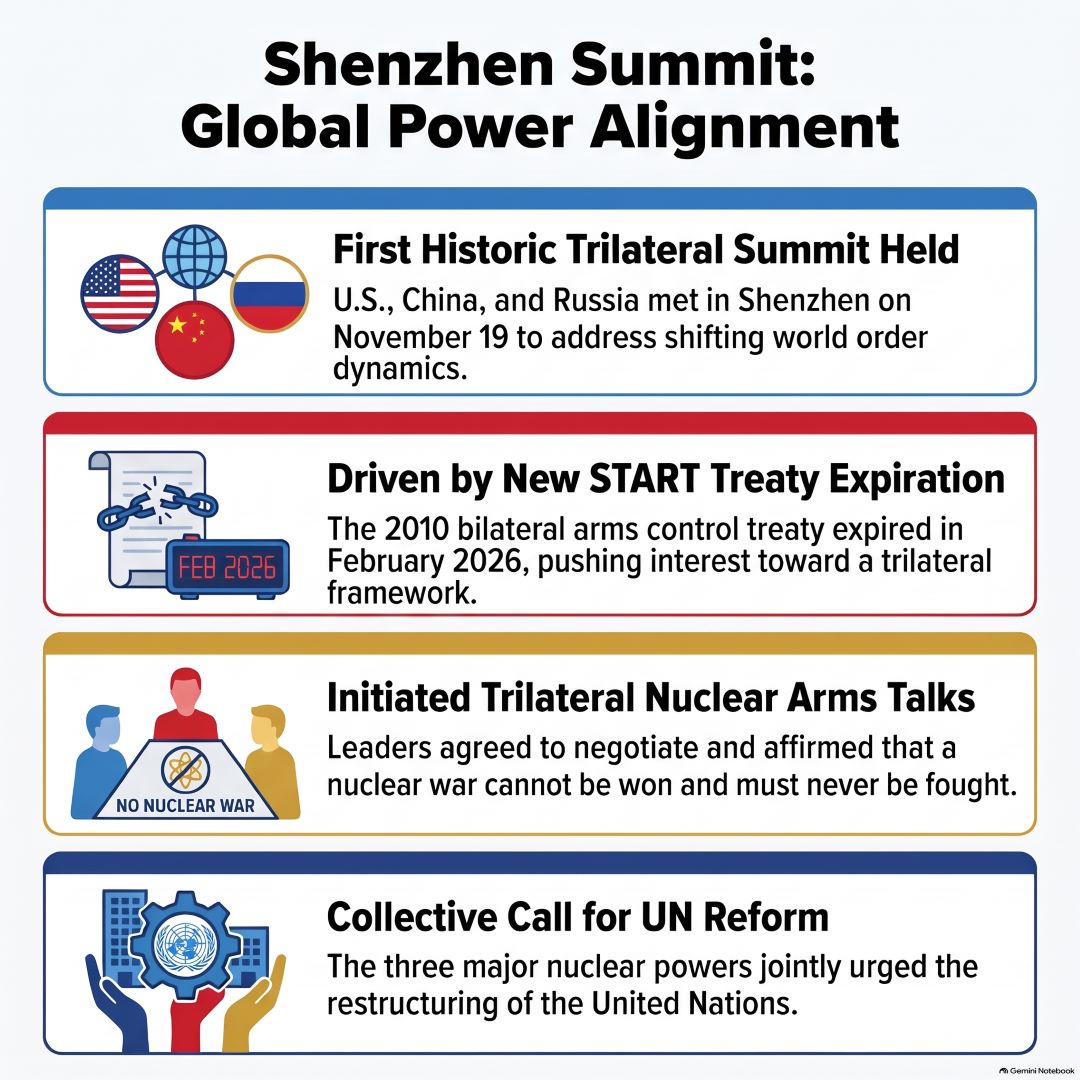
Historic US, China, Russia trilateral summit in Shenzhen addresses nuclear arms control and global stability, urging UN reform amid shifting world order.
Key Highlights:
- The first trilateral summit between the Presidents of China, the U.S., and Russia was held in Shenzhen on November 19.
- U.S. President Donald Trump advocated for joint talks among the three largest nuclear powers to reduce nuclear warheads.
- The summit reinforced China's status as a peer competitor to the U.S. and provided Russian President Vladimir Putin a prominent diplomatic platform.
- Leaders agreed to initiate trilateral talks on nuclear arms and issued a joint declaration stating that 'a nuclear war cannot be won and must never be fought'.
- The three leaders collectively called for the reform of the United Nations (UN).
Detailed Insights:
- The summit took place after the New START treaty between the U.S. and Russia expired in February 2026, prompting U.S. interest in China's involvement in nuclear talks.
- The meeting was compared to the 1945 Yalta Conference, though Shenzhen focused on establishing terms of engagement in a shifting global landscape.
|
The Yalta Conference, held from February 4–11, 1945, in Yalta, Crimea, was a World War II summit of the "Big Three" Allied leaders—U.S. President Franklin D. Roosevelt, British Prime Minister Winston Churchill, and Soviet Premier Joseph Stalin—to plan the defeat of Nazi Germany and the postwar order |
- Despite discussions, the summit did not achieve breakthroughs on nuclear arms reduction, non-proliferation, or the Ukraine war, nor did it offer a clear future roadmap.
- The long-term sustainability of the "Shenzhen spirit" is uncertain, given potential shifts in future U.S. presidential foreign policy.
- While UN reform is a positive step, any restructuring of international institutions should include rising middle powers such as India, South Africa, and Brazil.
- The Shenzhen framework could enhance stability and predictability in great-power relations, which is crucial as two of the three nations are currently involved in conflicts.
|
The New START Treaty (Strategic Arms Reduction Treaty), which stood for over a decade as the final pillar of nuclear arms control between the United States and Russia, officially expired on February 5, 2026. As of November 2026, the two largest nuclear powers are operating without a legally binding bilateral agreement for the first time in over 50 years. While both sides have recently shown a cautious interest in a "trilateral" framework involving China, the formal verification regimes of the New START era have ceased. 📜 What was the New START Treaty? Signed in 2010 by Presidents Barack Obama and Dmitry Medvedev, the treaty (officially known as New START / СНВ-III) replaced the 1991 START I and the 2002 SORT (Treaty of Moscow). 1. Core Numerical Limits The treaty imposed specific "central limits" on the strategic offensive arms of both nations:
2. Verification Mechanism One of the treaty's most critical features was its transparency regime. It allowed for 18 on-site inspections per year and twice-yearly exchanges of data regarding the status and location of strategic nuclear forces.
|