

Top court junks plea seeking new legislation for hate speech
Hindustan Times
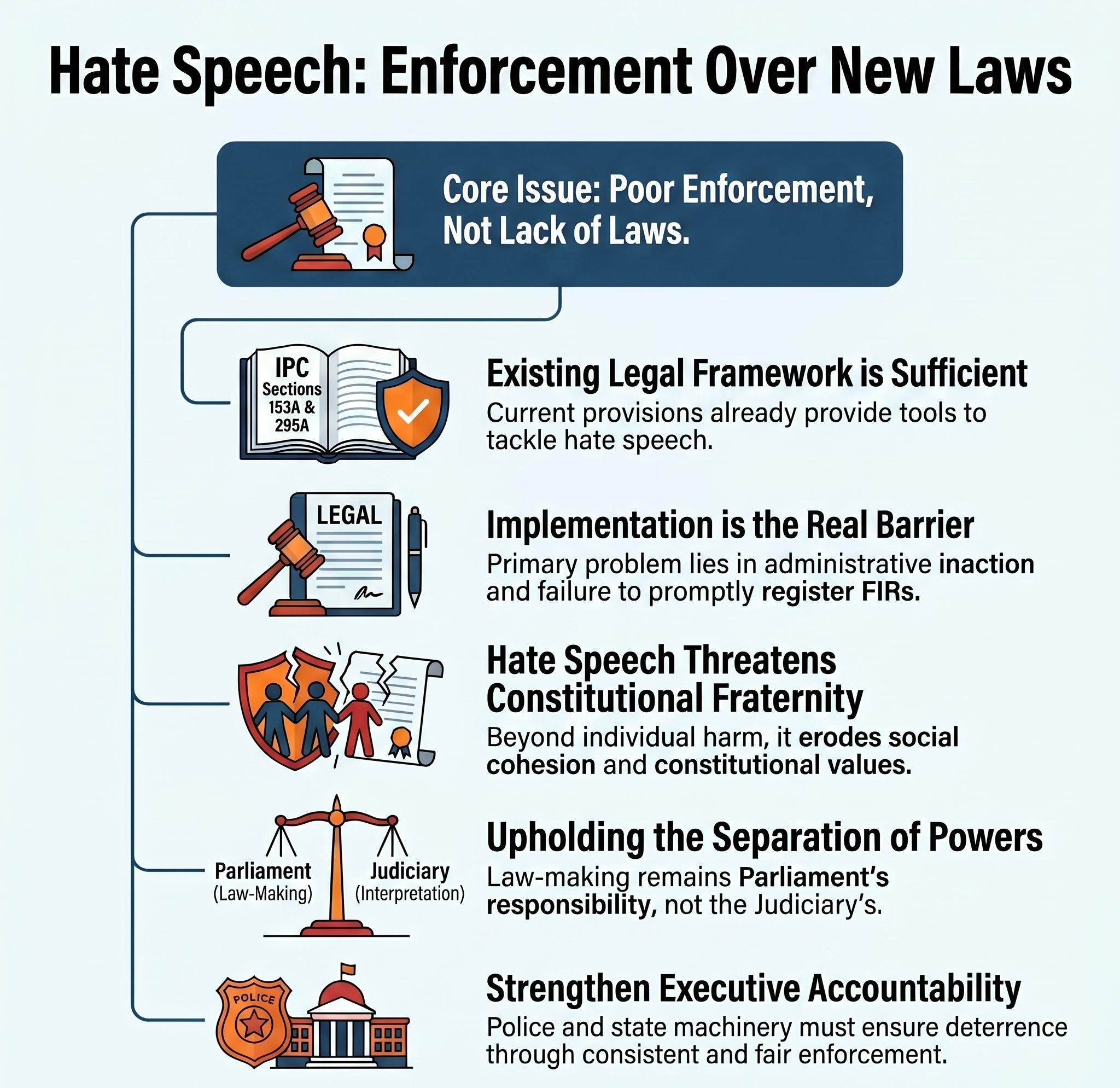
1. Core Theme
The article deals with:
- Supreme Court’s refusal to mandate new legislation on hate speech
- Assertion that existing legal framework is adequate
- Emphasis on constitutional morality, fraternity, and responsible speech
2. Key Arguments in the Article
(1) Supreme Court’s Position
- Existing laws are sufficient to tackle hate speech
- No immediate need for fresh legislation
Relevant provisions implicitly include:
- IPC Sections 153A, 295A, 505
- CrPC mechanisms for FIRs
(2) Hate Speech as a Constitutional Threat
- Court links hate speech with:
- erosion of fraternity
- weakening of constitutional values
- Goes beyond mere “speech” → affects social cohesion
(3) Emphasis on Constitutional Morality
- Citizens, institutions, and public figures must:
- act responsibly
- uphold constitutional ethos
(4) Problem Identified = Implementation, Not Law
- Issue lies in:
- poor enforcement
- failure to register FIRs promptly
- administrative inaction
(5) Judicial Restraint
- Court avoids:
- overreach into legislative domain
- Maintains:
- separation of powers
(6) Legislative Domain Clarified
- Law-making is:
- Parliament’s responsibility
- Judiciary:
- interprets, not creates law
(7) Role of State Machinery
- Police and executive must:
- act promptly
- ensure deterrence
3. Author’s Stance
- Broadly supportive of the Supreme Court’s reasoning
- Emphasises:
- adequacy of current laws
- need for better enforcement
- Implicit message:
- institutional accountability over legal expansion
4. Biases in the Article
(1) Institutional Trust Bias
- Assumes:
- existing laws are adequate if properly implemented
- May underplay:
- gaps in legal definitions of hate speech
(2) Underestimation of Legal Ambiguity
- Does not deeply engage with:
- lack of precise definition of hate speech in India
(3) Executive-Centric Solution
- Focuses more on:
- administrative efficiency
- Less on:
- structural legal reform
5. Pros and Cons
Pros
Judicial restraint upheld
- Prevents overreach into legislative domain
Focus on enforcement
- Targets real issue: weak implementation
Protects free speech balance
- Avoids excessive criminalisation
Cons
Legal ambiguity persists
- No clear statutory definition of hate speech
Scope for misuse
- Existing provisions often:
- vague
- selectively applied
Underestimates scale of problem
- Rising digital hate ecosystems not fully addressed
6. Policy Implications
(1) Strengthen Enforcement Mechanisms
- Police accountability in:
- FIR registration
- timely investigation
(2) Clear Operational Guidelines
- Standard protocols for:
- identifying hate speech
- prosecution thresholds
(3) Training of Law Enforcement
- Sensitisation on:
- constitutional values
- freedom vs harm balance
(4) Digital Governance Framework
- Address:
- online hate speech
- algorithmic amplification
(5) Law Commission Role
- Clarify:
- definitional scope
- legal consistency
7. Real-World Impact
Positive Outcomes
- Prevents:
- excessive legislation
- chilling effect on free speech
- Reinforces:
- constitutional morality discourse
Negative Risks
- Continued:
- selective enforcement
- political misuse
- Rising:
- social polarisation if unchecked
8. UPSC GS Linkages
GS Paper II
- Judiciary vs Legislature
- Fundamental Rights (Article 19)
- Governance and accountability
GS Paper IV (Ethics)
- Constitutional morality
- Responsibility in public discourse
GS Paper III
- Cyber governance (online hate speech dimension)
9. Critical Insight
The judgement reflects a deeper institutional philosophy: problems of governance cannot always be solved through more laws; often, they require better enforcement and ethical commitment.
10. Balanced Conclusion
The Supreme Court’s stance is:
- Legally sound in preserving separation of powers
- Pragmatic in identifying enforcement gaps
However:
- India still faces:
- definitional ambiguity
- inconsistent application of hate speech laws
11. Way Forward
- Improve enforcement capacity
- Develop clearer legal guidelines
- Address digital hate ecosystems
- Balance:
- free speech
- social harmony
Final Editorial Takeaway
The challenge is not the absence of laws but the absence of consistent, fair, and accountable enforcement—without which even the best legal framework fails to protect constitutional values.
