

TRANSFER OF DRDO CONVENTIONAL MISSILE TECHNOLOGY TO PRIVATE FIRMS

TRANSFER OF DRDO CONVENTIONAL MISSILE TECHNOLOGY TO PRIVATE FIRMS
Current Context
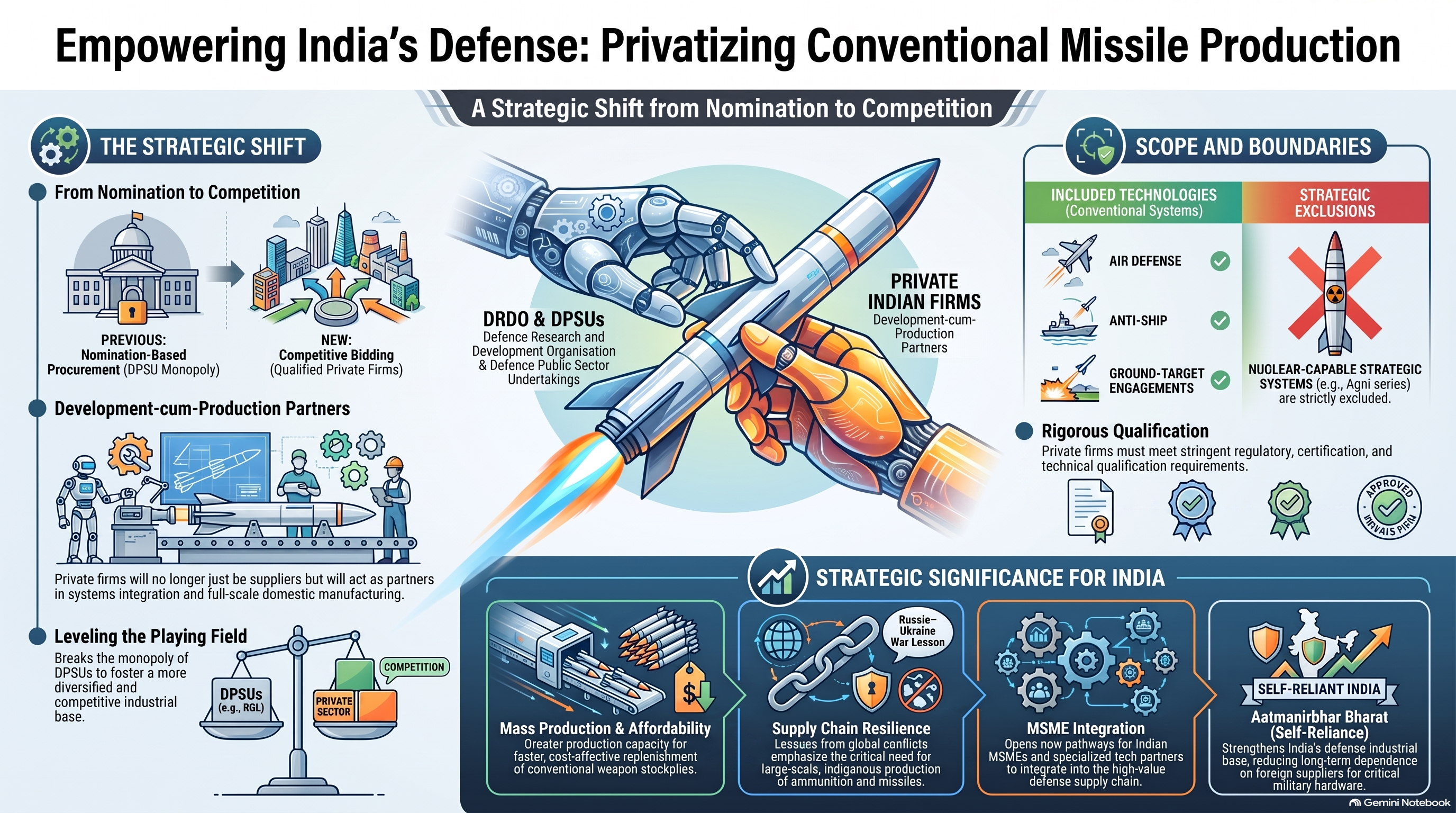
- Defence Minister Rajnath Singh approved the transfer of DRDO-developed technologies for conventional missile systems to qualified Indian private companies for domestic production.
- The move seeks to create a level playing field between private defence companies and Defence Public Sector Undertakings (DPSUs), which have traditionally been the primary manufacturers of such systems.
- Private firms will compete for the right to receive the technology, become development-cum-production partners and undertake systems integration in partnership with DRDO.
Scope of the Move
- The technology transfer covers DRDO-developed conventional missile systems, including systems used for air defence and missiles designed to engage ships, aircraft and ground targets.
- It excludes strategic missiles, including nuclear-capable systems such as the Agni series.
- The move covers weapons carrying conventional warheads and those without a strategic nuclear application.
- Private companies will have to meet applicable qualification, certification and regulatory requirements.
Shift from Nomination-Based Procurement
- DPSUs have traditionally received many defence contracts through nomination-based procurement, where a government-owned company is selected without competitive bidding.
- The new approach introduces competitive bidding among Indian private companies for technology transfer and production of conventional missiles.
- This represents a broader shift towards competitive procurement and greater private-sector participation in India's defence ecosystem.
Role of Private Industry
- Selected private companies will work with DRDO as development-cum-production partners.
- They will undertake systems integration and manufacture the missile systems domestically.
- The initiative is expected to create opportunities for Indian MSMEs and technology partners to participate in the defence supply chain.
- It can expand domestic production capacity and increase local value addition.
Existing Defence Industry Landscape
- Bharat Dynamics Limited (BDL) remains a major Indian missile systems integrator, particularly for long-range missiles.
- Conventional missile production involves a broad industrial network covering components such as propulsion systems, propellants and warheads.
- BrahMos Aerospace, an India–Russia joint venture, occupies a distinctive position in the cruise-missile segment and manufactures the supersonic BrahMos missile.
Significance for India
- Defence indigenisation: Strengthens domestic production of conventional missile systems.
- Import reduction: Reduces dependence on foreign suppliers for critical defence equipment.
- Defence industrial base: Expands India's manufacturing and systems-integration capabilities.
- Private-sector participation: Creates greater competition and enables private firms to enter areas traditionally dominated by DPSUs.
- MSME integration: Opens opportunities for MSMEs and specialised technology companies in the defence supply chain.
- Affordable mass production: Greater production capacity can support faster and more cost-effective replenishment of conventional weapons.
- Strategic preparedness: Lessons from conflicts such as the Russia–Ukraine war highlight the importance of large-scale domestic production of missiles and ammunition.
Conclusion
- The transfer of DRDO's conventional missile technologies to private firms marks an important step towards a more competitive and diversified Indian defence industry.
- By combining DRDO's technological capabilities with private-sector manufacturing capacity, the initiative can strengthen Aatmanirbhar Bharat, increase indigenous value addition and improve India's long-term defence preparedness.
