

Transforming Tribal Education: From Eklavya to Excellence

Transforming Tribal Education: From Eklavya to Excellence
Source: The Indian Express
Why in News?
On Janjatiya Gaurav Diwas (15 November), marking Birsa Munda's birth anniversary, the writer argues that transforming tribal education and skilling is a fitting tribute to tribal freedom fighters, and points to the Eklavya Model Residential Schools (EMRS) as the vehicle. This links to the Prime Minister's launch of 38 EMRS and the foundation stone of 19 more, in the previous note.
Background
- Article 46 asks the State to promote the educational and economic interests of STs. Article 275(1) provides central grants for tribal welfare, and Article 21A makes education a fundamental right for ages 6 to 14.
- The EMRS scheme is run by the Ministry of Tribal Affairs. STs were 8.6% of the population in Census 2011, with literacy below the national average.
- NEP 2020 favours teaching in the mother tongue or home language in the early years.
- The name comes from Eklavya in the Mahabharata, a young man denied formal education who mastered archery through dedication and discipline.
Key Highlights
- Concept: EMRS are set up for tribal children within their own community setting, for holistic development. The Union Budget 2018-19 expanded the scheme and aimed at one EMRS in every block with over 50% ST population and at least 20,000 tribal persons (Census 2011), taking CBSE-affiliated education to remote areas.
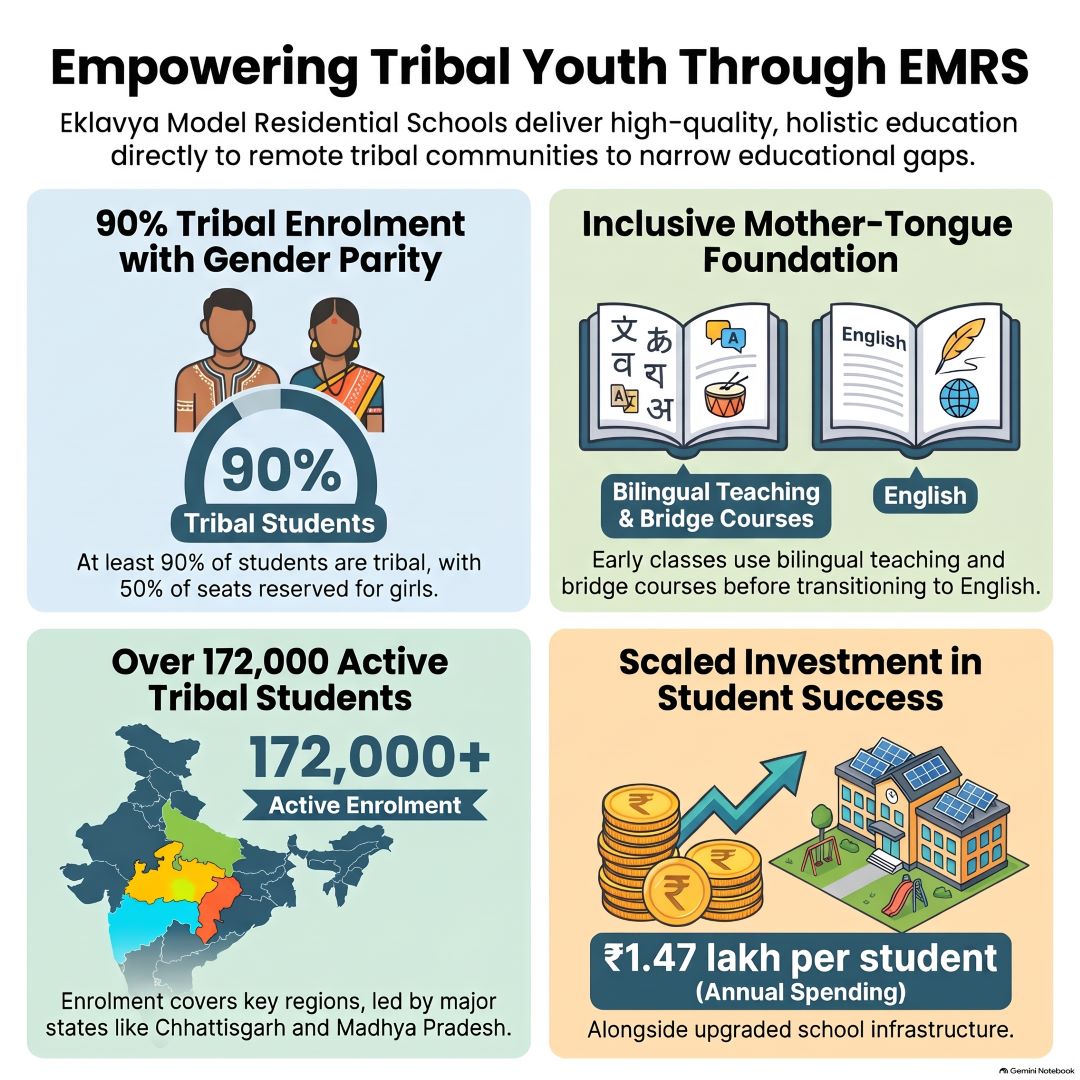
- Design: At least 90% of students are from tribal communities, against the 7.5% ST reservation in other schools. 50% of seats are reserved for girls. Admission is through a state-level entrance test, with preference to locals.
- First phase (1997-2018): 288 schools were sanctioned but faced structural challenges.
- EMRS 2.0 (from 2018): It stresses first-generation learners, with learning gap assessments, bridge courses and remedial classes, and bilingual teaching in the initial classes before a gradual shift to English. 440 new schools were sanctioned in tribal blocks.
- NESTS: The National Education Society for Tribal Students was set up in 2019 under the Ministry to establish, endow, maintain, control and manage the schools. It made a 65-day bridge course compulsory for newly admitted Class VI students. Schools are now run by State Government Societies under NESTS norms, supervised by a district-level committee under the District Collector, with the principal in overall charge.
- EMRS 3.0: The writer says the Ministry told him it was operationalised from this year.
- Costs: Capital cost per school was first ₹20 crore (plain areas) and ₹24 crore (North-East, hilly and LWE-affected areas), raised in 2021 to ₹37.8 crore and ₹48 crore. The maximum yearly expenditure for FY 2026-27 is ₹1,47,356 per student, covering mess, uniform, textbooks, medical expenses, CBSE fees and co-curricular activities.
- Enrolment: 1,72,953 students, of whom 84,636 are boys and 88,317 are girls. Schools approved: Odisha 114, Jharkhand 91, Chhattisgarh 75, Madhya Pradesh 71 and Gujarat 47. Highest enrolment: Chhattisgarh 28,884 and Madhya Pradesh 26,857.
|
Other Government Initiatives for Tribal Education
|
Conclusion
Bhagwan Birsa Munda inspired generations to stand up for their rights and dignity, and EMRS is empowering today's tribal youth. Janjatiya Gaurav Diwas honours the past by empowering tribal communities to shape a Viksit Bharat by 2047.