

Transgender Persons (Protection of Rights) Amendment Act, 2026: Rights and Healthcare

Transgender Persons (Protection of Rights) Amendment Act, 2026: Rights and Healthcare
Source: The Hindu
Why in News?
The Transgender Persons (Protection of Rights) Amendment Act, 2026 changes the basis of legal recognition. The 2019 Act recognised autonomy and self-identification, but the 2026 amendment requires a medical board's recommendation, selection from prescribed categories and certification by a District Magistrate. This moves recognition from self-identification to medical and administrative verification, raising concerns about constitutional rights, dignity, healthcare and social inclusion.
Background
- NALSA v. Union of India (2014): The Supreme Court recognised the right of a person to self-identify their gender and linked gender identity to dignity, autonomy and liberty under Article 21. It rejected compulsory medical intervention as a condition for recognition.
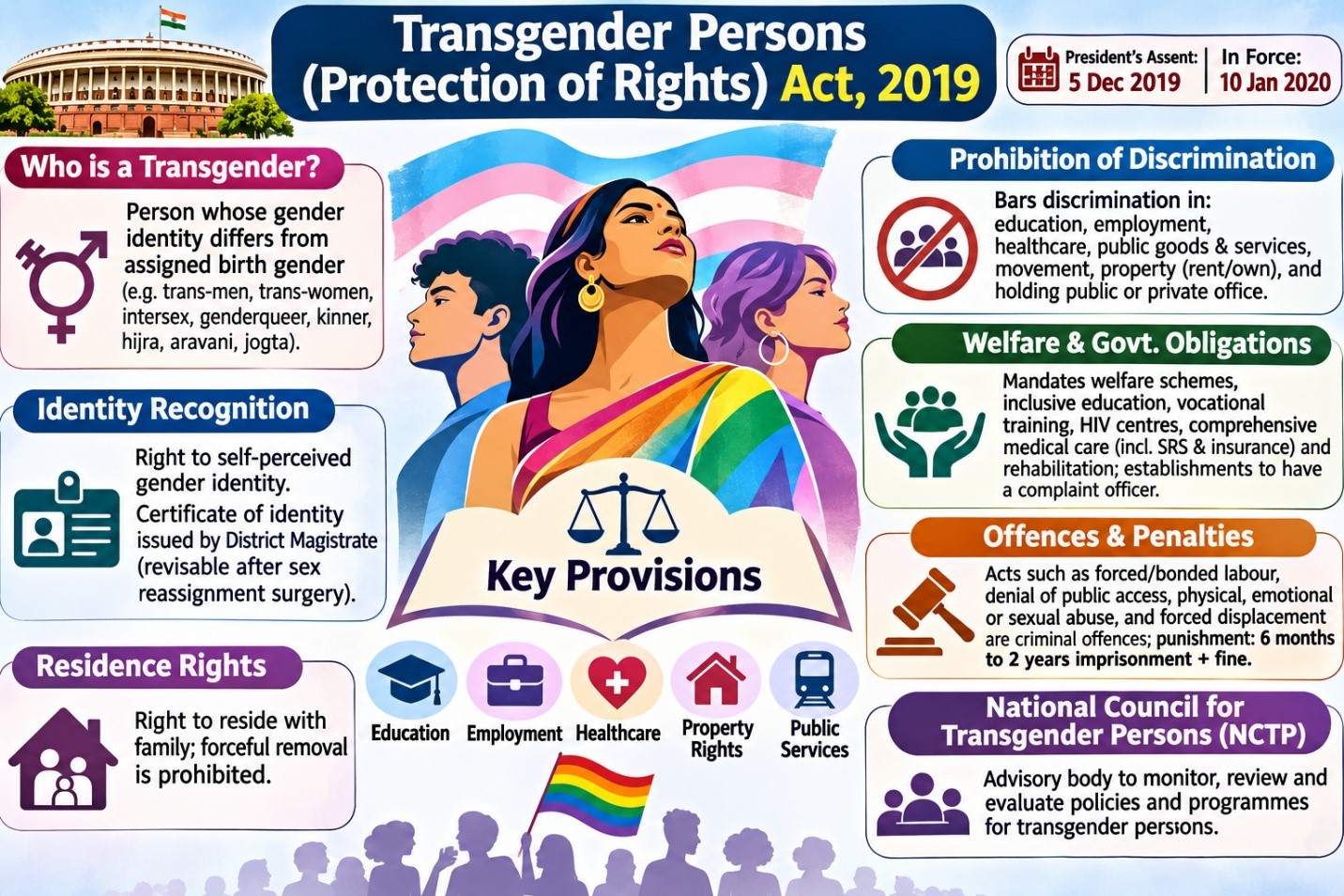
- Transgender Persons (Protection of Rights) Act, 2019: Provides for a certificate of identity, non-discrimination in education, employment and healthcare, a Complaints Officer in every establishment, and a National Council for Transgender Persons.
- WHO's ICD-11 and the WPATH Standards of Care (Version 8) are international clinical standards on gender identity and gender-affirming care.
- Madras High Court, Sushma v. Commissioner of Police (2021): Stressed sensitisation and education of professionals, including on medical curricula.
Key Highlights
The Transgender Persons (Protection of Rights) Act, 2019, remains the principal legislation, but it was substantially altered by the Amendment Act of 2026 (effective May 2026).
- Recognition of Identity: The 2019 Act allowed for self-perceived identity. However, the 2026 Amendment mandates that a Medical Board (headed by a Chief Medical Officer) must examine and recommend an applicant before the District Magistrate issues a Certificate of Identity.
- Narrower Scope: The 2026 Amendment restricted the definition of a "transgender person" to specific socio-cultural identities (e.g., Hijra, Kinner) and individuals with intersex variations, omitting broader terms like "trans-man" or "genderqueer".
- Offences and Penalties: New graded penalties were introduced in 2026 for forced identity assumption (e.g., forced surgery or emasculation). Punishment for such acts against adults ranges from 5 to 10 years, and for children, it can extend to life imprisonment.
|
Healthcare and Social Welfare The government’s primary vehicle for welfare is the SMILE Scheme (Support for Marginalized Individuals for Livelihood and Enterprise), which has seen significant budgetary outlays for the 2021–2026 period.
|
Legal Status and Key Changes
The 2026 Amendment received Presidential assent on March 30, 2026, and came into force on May 25, 2026. It fundamentally alters the parent Act of 2019 by shifting from administrative recognition to medical validation.
- Abolition of Self-Identification: The Act removes Section 4(2) of the 2019 Act, which guaranteed the right to self-perceived gender identity. Identity is no longer a matter of personal autonomy but requires external "verification."
- Narrower Statutory Definition: The definition of a "transgender person" has been restricted.
- Included: Specific socio-cultural identities (e.g., Kinner, Hijra, Aravani, Jogta, Eunuch) and persons with specified congenital intersex variations.
- Excluded: The terms "trans-man," "trans-woman," and "genderqueer" have been removed from the definition, leaving a significant portion of the community without legal protection.
- Mandatory Medical Board: To obtain a Certificate of Identity, an applicant must now be examined by a Medical Board (headed by a Chief Medical Officer). The District Magistrate (DM) issues the certificate only based on this board's recommendation.
Rights, Offences, and Penalties
The Amendment introduces new criminal categories and enhances punishments for specific crimes against the community, though critics note these are often focused on "forced identity" rather than general safety.
- Forced Identity Assumption: Kidnapping or using force/deceit to make someone assume a transgender identity (often involving forced surgery or emasculation) is now a grave offence.
- Adult victims: 5 to 10 years imprisonment + fine.
- Child victims: 10 to 14 years imprisonment + fine.
- Exploitation: Forcing a person to present as transgender for the purpose of begging or bonded labour is punishable with 5 to 10 years of imprisonment.
- Standard Penalties: Physical, sexual, or emotional abuse against transgender persons remains punishable with imprisonment between 6 months and 2 years.
Key Provisions
|
Conclusion
The amendment raises basic questions about autonomy, constitutional morality, medical authority and state regulation. Protecting vulnerable communities is a legitimate duty, but protection must not undermine dignity and freedom.