

Transgender Rights in India: Revisiting the NALSA Judgment

Transgender Rights in India: Revisiting the NALSA Judgment
Source: IE
Context
A fresh petition filed in the Supreme Court by the India chapter of Women’s Declaration International (WDI), a UK-based organisation advocating sex-based rights for women, has challenged provisions of the Transgender Persons (Protection of Rights) Act, 2019 and sought reconsideration of the landmark NALSA judgment (2014).
The petition raises concerns regarding the distinction between biological sex and gender identity and its implications for women-specific protections, benefits and sporting categories.
Background: Legal Framework for Transgender Rights
1. NALSA Judgment, 2014
In National Legal Services Authority (NALSA) v. Union of India (2014), the Supreme Court recognised the rights of transgender persons and established the following principles:
- Gender Identity: Biological sex and gender identity are distinct components of a person's identity.
- Self-Identification: Individuals have the right to determine their own gender identity without external interference.
- Constitutional Protection: Discrimination based on gender identity violates Articles 15 and 16.
- Right to Dignity: Self-determination of gender identity is protected under Article 21.
- No Mandatory Medical Intervention: Sex reassignment surgery, sterilisation or hormonal treatment cannot be imposed as a precondition for legal gender recognition.
2. Transgender Persons (Protection of Rights) Act, 2019
- Provides legal recognition and protection against discrimination in education, employment, healthcare and public services.
- Establishes a framework for issuing identity certificates to transgender persons.
- Seeks to promote equality, dignity and social inclusion.
|
What Other Initiatives has the Government Taken for Transgender Persons?
|
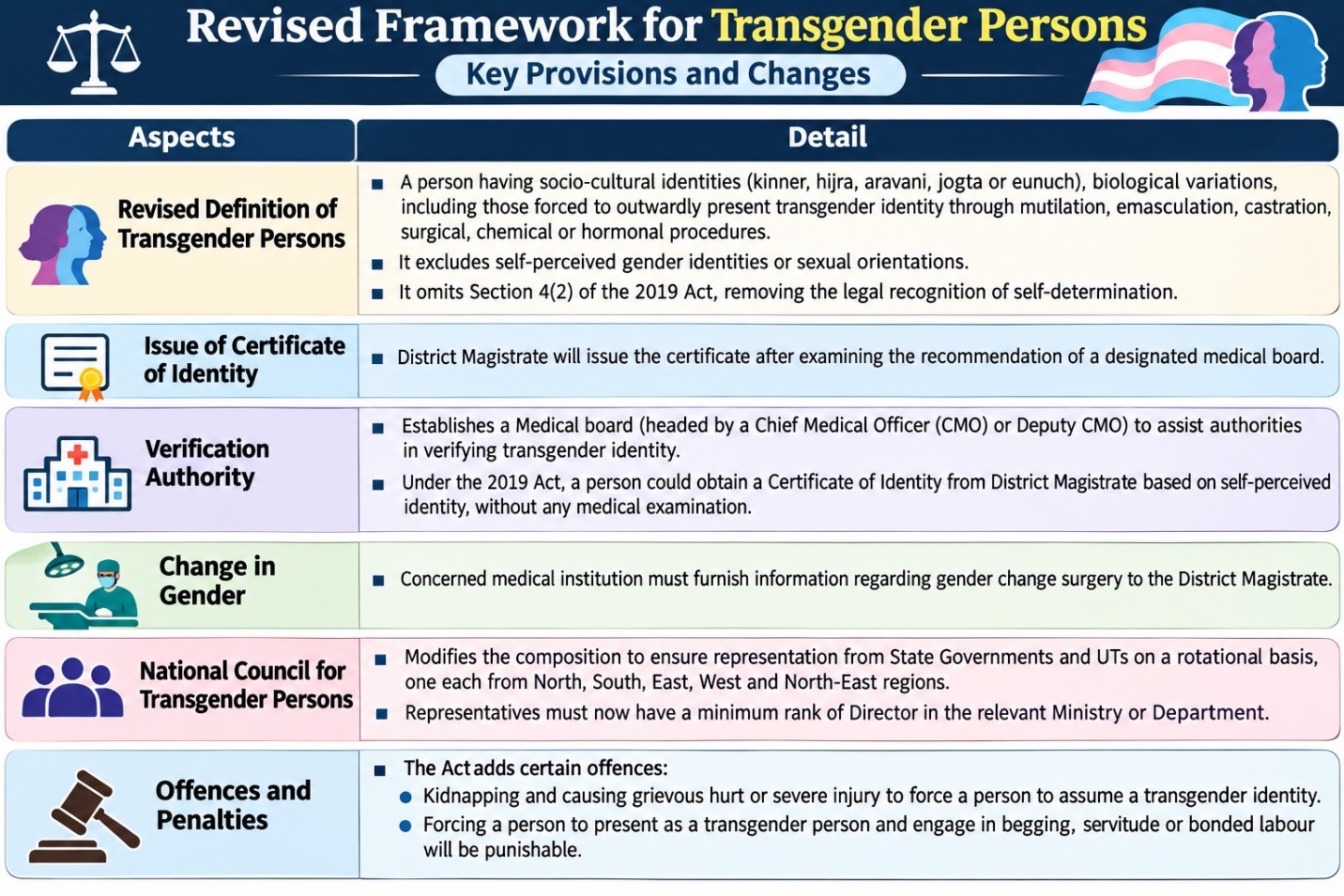
Major Concerns and Implications
- Constitutional Rights: The challenge raises questions about the relationship between gender identity, equality, dignity and the right to self-determination.
- Risk of Exclusion: Transgender persons already face discrimination in education, healthcare, employment and public services despite existing legal protections.
- Intersectional Vulnerability: Poor, rural and Adivasi transgender persons, particularly those dependent on begging or sex work, may face disproportionate consequences.
- Healthcare Access: Growing apprehension about discrimination may discourage transgender persons from accessing medical services.
- Social Stigmatisation: The debate may reinforce stereotypes and increase social exclusion, including through prejudicial public discourse.
Conclusion
The case raises important constitutional questions concerning gender identity, equality and individual dignity. The challenge is to address concerns relating to women-specific protections through evidence-based and context-specific measures without undermining the fundamental rights and legal recognition of transgender persons established under the NALSA judgment and the 2019 Act.