

Tribals in MP's Dindori Earn Rs 42 Lakh Collecting Sal Borer Beetles

Tribals in MP's Dindori Earn Rs 42 Lakh Collecting Sal Borer Beetles
Relevance: GS Paper III (Environment, Forest Conservation, Biodiversity) | GS Paper I (Tribal Livelihoods)
Why in the News?
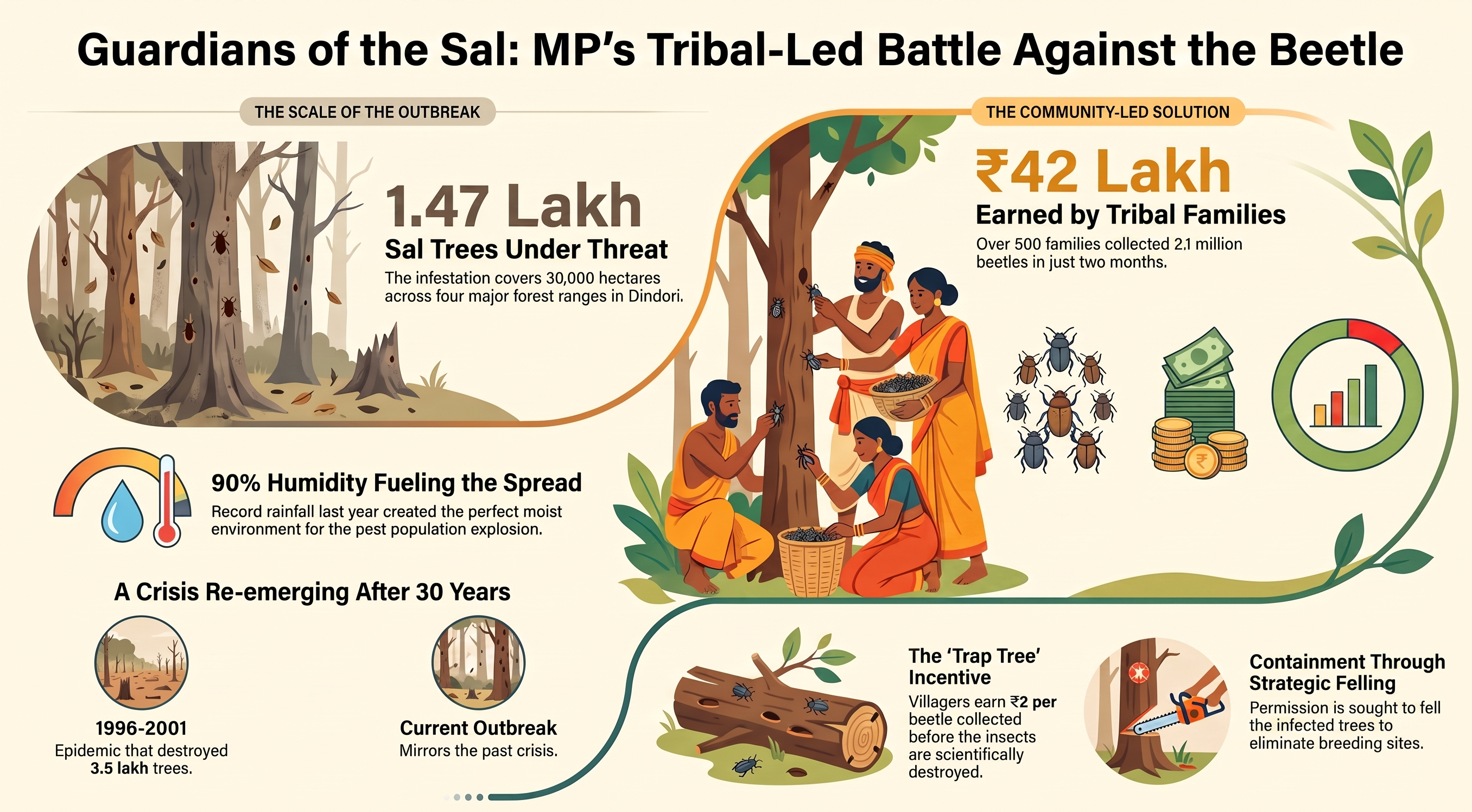
- Tribal communities in Madhya Pradesh's Dindori district have earned nearly Rs 42 lakh between June and July 30 by collecting more than 2.1 million sal borer beetles, under a forest department drive to contain a major infestation threatening sal forests.
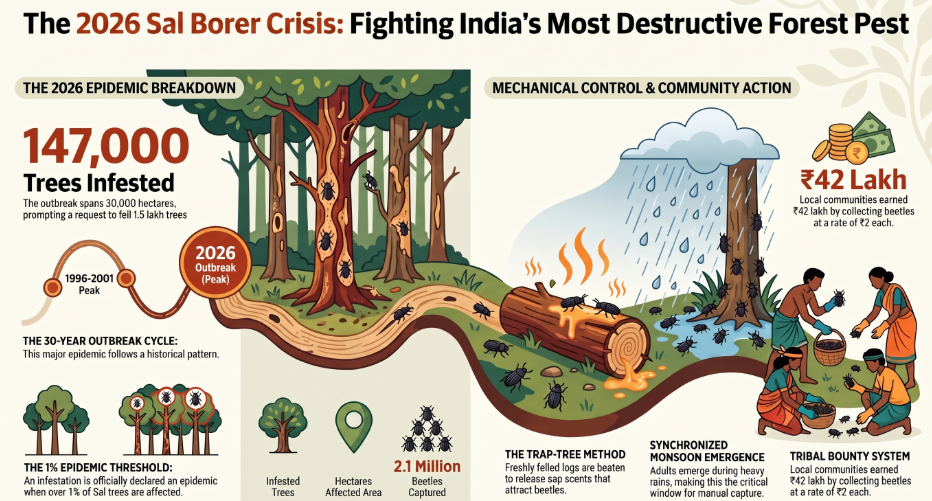
- Villagers are being paid Rs 2 per beetle under an ongoing "trap tree" operation aimed at reducing the adult beetle population before further spread.
- More than 400-500 tribal families participated in the initiative.
Scale of the Infestation
- The infestation has affected more than 1.47 lakh sal trees across nearly 30,000 hectares of forest in Dindori.
- Affected areas cover the East Karanjia, West Karanjia, South Samnapur, and Bajag forest ranges.
- Affected trees are at varying infestation stages, with some severely damaged and unlikely to recover.
How the Collection Drive Works?
- Villagers collect beetles from specially prepared trap trees and submit them to the forest department, often stringing them into garlands before handing them over.
- All collected beetles will later be scientifically destroyed under expert supervision to prevent further breeding.
Proposed Tree Felling to Contain the Outbreak
- The Madhya Pradesh forest department has sought permission from the Union Ministry of Environment, Forest and Climate Change to fell more than 1.47 lakh trees to contain the epidemic — accounting for 15% of the district's sal forests.
- Subhranjan Sen, Principal Chief Conservator of Forests (PCCF), confirmed this request.
- Officials note that felling heavily infested trees can reduce breeding sites and slow the pest's spread; all proposed trees for felling are confirmed infected.
Historical Context
- According to experts, this sal borer outbreak has returned after nearly three decades.
- Between 1996 and 2001, the pest destroyed around 3.5 lakh trees across three districts.
- The current outbreak was detected in December.
Scientific Explanation for the Outbreak
- Dr. C Mohan, senior scientist at the Tropical Forest Research Institute (TFRI), Jabalpur, explains that heavy rainfall last year raised moisture levels to nearly 90% in the Dindori-Amarkantak region, accelerating the pest's spread.
- Beetles are drawn to sap oozing from wounds on trees, where they lay eggs and hollow out the trees from within.
Significance
- The initiative demonstrates a community-based, incentive-driven approach to pest management, generating direct livelihood benefits for tribal households while supporting forest conservation goals.
- It highlights the link between climatic factors (heavy rainfall, elevated humidity) and forest pest outbreaks, relevant to broader discussions on climate change impacts on forest ecosystems.
- The scale of proposed tree felling (15% of district sal forests) raises important trade-off questions between immediate pest containment and longer-term forest cover/biodiversity conservation.
