

Two democracies shaped by history, a partnership that helps global stability
Indian Express
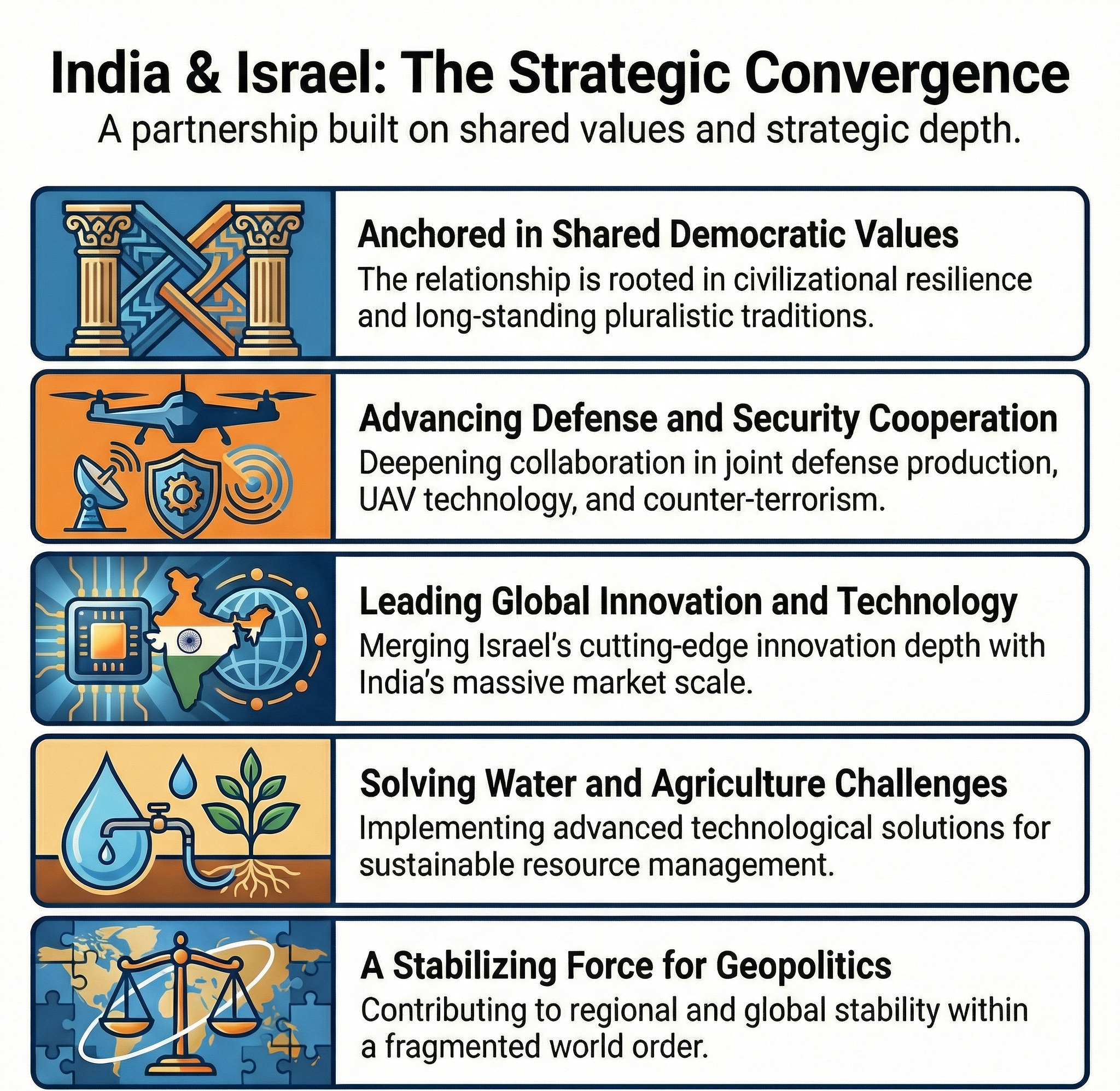
Core Theme of the Article
The article argues that the India–Israel relationship is rooted in shared democratic values, civilisational resilience, and strategic complementarities. It positions the partnership not merely as transactional diplomacy but as a stabilising force in a volatile global order.
The narrative blends history, culture, security cooperation, and technological collaboration to frame India–Israel ties as mature, trusted, and strategically aligned.
Key Arguments Presented
1. Historical Civilisational Bonds
The article highlights long-standing civilisational connections and India’s tradition of pluralism, particularly towards Jewish communities. This historical framing seeks to legitimise the partnership beyond contemporary geopolitics.
2. Democratic Convergence
Both countries are portrayed as vibrant democracies navigating security challenges while maintaining institutional resilience.
3. Strategic and Security Cooperation
The relationship is anchored in defence collaboration, intelligence sharing, counter-terrorism coordination, and technological innovation.
4. Technology and Innovation Linkages
Israel’s strength in innovation ecosystems and India’s scale and market depth are presented as mutually reinforcing.
5. Partnership for Global Stability
The article asserts that cooperation between India and Israel contributes to broader regional and global stability, particularly in a fragmented geopolitical environment.
Author’s Stance
The stance is clearly affirmative and partnership-oriented.
• Strongly supportive of deeper India–Israel ties
• Emphasises shared values over political differences
• Frames the relationship as morally and strategically sound
• Avoids highlighting contentious aspects
It is a celebratory yet strategic narrative rather than a critical or adversarial one.
Underlying Biases and Framing
Normative Democratic Bias
The partnership is framed primarily through democratic solidarity, possibly underplaying realpolitik motivations.
Selective Omission Bias
The article does not engage deeply with contentious issues such as West Asian sensitivities, Palestinian concerns, or India’s balancing act in the region.
Strategic Optimism Bias
Assumes alignment will remain smooth despite evolving geopolitical pressures.
These biases are typical of diplomatic commentary rather than investigative reporting.
Strengths of the Article
• Contextualises the relationship historically and culturally
• Links strategic cooperation with global order debates
• Highlights technology and innovation as future drivers
• Reinforces India’s diversified foreign policy
Limitations and Gaps
• Limited discussion on India’s West Asia balancing strategy
• Minimal engagement with geopolitical trade-offs
• Overlooks domestic political debates in both countries
• Underplays reputational and diplomatic sensitivities
Policy Implications
1. Defence and Security
Continued deepening of joint defence production, UAV technology, cyber-security, and counter-terrorism collaboration.
2. Technology Diplomacy
Expansion of cooperation in water management, agriculture technology, AI, and start-up ecosystems.
3. Strategic Autonomy
India must manage ties with Israel alongside relations with Arab states, Iran, and broader Global South partners.
4. Diplomatic Signalling
Democratic solidarity narratives must be balanced with pragmatic regional engagement.
Real-World Impact
Short Term
• Enhanced bilateral defence agreements
• Increased joint innovation projects
• Diplomatic messaging of shared democratic resilience
Medium Term
• Greater co-development in emerging technologies
• Expanded trade and investment linkages
Long Term
• Institutionalised strategic partnership contributing to India’s multi-aligned foreign policy
• Strengthening India’s image as an independent actor capable of engaging across blocs
UPSC GS Paper Alignment
GS Paper II – International Relations
• India–Israel relations
• India’s West Asia policy
• Strategic autonomy
• Role of diaspora and civilisational links in diplomacy
GS Paper III – Security
• Counter-terrorism cooperation
• Defence technology transfer
• Cyber security collaboration
GS Paper IV – Ethics
• Democratic values in foreign policy
• Balancing moral principles and national interest
Essay Relevance
• “Democracy as a pillar of foreign policy”
• “Strategic partnerships in a multipolar world”
Balanced Editorial Evaluation
The article succeeds in presenting India–Israel ties as historically grounded and strategically meaningful. It captures the diplomatic narrative effectively. However, it could have provided a more nuanced exploration of regional sensitivities and the complexities of West Asian geopolitics.
A mature foreign policy demands simultaneous engagement across competing interests. The strength of India’s diplomacy lies not in exclusivity but in calibrated multi-alignment.
Future Perspective
India–Israel ties will likely deepen in:
• Defence innovation
• Agriculture and water technologies
• Artificial intelligence and cybersecurity
• Start-up and venture ecosystems
However, sustainability of this partnership depends on:
• India’s ability to balance Arab world relations
• Managing regional conflict spillovers
• Preserving strategic autonomy
Final Editorial Judgment:
The article persuasively argues that India and Israel, shaped by history and democratic resilience, can contribute to global stability. Yet, in a fractured world, the durability of such partnerships will depend on strategic balance, not sentiment alone.
