

UN and the Long Road to Restoring Trust

UN and the Long Road to Restoring Trust
1. Why Trust in the UN is Declining
- The United Nations, established after World War II, was designed to promote peace, international law, diplomacy and collective action.
- The 81st UN General Assembly's theme, “Restoring Trust, Managing Transformation: a UN that delivers for all”, reflects concerns about effectiveness, accountability and representation.
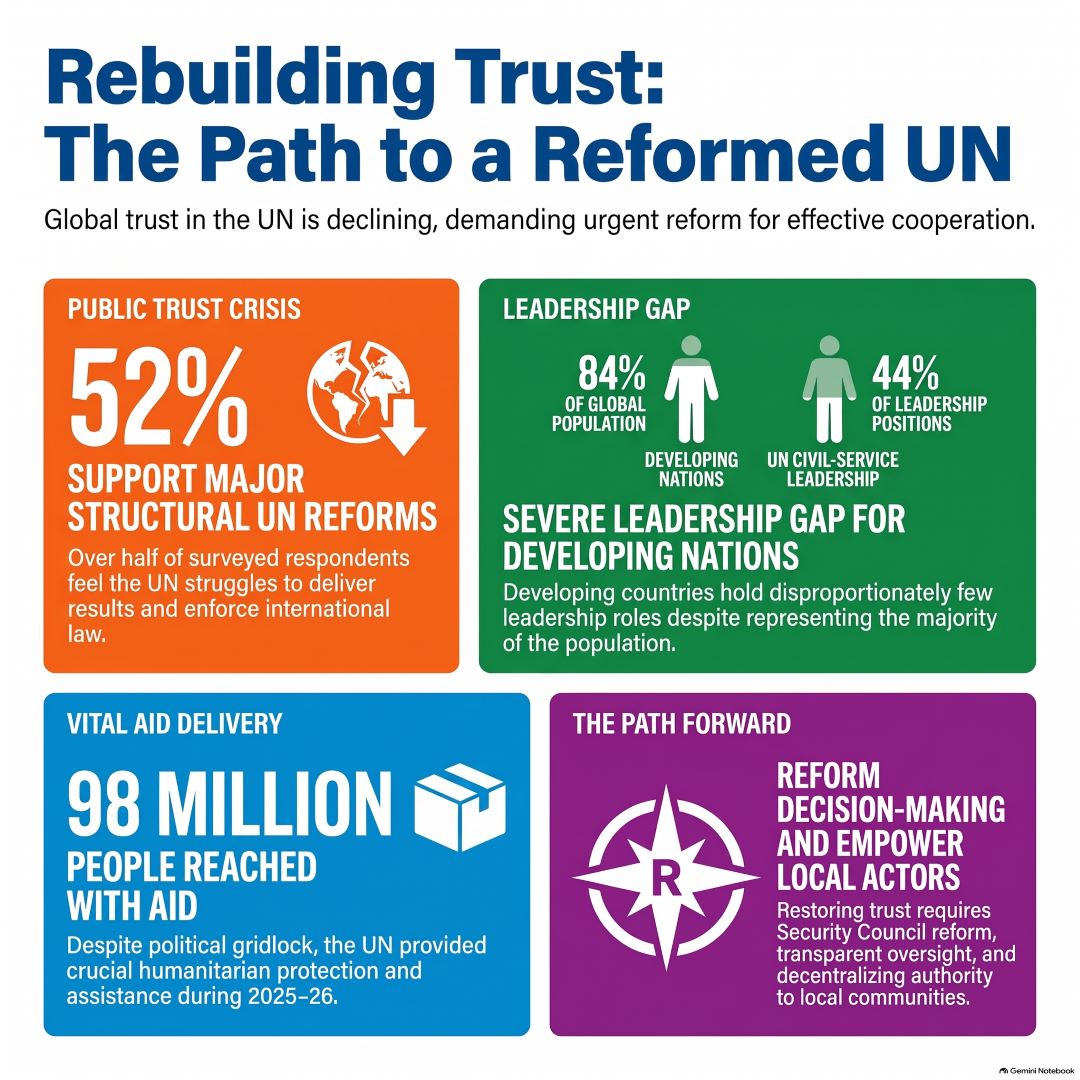
- A UN Foundation poll found 52% of respondents believed the UN was struggling to deliver results and supported major structural reforms.
- More than half felt that the UN struggled to enforce international law and protect human rights and was overly influenced by powerful states.
- The erosion of trust therefore reflects not only failures of performance but also concerns about the fairness and representativeness of the institution.
2. Structural Problems
- Security Council deadlock: The veto power of the five permanent members can prevent collective action during major international crises.
- Accountability deficit: Concerns over recruitment, procurement, resource allocation and peacekeeper misconduct raise questions about institutional oversight.
- Financial dependence: Heavy reliance on powerful donor countries can create perceptions of unequal influence over programmes, priorities and institutional decisions.
- Representation gap: Developing countries account for around 84% of the world's population but only 44% of UN civil-service leadership positions, indicating a mismatch between global demographics and institutional power.
- These issues collectively weaken the perception of the UN as an impartial and representative global institution.
3. UN's Continuing Relevance
- Despite its limitations, the UN remains a major provider of humanitarian assistance, peacekeeping, development support and international coordination.
- It provided humanitarian assistance and protection to approximately 98 million people during 2025–26.
- In conflicts such as Ukraine and Gaza, UN agencies continue to provide humanitarian assistance and address humanitarian and environmental risks.
- However, humanitarian interventions often do not translate into sustained political dialogue or long-term peacebuilding.
- Excessive centralisation can also prevent field-level officials and regional actors from responding quickly to opportunities for mediation.
4. Restoring Trust through Reform
- Security Council reform: Greater representation of developing countries and reforms to improve the credibility of collective decision-making.
- Transparency: Greater openness in recruitment, procurement, expenditure and resource allocation.
- Accountability: Independent scrutiny and institutional mechanisms rather than addressing failures only through individual punishment.
- Financial reform: Reduce excessive dependence on a small number of powerful donors and diversify funding.
- Global South representation: Increase participation of developing countries in leadership and decision-making positions.
- Local participation: Give greater responsibility to local communities and organisations in humanitarian and development programmes.
5. Way Forward
The UN's credibility will depend on its ability to combine representativeness with effectiveness. Reform should not only focus on changing institutions at the headquarters level but also on decentralising decision-making, empowering regional offices and strengthening local actors. Preventive diplomacy, conflict mediation and locally driven peacebuilding should receive greater attention so that humanitarian interventions can develop into sustained political dialogue. Ultimately, restoring trust requires the UN to demonstrate transparency, accountability, equal representation and the capacity to deliver tangible outcomes, particularly for countries and communities most affected by global crises.
