

UN: Earth Will Soon Exceed Safe Temperature Threshold

UN: Earth Will Soon Exceed Safe Temperature Threshold
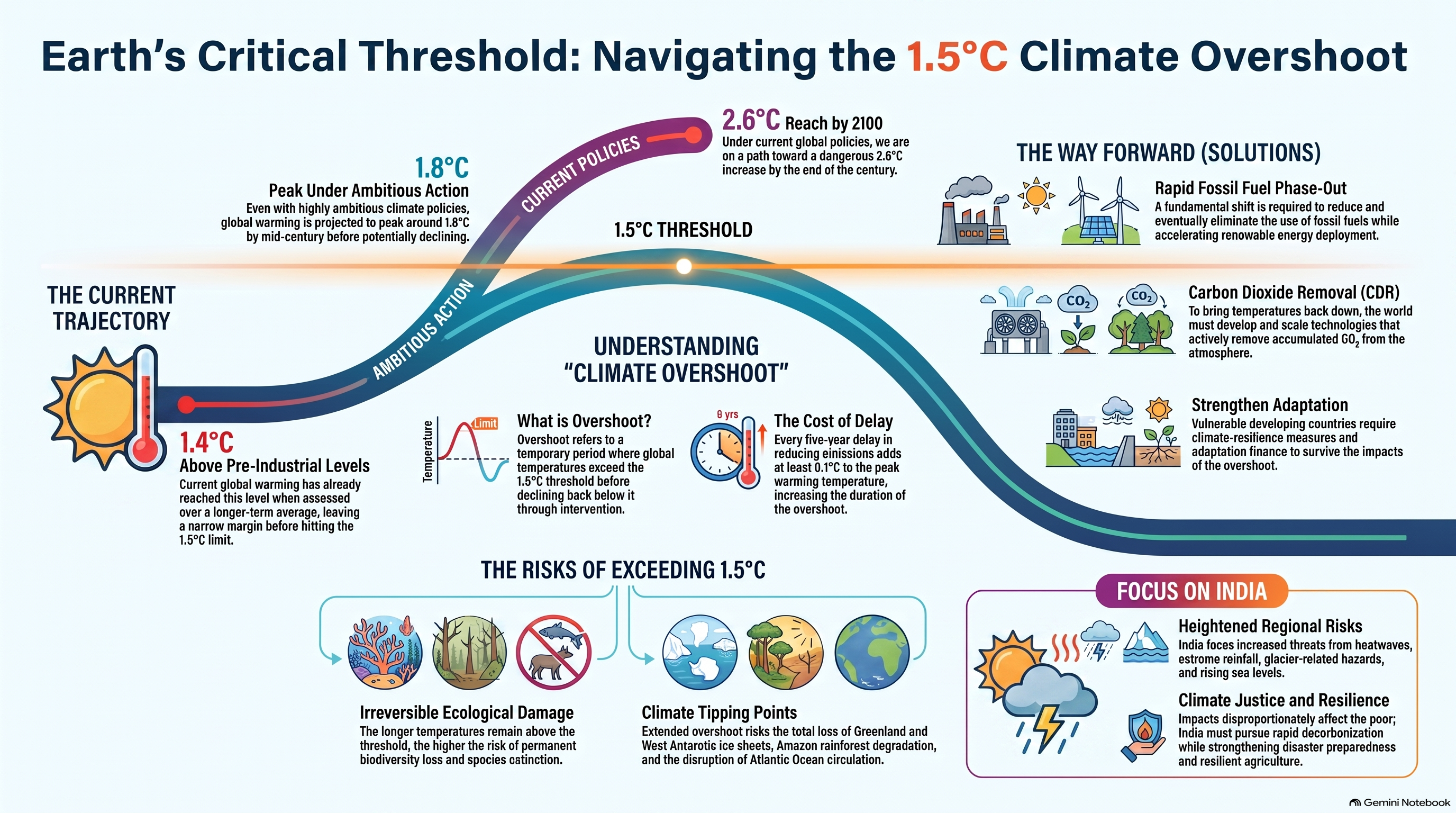
Context
- A new UNEP report acknowledges that the world is likely to cross the Paris Agreement’s 1.5°C warming threshold within the next few years.
- The challenge has shifted from preventing 1.5°C warming to limiting the extent and duration of the “overshoot” and subsequently bringing temperatures below the threshold.
Current Trajectory
- Global warming is already around 1.4°C above pre-industrial levels when assessed over a longer-term average.
- Under ambitious climate action, warming could peak around 1.8°C by mid-century.
- Under current policies, temperatures could reach about 2.6°C above pre-industrial levels by 2100.
What is Climate Overshoot?
- Overshoot refers to a temporary period during which global temperatures exceed 1.5°C before potentially declining below it.
- The longer temperatures remain above the threshold, the greater the risks of irreversible ecological and climatic damage.
- Every five-year delay in reducing emissions could add at least 0.1°C to peak warming.
Major Risks
- More frequent and intense extreme weather events.
- Sea-level rise and accelerated melting of glaciers and ice sheets.
- Biodiversity loss and species extinctions.
- Greater risks of climate tipping points, including:
- Loss of Greenland and West Antarctic ice sheets.
- Amazon rainforest degradation.
- Disruption of Atlantic Ocean circulation.
Way Forward
- Rapid reduction and eventual phase-out of fossil-fuel use.
- Accelerated deployment of renewable and low-carbon energy.
- Development of carbon dioxide removal technologies to remove accumulated CO₂ from the atmosphere.
- Minimise both the peak level and duration of warming above 1.5°C.
- Strengthen adaptation and climate-resilience measures, particularly for vulnerable developing countries.
Significance for India
- Higher warming increases risks of heatwaves, extreme rainfall, floods, droughts, glacier-related hazards and sea-level rise.
- Climate impacts disproportionately affect poorer and vulnerable communities, making climate justice and adaptation finance critical.
- India therefore needs to pursue rapid decarbonisation while simultaneously strengthening climate-resilient agriculture, cities, water systems and disaster preparedness.
Conclusion
Crossing 1.5°C should not be treated as the end of climate action. It represents a shift from preventing threshold exceedance to limiting overshoot, accelerating emission reductions and restoring a safer climate trajectory. The report underlines that every fraction of a degree and every year of delayed action matters.