

UN should survive US attack. It may not
The Tribune
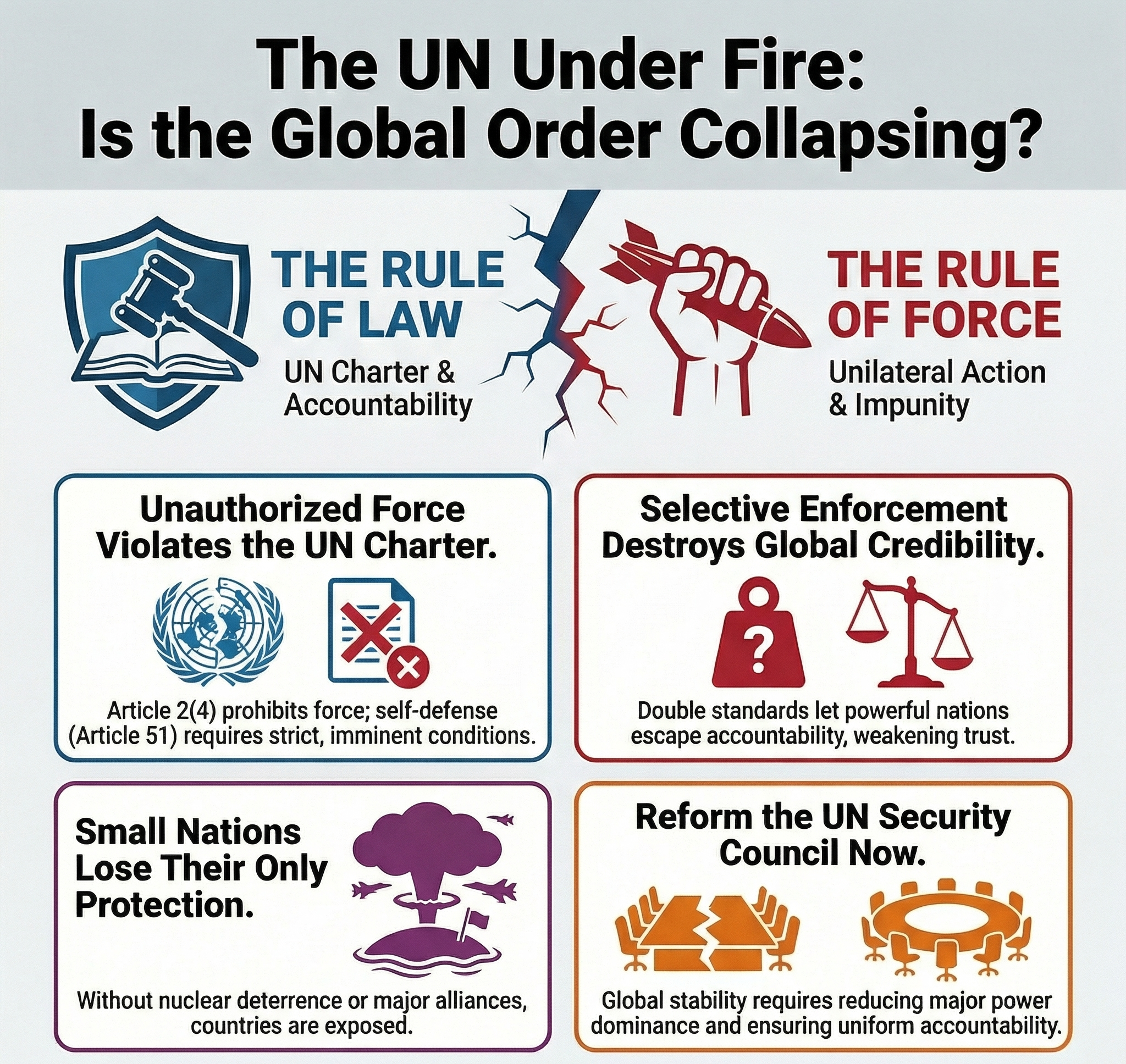
1. Key Arguments
A. Violation of UN Charter Principles
Use of force without UN Security Council authorisation is illegitimate.
Article 2(4) prohibits force; Article 51 allows self-defence only under strict conditions.
B. Weakness of Self-Defence Justification
Preventive or pre-emptive war lacks legal legitimacy.
The absence of an imminent threat weakens the US claim.
C. Erosion of Multilateralism
Bypassing the UN weakens global governance structures.
Sets a precedent for unilateral military action.
D. Selective Enforcement by Global Powers
Double standards in international responses
Powerful nations escape accountability.
E. Diplomatic Undermining
Military action during negotiations damages trust in diplomacy.
Destroys credibility of mediation efforts.
F. Vulnerability of Smaller Nations
Countries without alliances or nuclear deterrence are exposed.
Law becomes their only protection—now weakened.
2. Author’s Stance
Strongly critical and normative
Defends international law and UN system
Sees UN Charter as cornerstone of global order.
Criticises US unilateralism
Portrays it as destabilising and legally flawed.
3. Biases and Limitations
Normative Bias
Strong moral framing against US actions
Limited exploration of strategic/security concerns.
Selective Focus
Primarily critiques one actor
Less attention to broader geopolitical complexities.
Idealistic Multilateralism
Assumes effectiveness of UN system
Underplays its structural limitations (e.g., veto power).
4. Strengths (Pros)
Reinforces importance of rule-based order
Highlights need for legal consistency.
Timely critique of unilateralism
Relevant in current geopolitical climate.
Focus on smaller states’ vulnerability
Brings equity dimension into IR discourse.
Strong legal grounding
References UN Charter provisions effectively.
5. Weaknesses (Cons)
Limited strategic analysis
Ignores realpolitik considerations.
Over-reliance on legal idealism
Global politics often deviates from legal norms.
Lack of alternative frameworks
Does not suggest viable reforms to UN system.
6. Policy Implications
A. Strengthening UN Mechanisms
Reforming Security Council processes
Reducing dominance of major powers.
B. Clarifying Self-Defence Doctrine
Defining limits of pre-emptive action
Prevent misuse.
C. Enhancing Accountability
Mechanisms for enforcing international law uniformly
D. Promoting Multilateral Diplomacy
Reviving trust in negotiation processes
E. Strategic Autonomy for Countries like India
Balancing global power politics with legal commitments
7. Real-World Impact
Global Governance
Weakening of UN credibility
Reduced effectiveness in conflict resolution.
Security Environment
Increased risk of unilateral military actions
Destabilisation of international order.
Diplomatic Relations
Erosion of trust in negotiations
Reduced role of mediators.
Impact on Smaller Nations
Heightened insecurity and dependence on alliances
8. UPSC GS Paper Linkages
GS Paper II (International Relations)
- UN system
- Global governance
- Multilateralism vs unilateralism
GS Paper IV (Ethics)
- Just war theory
- Moral legitimacy of force
GS Paper III (Security)
- International security
- Strategic doctrines
9. Balanced Conclusion
The article powerfully defends the sanctity of international law and the UN system, but it underestimates the realities of power politics. A balance between legal norms and strategic imperatives is essential for a stable global order.
10. Future Perspective
Reform of UN Security Council
More representative and accountable structure.
Codification of modern warfare norms
Addressing new forms of conflict.
Strengthening global legal institutions
Ensuring enforcement capability.
Rise of multipolar world order
Reducing unilateral dominance.
Final Insight
When powerful nations bypass the rules they helped create, the real casualty is not just peace—but the very idea of a rules-based international order.
