

UPI Merchant Discount Rate (MDR): New Fee Structure

Source: The Hindu
Why in News?
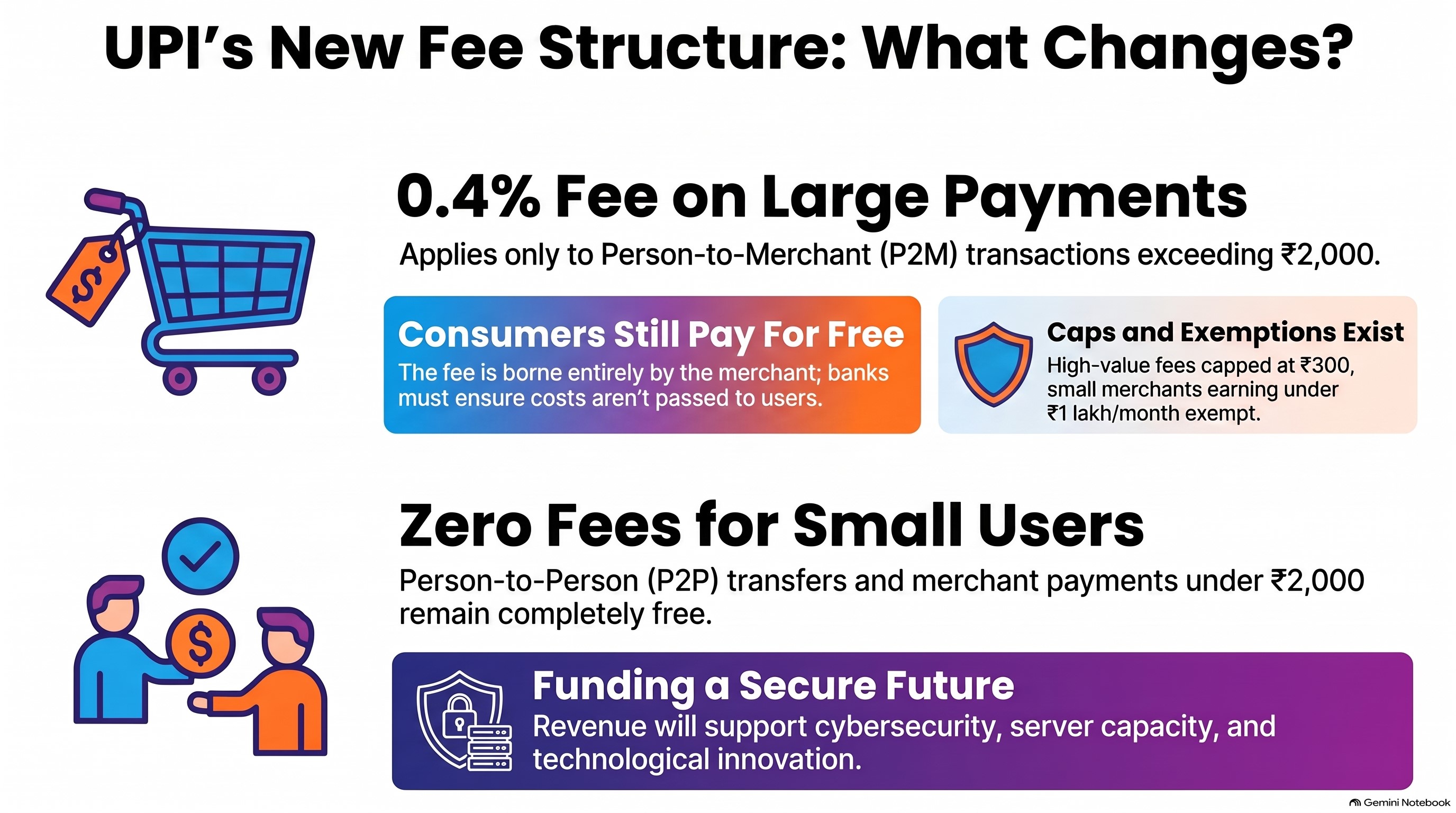
- The National Payments Corporation of India (NPCI) has introduced a Merchant Discount Rate (MDR) on certain UPI merchant transactions, effective from 15 October 2026.
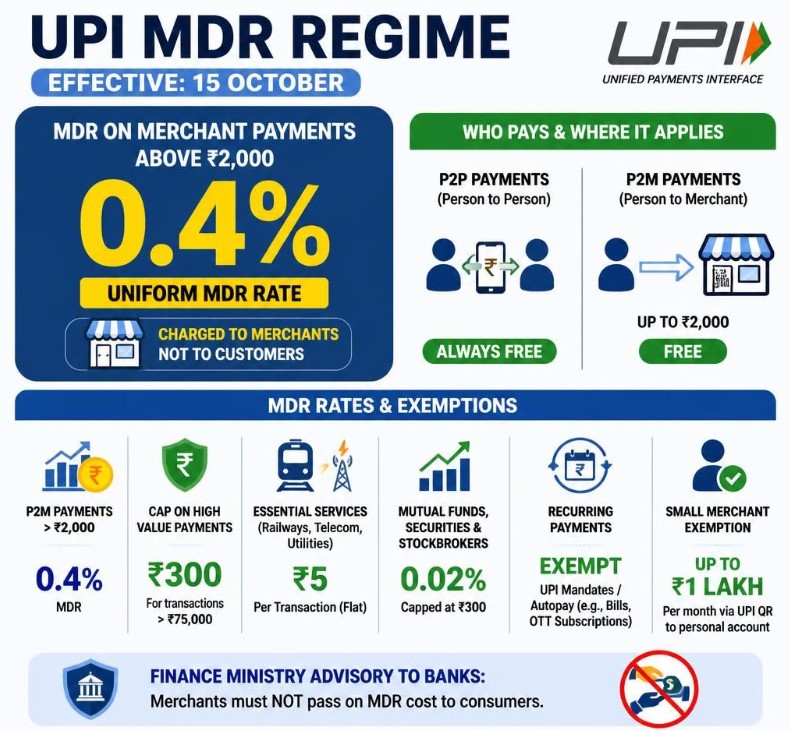
- A uniform MDR of 0.4% applies to Person-to-Merchant (P2M) UPI transactions above ₹2,000.
- The charge is borne by the merchant and not the consumer.
- The move seeks to address the financial sustainability of UPI infrastructure, including maintenance, cybersecurity and technological upgrades.
What is MDR?
- Merchant Discount Rate is a fee deducted from the merchant’s transaction value for processing a digital payment.
- It is generally distributed among entities involved in the payment ecosystem, such as:
- Issuing/payment bank.
- Acquiring bank.
- Payment network such as NPCI.
- Under the new UPI framework, MDR does not apply to Person-to-Person (P2P) transactions.
New UPI MDR Framework
|
Transaction category |
MDR |
|
P2P payments |
Zero |
|
P2M payments up to ₹2,000 |
Zero |
|
P2M payments above ₹2,000 |
0.4% |
|
Transactions of ₹75,000 and above |
0.4%, capped at ₹300 |
|
Railways, telecom and utility payments |
Flat ₹5 |
|
Mutual funds, securities and stockbrokers |
0.02%, capped at ₹300 |
|
UPI AutoPay/recurring mandates |
Exempt |
|
Small merchants receiving up to ₹1 lakh/month through QR into personal bank accounts |
Exempt |
- Merchants with UPI QR inflows exceeding ₹1 lakh per month for three consecutive months can be shifted to the regular merchant category.
- Banks have been advised to ensure that merchants do not directly pass the MDR burden to consumers.
Why Has MDR Been Reintroduced?
- UPI has operated under a zero-MDR framework for small merchant transactions, while the cost of maintaining the digital payments ecosystem has continued to rise.
- The annual cost of operating and maintaining UPI infrastructure is estimated at around ₹20,000 crore.
- The new MDR is intended to create a revenue stream for sustaining:
- Payment infrastructure.
- Cybersecurity.
- Server and network capacity.
- Technological innovation.
- Exempting P2P and small-value transactions seeks to protect digital inclusion and prevent additional costs for small merchants and ordinary users.
Significance for Digital Payments
- The framework represents a shift from prioritising rapid UPI adoption towards ensuring the long-term financial sustainability of India’s Digital Public Infrastructure (DPI).
- Protecting small-value transactions can preserve UPI’s role in everyday retail payments while monetising higher-value merchant transactions.
- A sustainable payment ecosystem requires balancing three objectives: affordability zfor users, viability for banks and fintechs, and continued investment in secure and resilient digital infrastructure.
- The effectiveness of the framework will depend on transparent implementation, prevention of consumer cost pass-through and ensuring that MDR does not discourage smaller businesses from adopting digital payments
