

US Section 301 Investigation and Global Manufacturing Overcapacity

US Section 301 Investigation and Global Manufacturing Overcapacity
Global Manufacturing Overcapacity
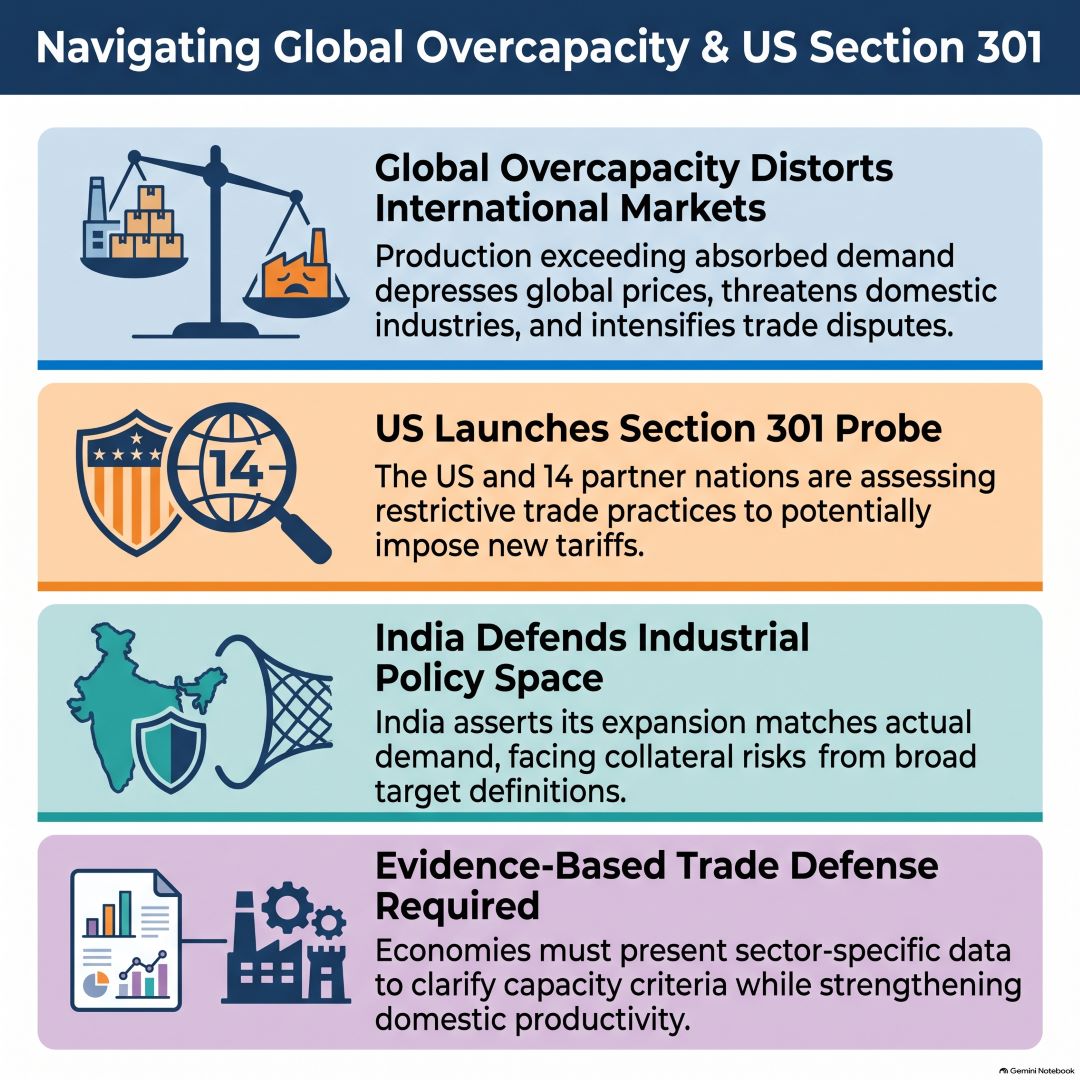
- Global manufacturing overcapacity occurs when production exceeds the demand that domestic and international markets can absorb at prevailing prices.
- Causes include excessive investment, government subsidies, weak demand and inefficient allocation of capital.
- It can depress global prices, weaken domestic industries, cause job losses and intensify trade disputes.
- Key sectors under international scrutiny include electric vehicles, automobiles, batteries, chemicals, foundational semiconductors and solar panels. China has faced allegations of excess capacity in several of these sectors.
US Section 301 Investigation
- Section 301 of the US Trade Act of 1974 empowers the United States to investigate foreign government practices considered unreasonable, discriminatory or restrictive to US commerce.
- The investigation may lead to additional tariffs or other trade restrictions, depending on its findings and subsequent US action.
- In September–October 2026, discussions among the US, India, the EU and other economies focused on concerns over structural manufacturing overcapacity.
- On October 7, the US announced a joint statement involving 14 countries and the EU. Participants agreed to continue technical discussions, exchange non-confidential information and identify data gaps before December 2026.
- The investigation covers several economies, including India, China, Japan, South Korea, Southeast Asian countries and EU members.
Why India’s Participation Matters?
- India maintains that its manufacturing capacity serves domestic and global demand and that it does not have structural excess capacity in the identified sectors.
- Cooperation could help India present evidence supporting its industrial expansion and potentially influence US decisions on tariffs. However, participation does not guarantee favourable treatment.
- Lower tariff exposure would support Indian exporters competing with Chinese and ASEAN manufacturers in the US market.
- The central challenge is to address international concerns without compromising India's industrialisation, employment generation, investment and strategic manufacturing goals.
Challenges for India
- Risk of collateral damage: Broad definitions of overcapacity could bring legitimate Indian manufacturing expansion under scrutiny.
- Industrial policy versus protectionism: Restrictions could constrain developing economies seeking to improve productivity, create jobs and reduce import dependence.
- Subsidy asymmetry: India may seek balanced scrutiny of subsidised exports and excess production across sectors, including agriculture in developed economies.
- Industrial corridors: Criticism of manufacturing hubs, including the Pune–Gujarat–Chennai corridor, highlights concerns about how industrial expansion may be assessed in trade investigations.
Way Forward
- Use sector-specific evidence on production, domestic demand, capacity utilisation, exports and investment to demonstrate the commercial rationale for manufacturing expansion.
- Engage with the US to clarify the criteria for identifying structural overcapacity and their implications for Indian exporters.
- Protect policy space for legitimate industrial development while addressing demonstrable trade distortions.
- Improve logistics, infrastructure, skills, technology adoption and productivity to strengthen export competitiveness.
- Use the G20 and other multilateral forums to promote transparent, evidence-based and balanced approaches to global trade imbalances.