

Vanashakti Judgment: A Middle Path for Environmental Governance

Vanashakti Judgment: A Middle Path for Environmental Governance
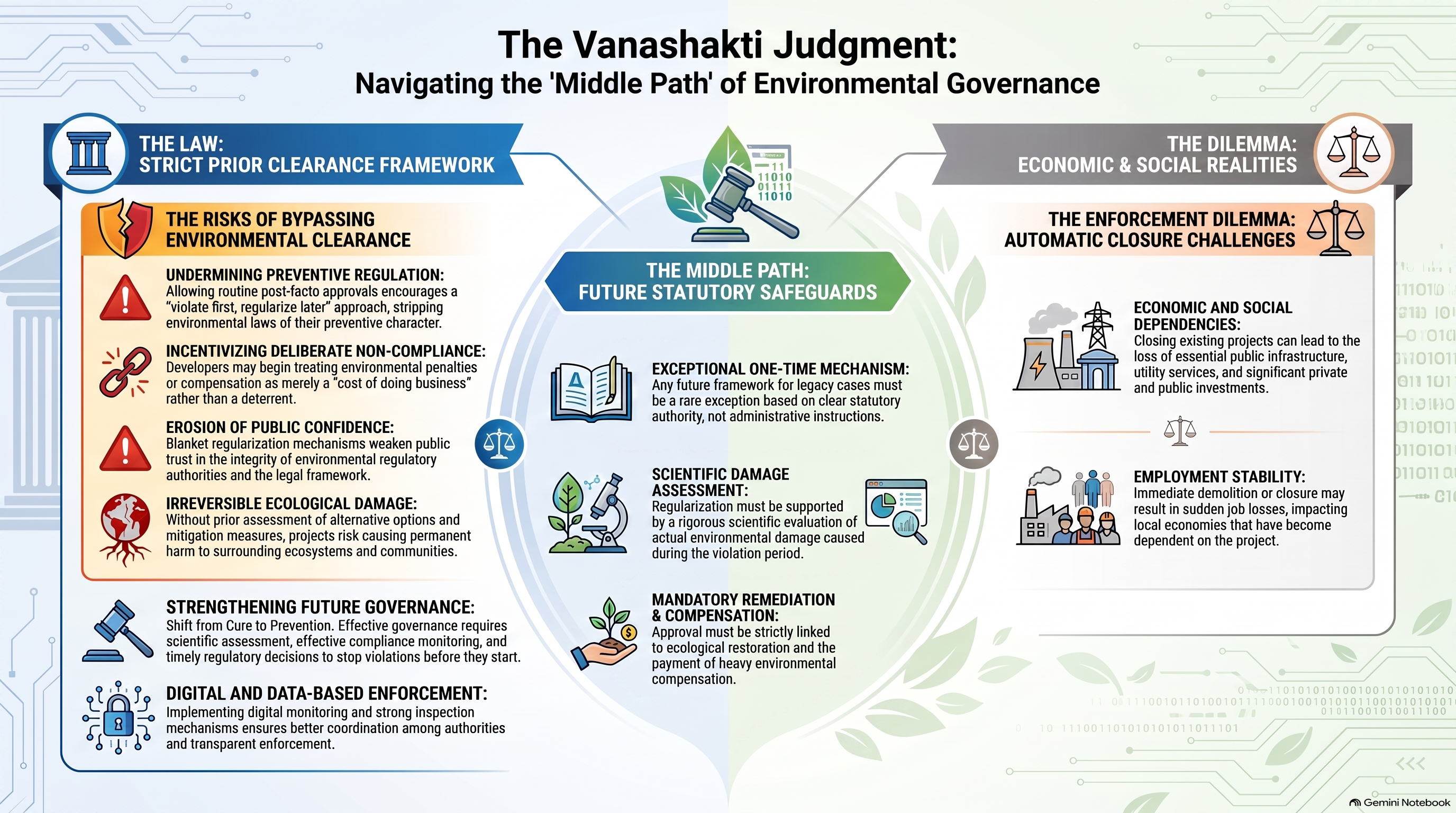
The Supreme Court’s July 29, 2026 judgment in Vanashakti vs Union of India has clarified the legal position regarding projects that began construction or operations without obtaining prior Environmental Clearance (EC).
The judgment reinforces the principle that environmental regulation must be preventive while recognising the practical difficulties associated with existing or legacy violations.
Why Prior Environmental Clearance Matters?
The Environment Impact Assessment (EIA) Notification, 2006 requires prior EC for specified projects.
The Supreme Court reaffirmed that prior EC is a substantive legal requirement and not merely a procedural formality. Environmental assessment is intended to take place before a project begins so that authorities can examine:
- Potential ecological risks
- Alternative options
- Environmental mitigation measures
- Likely impacts on surrounding ecosystems and communities
Allowing routine post-facto approval could encourage a “violate first, regularise later” approach and weaken the preventive character of environmental regulation.
No Fresh Resort to Earlier Regularisation Mechanisms
· The judgment closes the route for project proponents who failed to use the earlier mechanisms to now seek regularisation under the 2017 Notification or the 2021 Standard Operating Procedure.
· This has implications for industrial, infrastructure, commercial and real-estate projects where construction or operations commenced without the required prior EC.
· The broader message is that environmental approval must ordinarily be secured before project commencement.
Limits of Administrative Instructions
· The Court also clarified the distinction between executive instructions and statutory authority.
· An Office Memorandum cannot override the statutory requirement of prior EC or independently create a broad retrospective-clearance mechanism.
· However, the Central Government retains powers under Section 3 of the Environment (Protection) Act, 1986 to take legally authorised environmental measures.
· Therefore, a properly designed statutory framework could potentially be considered, but it cannot be created merely through administrative instructions.
Why Blanket Regularisation Is Problematic?
A broad retrospective-clearance system could weaken environmental law in several ways:
- It may incentivise deliberate non-compliance.
- It could undermine the preventive purpose of environmental clearance.
- Developers may begin treating penalties or compensation as the cost of avoiding prior approval.
- It could weaken public confidence in environmental regulation.
Therefore, retrospective regularisation cannot become a routine substitute for prior environmental assessment.
Why Automatic Closure Is Also Not Always Practical?
At the same time, automatically closing or demolishing every project that has violated EC requirements may not always produce the best environmental or public-interest outcome.
Some projects may involve:
- Significant existing investments
- Essential public infrastructure
- Public utilities
- Employment and economic dependencies
The appropriate response therefore requires distinguishing between legitimising an environmental violation and responsibly managing an already existing legacy violation.
Scope for a Future Statutory Mechanism
The Supreme Court has not directed the Central Government to establish a new regularisation framework. It has only recognised that the Government may consider appropriate intervention in the larger public interest.
If such a mechanism is created, it should ideally be:
- One-time and exceptional
- Based on clear statutory authority
- Supported by scientific assessment of environmental damage
- Linked to remediation and environmental compensation
- Subject to strict future compliance
- Governed by clearly defined eligibility criteria
- Supported by continuous monitoring
Such safeguards would ensure that a mechanism for dealing with legacy cases does not become an incentive for future violations.
Broader Lessons for Environmental Governance
The judgment highlights that effective environmental governance requires more than granting or denying clearances.
It requires:
- Scientific environmental assessment
- Effective compliance monitoring
- Ecological restoration
- Environmental compensation
- Timely regulatory decisions
- Strong inspection mechanisms
- Digital monitoring and data-based enforcement
- Better coordination among regulatory authorities
Strengthening these institutions can help prevent new violations rather than relying on retrospective solutions after damage has occurred.
Way Forward
· The earlier 2017 and 2021 mechanisms cannot be used for fresh applications. Any decision to introduce a new statutory framework rests with the Central Government.
· If such a mechanism is considered necessary, it should be narrowly targeted, transparent, time-bound and scientifically grounded.
· Projects involving serious or irreversible ecological damage should face stringent restrictions, while cases involving limited or procedural violations may be evaluated using objective environmental criteria.
· The greater priority should remain prevention through stronger compliance systems and effective environmental monitoring.
Conclusion
The Vanashakti judgment seeks to balance two competing concerns: protecting the sanctity of prior Environmental Clearance and dealing pragmatically with existing legacy violations.
It firmly rejects the idea that environmental approvals can routinely be obtained after a project has already commenced. At the same time, it leaves limited policy space for the Government to address genuine legacy cases through a legally valid statutory mechanism.
The guiding principles for any future intervention should be statutory legitimacy, scientific assessment, environmental compensation, ecological remediation and strict future compliance. Environmental violations should neither be rewarded nor simply ignored.
