

Vande Mataram: From Freedom Struggle to a Contemporary Constitutional Debate

Vande Mataram: From Freedom Struggle to a Contemporary Constitutional Debate
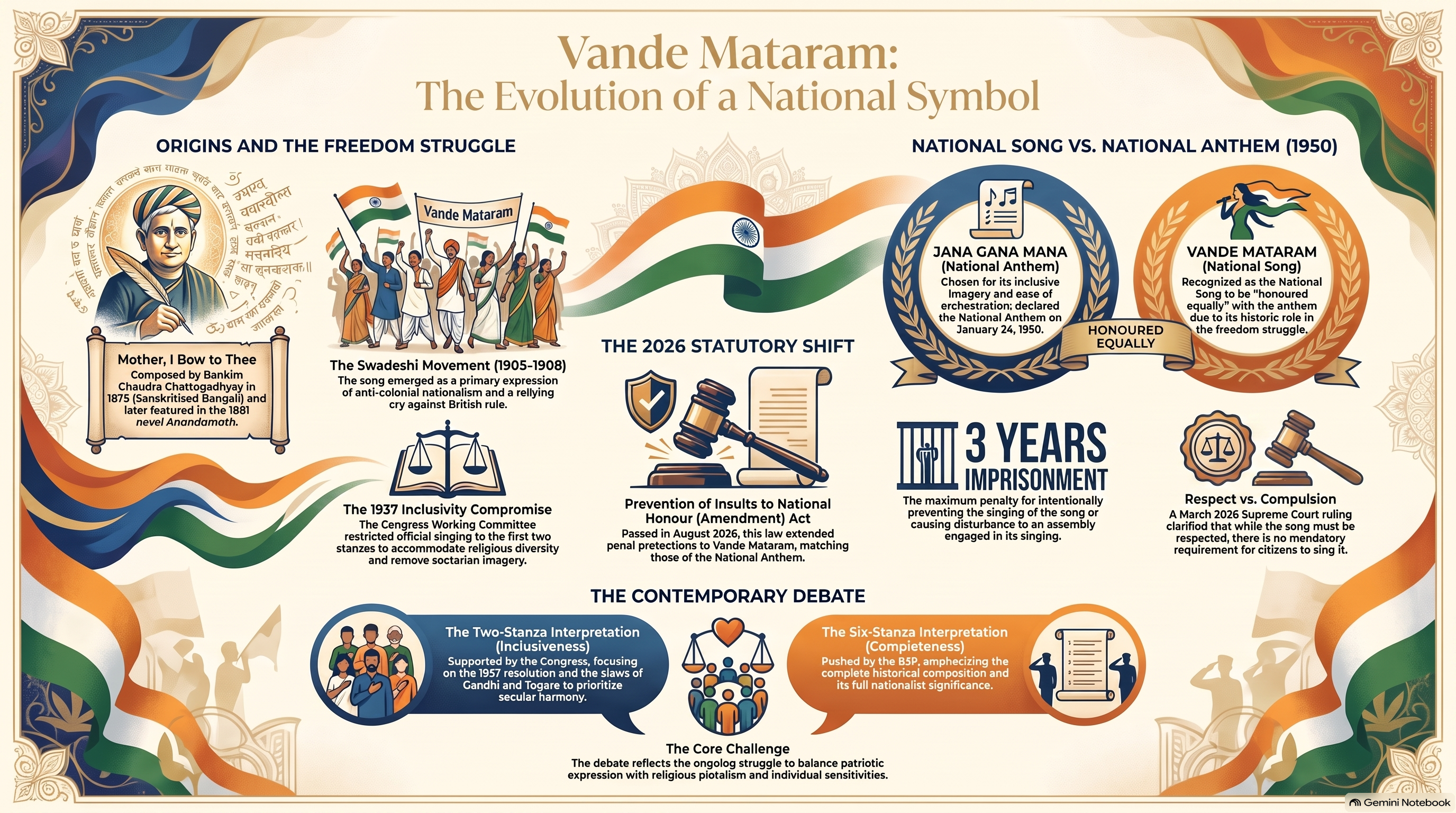
Source: the hindu
Vande Mataram has been closely associated with India’s freedom struggle and holds a unique position in independent India’s national symbolism. However, differences over its religious imagery, the number of stanzas to be sung and the manner of its official use have periodically generated political and social debate.
The recent decision of the Congress Working Committee (CWC) to restrict its programmes to the first two stanzas has revived this debate.
Origins and Role in the Freedom Movement
· Vande Mataram, meaning “Mother, I bow to thee”, was composed by Bankim Chandra Chattopadhyay in Sanskritised Bengali in 1875. It was later incorporated into his novel Anandamath in 1881.
· The novel was set against the background of the late-18th-century Sanyasi Rebellion in Bengal.
· The song became particularly prominent during the Swadeshi Movement of 1905–08 and emerged as an important expression of anti-colonial nationalism.
· However, some sections of the Muslim community objected to portions of the composition because of its religious imagery and the depiction of the motherland in divine form.
The 1937 Congress Decision
· In October 1937, the Congress Working Committee decided that only the first two stanzas should generally be sung at national gatherings.
· The rationale was that the later stanzas contained religious references and ideological elements that might not be compatible with the beliefs of all religious communities.
· This decision established an important precedent for the public use of the song in a religiously diverse India.
Vande Mataram and the National Anthem Debate
The Constituent Assembly Resolution (1950)
The formal status of both compositions was settled on January 24, 1950, by the President of the Constituent Assembly, Dr. Rajendra Prasad.
- Jana Gana Mana: Declared the National Anthem, chosen primarily for its inclusive imagery and ease of orchestral orchestration.
- Vande Mataram: Recognized as the National Song. Dr. Prasad stated it should be "honoured equally" with the National Anthem and have "equal status" because of its historic role in the freedom struggle.
The 2026 Statutory Shift
Historically, there was a legal asymmetry: while the Prevention of Insults to National Honour Act, 1971, criminalized disrespect to the Anthem, it was silent on the National Song.
- The 2026 Amendment: In August 2026, Parliament passed the Prevention of Insults to National Honour (Amendment) Act. This law formally extended penal protections to Vande Mataram.
- Current Offence: It is now a punishable offence (up to 3 years imprisonment) to intentionally prevent the singing of the National Song or cause disturbance to an assembly engaged in its singing.
Key Areas of Debate
The friction between the two often stems from three distinct perspectives:
- Historical vs. Practical: Proponents of Vande Mataram highlight its role as the rallying cry of the Swadeshi Movement (1905). Critics of Jana Gana Mana historically (and incorrectly) claimed it was written for King George V, though it was actually a hymn to the "Dispenser of India's Destiny."
- Religious Imagery: Vande Mataram, particularly in its later stanzas, uses Hindu religious metaphors (invocations of Goddess Durga/Lakshmi). To maintain secular inclusivity, the Congress Working Committee (1937) and later the state decided that only the first two stanzas (which praise the land and nature) would be sung officially.
- Compulsion vs. Choice: Courts, including the Supreme Court in March 2026, have reiterated that while the song must be respected, there is no mandatory constitutional requirement for every citizen to sing it.
The Present Political Dispute
The issue has recently resurfaced with the Congress deciding that only the first two stanzas will be sung at its programmes.
The Congress has cited the 1937 CWC resolution and the views of Gandhi and Tagore to support its position.
The BJP, on the other hand, has criticised the truncation of the song and has pushed for the singing of all six stanzas.
The debate therefore reflects two competing interpretations:
- One emphasises the complete historical composition and its nationalist significance.
- The other emphasises inclusiveness and the concerns associated with its religious imagery.
Recent Legal and Administrative Developments
· The debate has acquired additional significance following recent government measures concerning the National Song.
· The Prevention of Insults to National Honour (Amendment) Act, 2026 extends legal protection to Vande Mataram similar to that available to the National Anthem.
· The amended framework makes it an offence to intentionally prevent the singing of the National Song or deliberately disrupt an assembly engaged in singing it.
· The Ministry of Home Affairs has also issued protocols concerning the singing of Vande Mataram, including directions relating to its official rendition.
· These developments have raised questions about the relationship between executive protocols, statutory protection and the historical understanding of the National Song.
Why the Issue Matters?
The Vande Mataram debate goes beyond the question of how many stanzas should be sung. It involves broader issues of:
- National identity and symbolism
- Freedom movement history
- Religious pluralism
- Communal harmony
- Constitutional values
- The role of executive protocols in regulating national symbols
- The balance between patriotic expression and individual sensitivities
Conclusion
Vande Mataram occupies a distinctive place in India’s national history because of its contribution to the freedom struggle and its continuing symbolic importance.
The controversy over its complete rendition reflects the challenge of reconciling historical nationalism with India’s religious diversity. The earlier Congress decision to use the first two stanzas sought to preserve the song’s nationalist character while avoiding religiously sensitive imagery.
The contemporary debate therefore needs to be viewed not merely as a political confrontation but also in the context of India’s constitutional commitment to pluralism, communal harmony and respect for diverse beliefs.
