

Venezuela Earthquake: Rare Seismic Doublet
Core Thesis
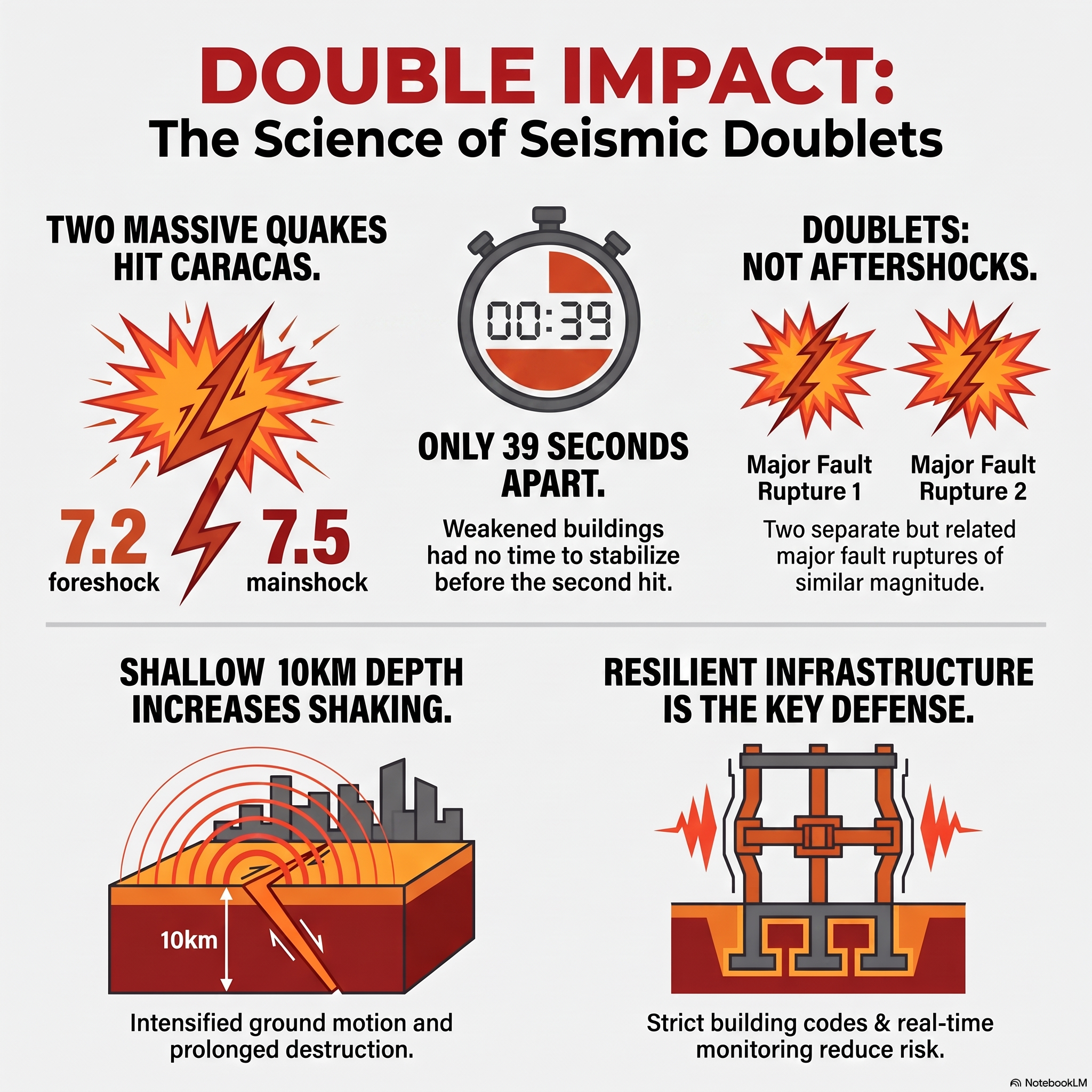
A rare seismic doublet struck Venezuela near Caracas, causing widespread devastation. The event highlights the destructive potential of closely spaced large earthquakes in tectonically active regions and underscores the importance of earthquake-resilient infrastructure and disaster preparedness.
Background
- Two powerful earthquakes struck western Venezuela near Caracas:
- Magnitude 7.2 (Foreshock)
- Magnitude 7.5 (Mainshock)
- The two earthquakes occurred 39 seconds apart, leading the US Geological Survey (USGS) to classify them as a seismic doublet.
- The second earthquake is the largest to strike Venezuela or its offshore region since 1900.
- Tremors were felt across Colombia and parts of Brazil.
What is a Seismic Doublet?
- A seismic doublet refers to two earthquakes of similar magnitude occurring within a short time interval and close geographic proximity due to separate but closely related fault ruptures.
- Unlike a typical earthquake sequence:
- A foreshock precedes the main earthquake.
- Aftershocks are generally much smaller than the mainshock.
- Doublets involve two major earthquakes, making them significantly more destructive.
Why Did the Earthquake Occur?
- Venezuela lies along the boundary between the:
- Caribbean Plate, and
- South American Plate.
- The earthquakes resulted from shallow strike-slip faulting, where tectonic plates slide horizontally past one another.
- The mainshock occurred at a shallow depth of about 10 km, increasing ground shaking intensity.
Why Was It So Destructive?
- Two major earthquakes occurred within 39 seconds, leaving no time for structures weakened by the first shock to stabilise.
- The shallow focus intensified surface shaking.
- Doublets prolong the duration of strong ground motion, increasing:
- Structural collapse.
- Casualties.
- Difficulty in rescue and relief operations

Key Geological Concepts
Fault
- A fracture or zone of fractures in the Earth's crust along which rocks move, generating earthquakes.
Strike-Slip Fault
- Two tectonic blocks slide horizontally past each other.
- Common along transform plate boundaries.
Foreshock
- A smaller earthquake occurring before the largest earthquake (mainshock).
Mainshock
- The largest earthquake in a seismic sequence.
Aftershock
- Smaller earthquakes occurring after the mainshock due to crustal adjustment.
Previous Examples of Seismic Doublets
- Türkiye–Syria (2023): Magnitude 7.8 and 7.7 earthquakes.
- Indian Ocean (2021): Magnitude 8.6 and 8.2 earthquakes near Malaysia.
- Australia (1988): A rare earthquake triplet (three major earthquakes within about 30 minutes).
Significance
- Demonstrates the complexity of earthquake rupture processes.
- Highlights the vulnerability of shallow, strike-slip earthquakes.
- Reinforces the need for:
- Earthquake-resistant infrastructure.
- Real-time seismic monitoring.
- Effective disaster preparedness and emergency response systems.

Way Forward
- Strengthen seismic hazard mapping and monitoring.
- Enforce earthquake-resistant building codes, especially in high-risk regions.
- Improve early warning, emergency communication and evacuation planning.
- Enhance international cooperation in seismic research and disaster management.
Conclusion
The Venezuela earthquake illustrates how a rare seismic doublet can cause catastrophic destruction due to prolonged and intense ground shaking. As urbanisation increases in seismically active regions, resilient infrastructure and disaster preparedness remain the most effective tools for reducing earthquake risk.
Final Takeaway
While earthquakes cannot be prevented, their impact can be significantly reduced through scientific monitoring, resilient infrastructure, strict building standards and effective disaster preparedness.
