

Venezuelan Oil Imports: India’s Energy Security and Strategic Autonomy

Venezuelan Oil Imports: India’s Energy Security and Strategic Autonomy
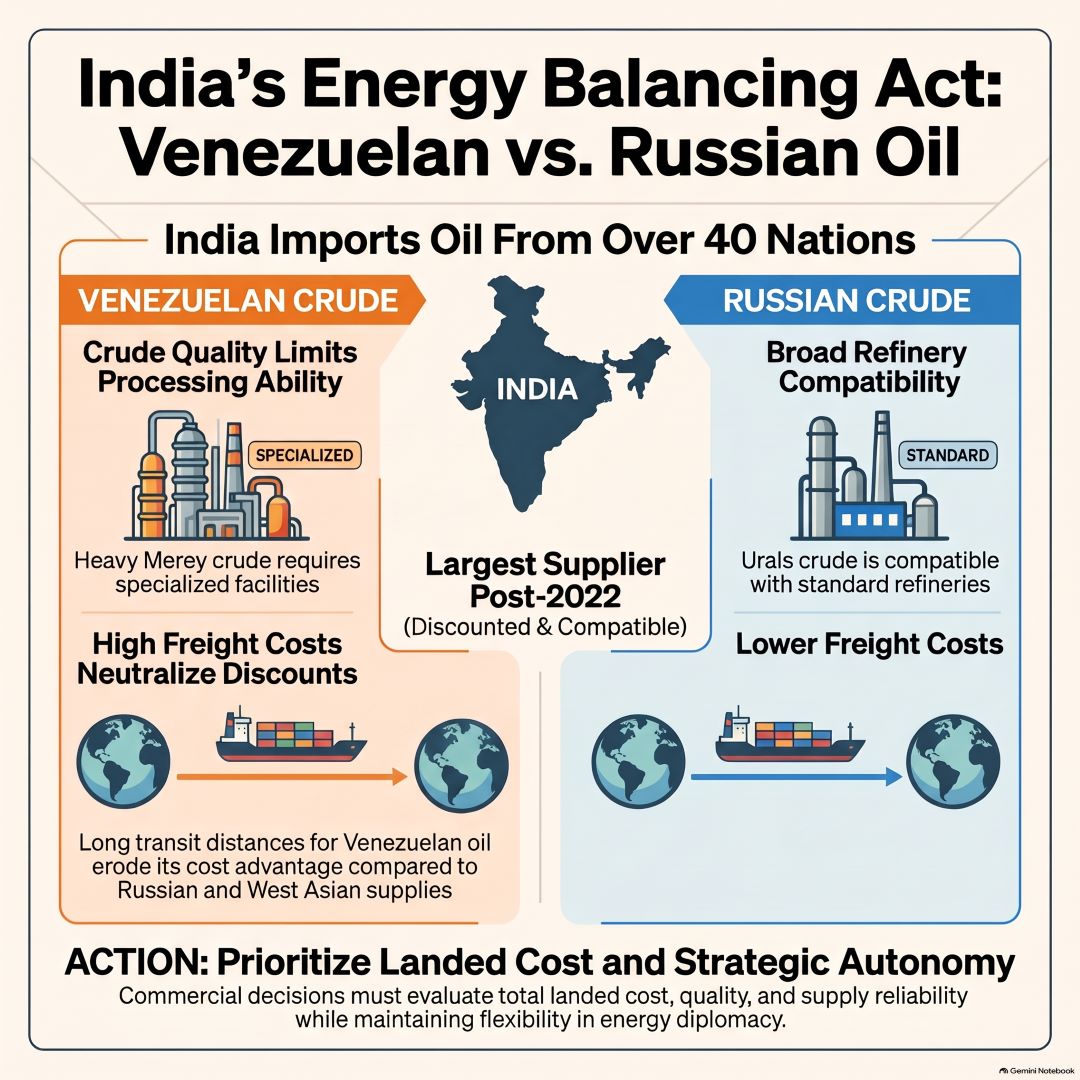
Source: The Indian Express, 23 October 2026
Why in News?
- US Secretary of State Marco Rubio’s reported visit to Reliance Industries’ Jamnagar refinery has highlighted US efforts to encourage India to increase imports of Venezuelan crude oil.
- The issue reflects the challenges of balancing energy security, commercial interests and geopolitical relations with the US and Russia.
India’s Crude Oil Import Dependence
- India is one of the world’s largest crude oil importers, making it vulnerable to global price fluctuations and geopolitical disruptions.
- India sources crude oil from more than 40 countries to diversify its energy supplies.
- Russia became India’s largest crude oil supplier following the Russia–Ukraine war in 2022, partly because discounted Russian oil became available.
- Disruptions in West Asia have further highlighted the importance of diversifying suppliers and securing critical shipping routes.
Venezuela’s Oil and Refining Challenges
- Venezuela possesses vast oil reserves, but its production remains constrained.
- Its major export grade, Merey, is heavy and has high sulphur content, requiring specialised refining facilities.
- Reliance Industries’ Jamnagar refinery complex is equipped to process such crude, but only a limited number of Indian refineries can handle large volumes.
- Although Venezuelan crude may be offered at a discount to Brent, high transportation costs can reduce or eliminate its price advantage.
- Supplies from West Asia may be more competitive because of shorter shipping distances and lower freight costs.
Venezuelan Oil vs Russian Oil
|
Parameter |
Venezuelan crude |
Russian crude |
|
Major grade |
Merey |
Urals |
|
Oil characteristics |
Very heavy, high sulphur |
Comparatively easier to process in a wider range of Indian refineries |
|
Refinery compatibility |
Requires specialised facilities |
Compatible with a broader range of refineries |
|
Key constraint |
High freight costs and limited refinery compatibility |
Geopolitical restrictions and sanctions-related risks |
|
Strategic role |
Supplier diversification |
Major source of India's crude oil imports |
Geopolitical Significance
- The US seeks to expand Venezuelan oil exports to markets such as India while encouraging a reduction in India's dependence on Russian oil.
- India must balance its relations with the US and Russia while protecting its domestic energy requirements.
- Energy trade is increasingly linked to sanctions, trade negotiations and broader geopolitical relationships.
Way Forward
- Assess crude purchases on the basis of total landed cost, quality, refinery compatibility and supply reliability.
- Diversify suppliers without creating excessive dependence on any single country.
- Strengthen strategic petroleum reserves to manage supply disruptions.
- Expand renewable energy, biofuels and domestic energy production to reduce long-term import dependence.
- Maintain flexibility in energy diplomacy and ensure that commercial decisions reflect India's national interests.
Conclusion
Venezuelan crude can contribute to India's energy diversification, but it cannot automatically replace Russian oil because of differences in quality, refinery compatibility and transportation costs. India must pursue a commercially viable and diversified energy strategy that safeguards energy security while maintaining strategic autonomy in international relations.