

Wangchuk, Preventive Detention and the Reach of State Power
Morning Standard
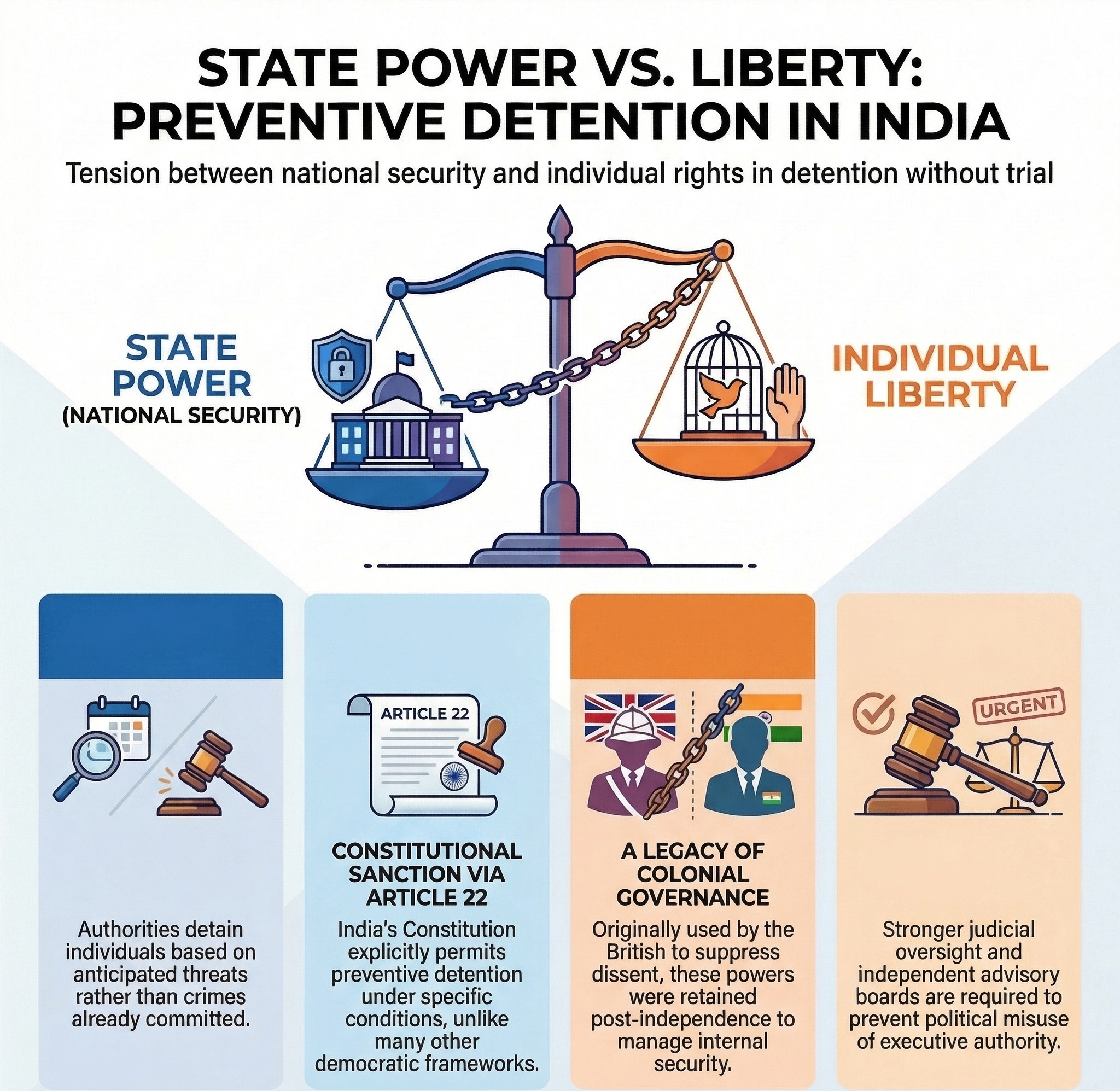
Key Arguments of the Article
Preventive Detention as an Instrument of State Power
The article argues that preventive detention laws give extraordinary authority to the state to detain individuals without trial on grounds such as national security, public order, or maintenance of essential services.
Such powers allow authorities to act before a crime is committed, which fundamentally distinguishes preventive detention from punitive detention.
Constitutional Legitimacy and Judicial Validation
Preventive detention is constitutionally permitted in India under Article 22, which allows detention without trial under certain conditions. Over time, the Supreme Court has interpreted and upheld preventive detention laws in multiple cases.
The article highlights how judicial rulings have shaped the operational framework of preventive detention statutes.
Case of Sonam Wangchuk
The detention of Wangchuk illustrates how preventive detention laws can be invoked in situations involving political activism or protest movements. The article suggests that such cases raise questions about the proportionality and necessity of state action.
This case therefore becomes a symbol of the broader debate on the limits of executive authority.
Historical Evolution of Preventive Detention
The article traces the origins of preventive detention to colonial laws used by the British administration to suppress dissent. After independence, India retained preventive detention provisions, arguing that security concerns required extraordinary powers.
Over the decades, several laws such as the Maintenance of Internal Security Act and National Security Act have institutionalised these powers.
Weak Institutional Safeguards
Although procedural safeguards exist—such as review by advisory boards—the article argues that these mechanisms are often insufficient to prevent misuse.
Preventive detention may therefore be used as a political tool rather than strictly for national security.
Author’s Stance
The author takes a critical view of preventive detention laws and argues that they often expand state power at the cost of individual liberty. While acknowledging the need for security mechanisms, the article warns that unchecked executive authority risks undermining democratic principles.
The tone emphasises constitutional accountability and the need to preserve civil liberties.
Possible Biases
Civil Liberties Perspective
The article strongly emphasises individual freedoms and may understate legitimate security concerns faced by the state.
Critical View of State Authority
The narrative leans toward scepticism regarding executive power and preventive detention practices.
Limited Security Perspective
The article gives relatively less attention to the operational challenges faced by law enforcement agencies in maintaining public order.
Advantages of Preventive Detention
National Security Protection
Preventive detention allows authorities to act quickly in situations where immediate threats to national security or public order are anticipated.
Pre-emptive Action
It enables the state to prevent violence, terrorism, or large-scale disorder before such acts occur.
Administrative Efficiency
In emergency situations, preventive detention can provide swift response mechanisms where traditional legal processes may be too slow.
Risks and Concerns
Violation of Civil Liberties
Detention without trial challenges fundamental rights such as personal liberty and due process.
Potential Political Misuse
Preventive detention laws may be used against political opponents, activists, or dissenting voices.
Weak Judicial Oversight
Limited transparency and delayed judicial review can reduce accountability.
Legacy of Colonial Governance
The continued use of preventive detention reflects a colonial legal framework that prioritised state authority over individual rights.
Policy Implications
Strengthening Legal Safeguards
Clearer standards and stronger judicial oversight are necessary to prevent misuse of preventive detention laws.
Balancing Security and Liberty
Policymakers must ensure that preventive detention powers are exercised only in exceptional circumstances.
Institutional Accountability
Independent review mechanisms can strengthen transparency and public trust.
Periodic Legal Review
Preventive detention laws should undergo regular legislative and judicial scrutiny to ensure compliance with constitutional principles.
Real-World Impact
If preventive detention powers are used responsibly:
• Effective management of national security threats
• Prevention of violence and large-scale disturbances
• Strengthened state capacity in crisis situations
If misused:
• Erosion of civil liberties
• Weakening of democratic institutions
• Loss of public trust in governance
Alignment with UPSC GS Papers
GS Paper II
Constitutional provisions, preventive detention, fundamental rights, balance between security and liberty.
GS Paper IV
Ethics in governance, accountability of public institutions, protection of civil liberties.
GS Paper III
Internal security and legal frameworks for maintaining public order.
Balanced Assessment
Preventive detention laws represent one of the most controversial features of India’s constitutional framework. While they provide the state with necessary tools to address security threats, their extraordinary nature demands strict oversight and accountability.
The challenge lies in maintaining a delicate balance between safeguarding national security and protecting individual freedoms.
Future Perspective
As democratic societies evolve, debates on preventive detention will likely intensify, particularly in contexts involving political dissent and civil liberties. Strengthening institutional safeguards, ensuring judicial vigilance, and fostering transparent governance will be essential to maintaining the legitimacy of such laws.
For civil services aspirants and policymakers, the issue illustrates the complex interplay between state authority, constitutional rights, and democratic accountability.
