

Water and Gender Equality
The Statesman
1. Key Arguments
A. Gendered Burden of Water Scarcity
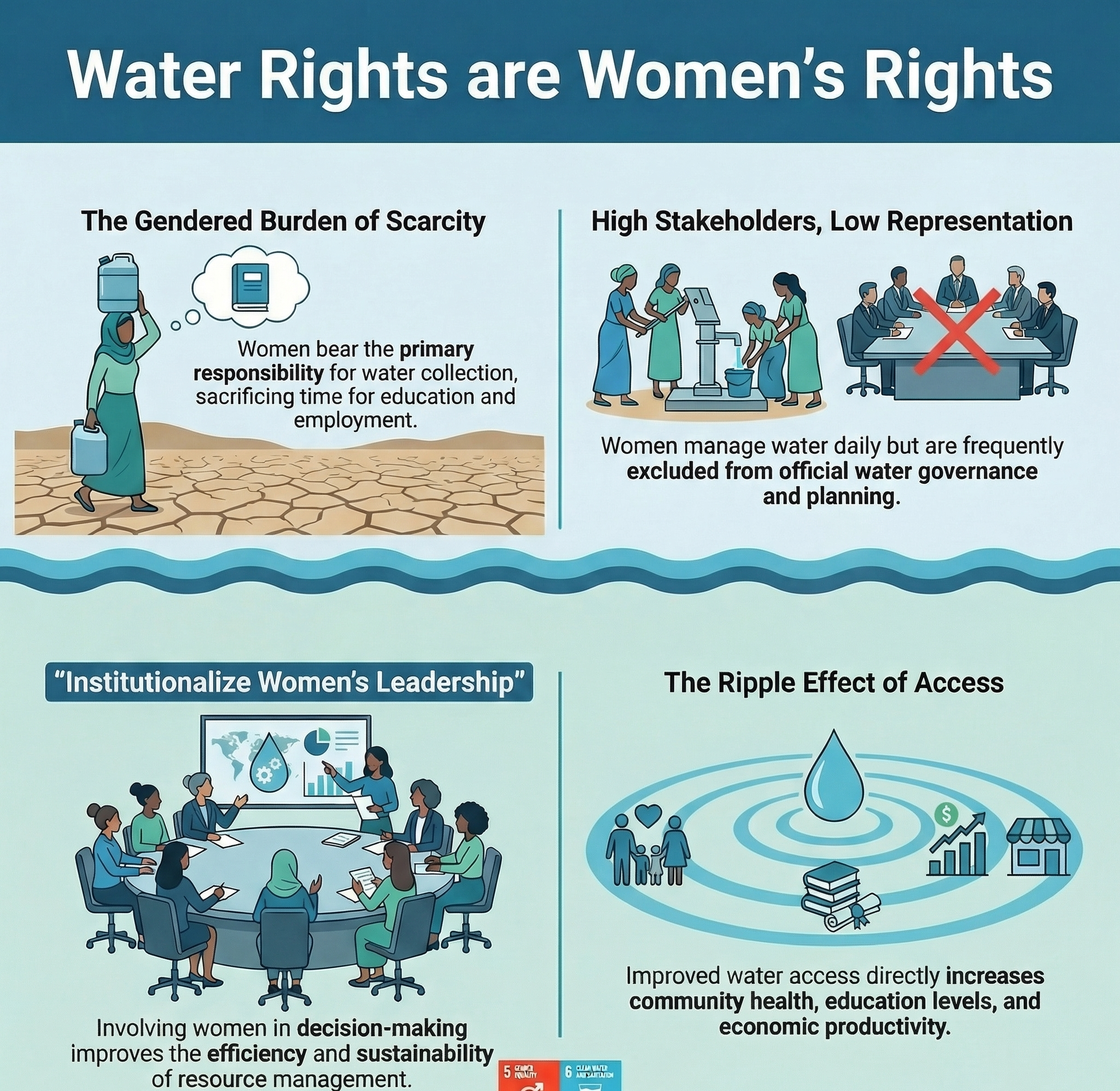
Women bear the primary responsibility for water collection and management.
In rural and marginalised settings, this limits their time for education, employment, and participation in public life.
B. Link Between Water Access and Social Outcomes
Improved water access enhances health, education, and livelihoods.
Reduced drudgery leads to better well-being and economic participation of women.
C. Underrepresentation in Decision-Making
Women are often excluded from water governance institutions.
Despite being primary stakeholders, their voices are limited in policy and planning.
D. Role of Policy Frameworks
Global and national initiatives recognise gender-water linkage.
SDG 6 (Clean Water) and SDG 5 (Gender Equality) emphasise inclusive water management.
E. Empowerment as a Solution
Involving women leads to better resource management outcomes.
Evidence suggests that women-led initiatives improve efficiency and sustainability.
2. Author’s Stance
Strongly pro-equity and development-oriented
Advocacy for women’s empowerment
The author emphasises inclusion as both a rights-based and efficiency-driven approach.
Policy-aligned perspective
Supports integration of gender considerations into water governance.
3. Biases and Limitations
Optimistic view of participation outcomes
Assumes inclusion will automatically improve governance outcomes.
Limited attention to structural barriers
Patriarchy, caste, and economic inequalities are not deeply analysed.
Urban-rural variation underexplored
Focus is more on rural contexts, less on urban water governance challenges.
4. Strengths (Pros)
Strong linkage between gender and development
Connects water access with broader socio-economic outcomes.
Alignment with global development goals
Integrates SDGs and international frameworks.
Policy relevance
Highlights actionable areas for governance reform.
5. Weaknesses (Cons)
Limited empirical evidence
Lacks detailed data or case studies.
Insufficient institutional analysis
Does not deeply explore governance structures and constraints.
Generalised approach
May overlook regional and cultural diversity.
6. Policy Implications
A. Gender-Inclusive Water Governance
Ensuring representation of women in water committees
Institutionalising participation at all levels.
B. Infrastructure Development
Improving access to safe and nearby water sources
Reducing time and labour burden.
C. Capacity Building
Training women in water management and leadership
Enhancing decision-making capabilities.
D. Integration with Social Policies
Linking water access with health, education, and livelihood programs
Holistic development approach.
E. Addressing Structural Inequalities
Targeting marginalised groups
Intersectional approach to gender and water issues.
7. Real-World Impact
Social Impact
Improved gender equality and empowerment
Greater participation in public and economic life.
Health Outcomes
Better sanitation and reduced disease burden
Access to clean water improves community health.
Economic Impact
Increased productivity and income opportunities
Reduced time spent on water collection.
Environmental Sustainability
Better resource management
Community-based conservation improves outcomes.
8. UPSC GS Paper Linkages
GS Paper I (Society)
- Gender roles and inequalities
- Social empowerment
GS Paper II (Governance)
- Inclusive policies
- Role of institutions in service delivery
GS Paper III (Environment)
- Water resource management
- Sustainable development
GS Paper IV (Ethics)
- Gender justice
- Equity and fairness
9. Balanced Conclusion
Water governance is both a technical and social issue, requiring gender-sensitive approaches.
While inclusion of women is essential, it must be supported by structural reforms and institutional capacity.
10. Future Perspective
Towards integrated gender-water policies
Mainstreaming gender in all water-related programs.
Strengthening local governance
Empowering communities for sustainable management.
Addressing intersectionality
Recognising diversity within women’s experiences.
Building resilient systems
Linking water security with climate adaptation.
Final Insight
Achieving water security without gender equality is incomplete—true sustainability lies in empowering those who manage water at the grassroots.
