

What insurance numbers do not reveal
The Hindu
1. Key Arguments
A. Limitations of Insurance Metrics
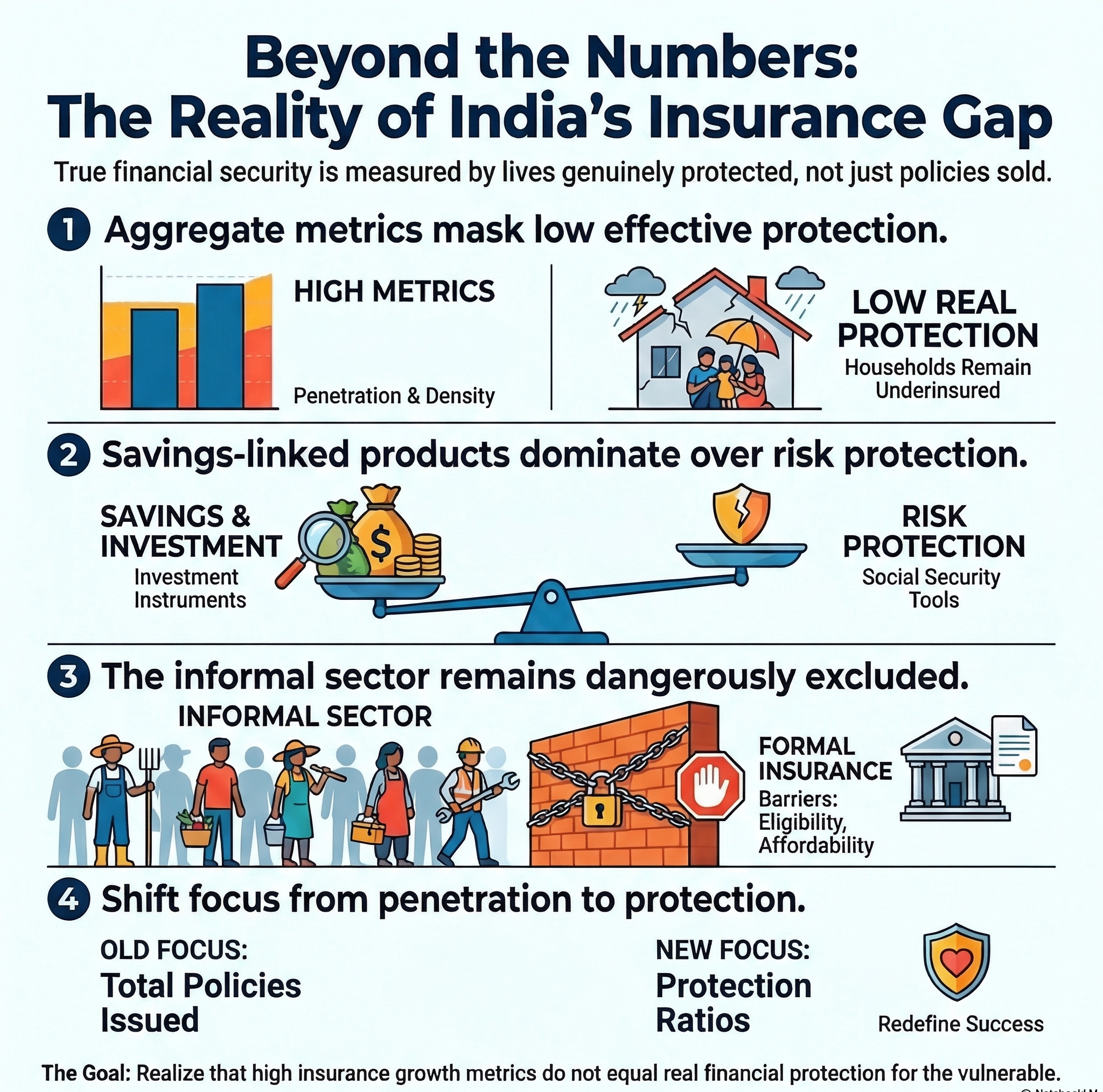
Penetration and density do not reflect real coverage.
High aggregate numbers can mask low effective protection at the household level.
B. Unequal Distribution of Coverage
Insurance access is skewed towards formal and higher-income groups.
Low-income households remain underinsured or uninsured.
C. Nature of Insurance Products
Savings-linked policies dominate over risk protection.
Many insurance products function more as investment instruments than as social security tools.
D. Informal Sector Vulnerability
Large workforce lacks access to formal insurance mechanisms.
Informal employment reduces eligibility and affordability.
E. Misinterpretation in Policy Discourse
Over-reliance on aggregate indicators leads to complacency.
Policymakers may assume adequate coverage when gaps persist.
2. Author’s Stance
Critical and reform-oriented
Questioning headline metrics
The author challenges conventional indicators used in economic analysis.
Advocacy for inclusive financial protection
Focus on vulnerable populations and real risk coverage.
3. Biases and Limitations
Underemphasis on recent policy efforts
Schemes like PMJJBY, PMSBY, and Ayushman Bharat are not deeply analysed.
Limited industry perspective
Challenges faced by insurers (pricing, risk, awareness) are underexplored.
Focus on critique over solutions
Less emphasis on actionable reforms.
4. Strengths (Pros)
Highlights hidden vulnerabilities
Brings attention to gaps in financial protection.
Challenges conventional economic indicators
Encourages deeper analysis beyond surface-level metrics.
Relevant to inclusive development discourse
Aligns with concerns of financial inclusion and social security.
5. Weaknesses (Cons)
Insufficient empirical detailing
Lacks granular data on coverage gaps.
Limited policy roadmap
Does not fully outline how to bridge the gap.
Overgeneralisation risk
May understate progress in insurance expansion.
6. Policy Implications
A. Redefining Insurance Metrics
Focus on effective coverage and adequacy
Move beyond penetration to protection ratios.
B. Expanding Social Insurance
Target informal sector and vulnerable groups
Subsidised and universal schemes.
C. Product Reorientation
Shift towards pure risk coverage products
Reduce dominance of savings-linked policies.
D. Financial Literacy
Improving awareness of insurance benefits
Encourage informed decision-making.
E. Regulatory Strengthening
Ensuring transparency and consumer protection
Prevent mis-selling and improve trust.
7. Real-World Impact
Household Vulnerability
Exposure to financial shocks
Health emergencies, accidents, and disasters push families into poverty.
Economic Stability
Low insurance coverage increases systemic risk
Impacts consumption and savings patterns.
Social Equity
Widening inequality in risk protection
Better-off groups are more secure than vulnerable populations.
Financial Sector Development
Underutilisation of insurance as a risk mitigation tool
Limits its role in economic resilience.
8. UPSC GS Paper Linkages
GS Paper III (Economy)
- Financial inclusion
- Insurance sector
- Social security
GS Paper II (Governance)
- Welfare schemes
- Inclusive development
GS Paper I (Society)
- Vulnerability and poverty
GS Paper IV (Ethics)
- Equity and fairness in access to financial services
9. Balanced Conclusion
Insurance growth in India is quantitatively visible but qualitatively uneven.
While penetration has improved, real protection remains inadequate, especially for vulnerable groups.
10. Future Perspective
Shift towards universal risk protection
Insurance as a core pillar of social security.
Data-driven policy reform
Better indicators to measure actual coverage.
Inclusive financial ecosystem
Bridging gaps between formal and informal sectors.
Strengthening trust and awareness
Key to expanding effective insurance coverage.
Final Insight
True financial security lies not in how many policies exist, but in how many lives are genuinely protected.
