

What is at stake at the WTO’s MC14?
The Hindu
1. Key Arguments
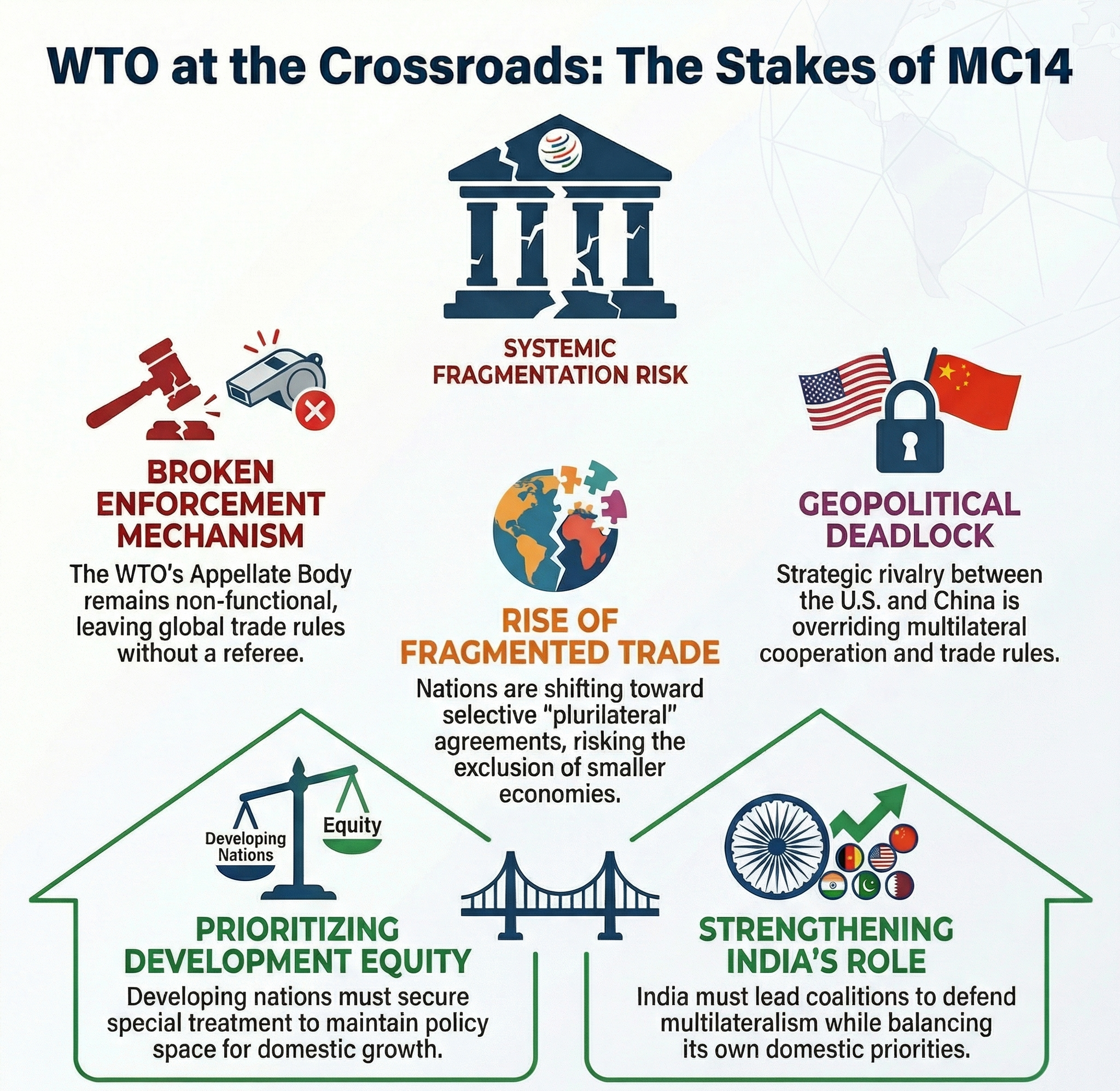
A. Crisis of Multilateralism
WTO’s consensus-based system is under strain.
Trade negotiations have stalled, and unilateral measures are increasing.
B. Breakdown of Dispute Settlement Mechanism
Appellate Body remains non-functional.
This undermines enforcement of trade rules and weakens global trade governance.
C. Rise of Plurilateral Agreements
Countries are shifting towards selective agreements.
This risks fragmenting the global trade system and marginalising smaller economies.
D. U.S.–China Rivalry
Geopolitical tensions are shaping trade rules.
Strategic competition is influencing WTO dynamics and decision-making.
E. Development Concerns
Developing countries seek special and differential treatment (S&DT).
Issues like digital trade, agriculture, and policy space remain contentious.
F. India’s Role
India must defend multilateralism and development interests.
Balancing domestic priorities with global trade commitments is crucial.
2. Author’s Stance
Pro-multilateral and development-oriented
Critical of unilateralism and protectionism
The author favours strengthening WTO mechanisms.
Supportive of developing country concerns
Advocates policy space and equity in trade rules.
3. Biases and Limitations
Developing-country bias
Focus on equity may underplay efficiency and competitiveness concerns.
Limited perspective on advanced economies
Concerns of developed nations are not fully explored.
Normative emphasis
Relies on principles rather than detailed economic modelling.
4. Strengths (Pros)
Comprehensive coverage of WTO challenges
Addresses institutional, geopolitical, and economic dimensions.
Relevance to current global trade scenario
Captures ongoing shifts in trade governance.
Focus on India’s strategic role
Important for policy discourse.
5. Weaknesses (Cons)
Limited policy detailing
Does not provide concrete negotiation strategies.
Underexplored sectoral impacts
Agriculture, services, and digital trade need deeper analysis.
Overemphasis on institutional crisis
May understate resilience of global trade systems.
6. Policy Implications
A. Reviving Dispute Settlement Mechanism
Restoring Appellate Body functionality
Ensuring rule-based trade governance.
B. Balancing Multilateral and Plurilateral Approaches
Preventing fragmentation of trade rules
Inclusive negotiation frameworks.
C. Protecting Development Interests
Safeguarding policy space for developing countries
Special and differential treatment provisions.
D. Strengthening India’s Trade Strategy
Proactive engagement in negotiations
Coalition-building with developing nations.
E. Addressing Emerging Trade Issues
Digital trade, e-commerce, and sustainability
Adapting WTO agenda to new challenges.
7. Real-World Impact
Global Trade Stability
Weak WTO undermines predictability
Increases trade disputes and uncertainty.
Economic Growth
Trade fragmentation affects global supply chains
Impacts developing economies.
India’s Economy
Export competitiveness and policy flexibility
Balancing domestic and global interests.
Geopolitical Dynamics
Trade becomes a tool of strategic competition
Shifts global power balance.
8. UPSC GS Paper Linkages
GS Paper II (International Relations)
- WTO and global governance
- India’s foreign trade policy
GS Paper III (Economy)
- Global trade
- Protectionism vs liberalisation
GS Paper I (Geography)
- Trade routes and economic geography
9. Balanced Conclusion
MC14 represents a critical juncture for the WTO and global trade governance.
While challenges are significant, reform and cooperation can restore the relevance of multilateralism.
10. Future Perspective
Towards reformed multilateralism
Adapting WTO to contemporary realities.
Balancing equity and efficiency
Ensuring fair and effective trade rules.
Strengthening global cooperation
Reducing geopolitical tensions in trade.
Enhancing India’s leadership role
Strategic engagement in global forums.

Final Insight
The future of global trade will depend not just on rules, but on the willingness of nations to uphold and reform them collectively.
