

What Will US Tariff be Now?
Indian Express
I. Core Context
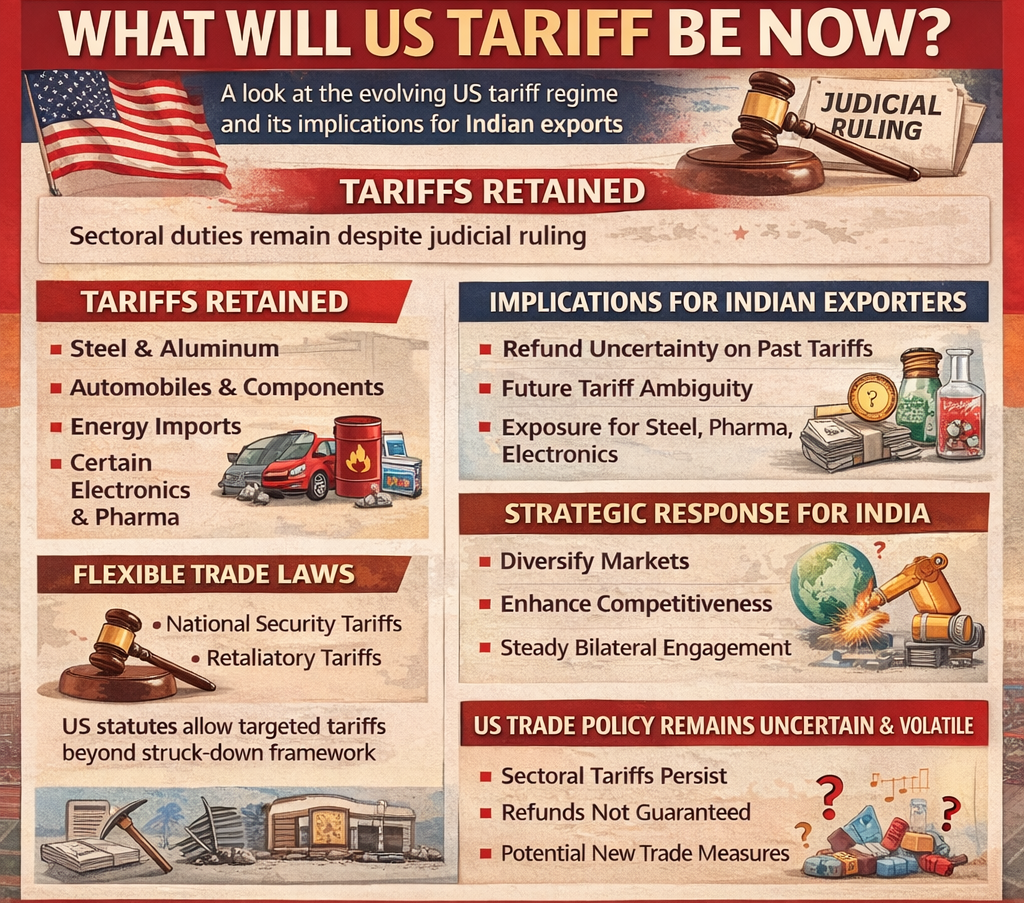
The article examines the evolving US tariff regime following a judicial intervention that invalidated portions of a broader reciprocal tariff framework. It analyses the immediate and prospective implications for Indian exports amid shifting US trade policy under protectionist pressures.
The focus is on:
- The rollback of certain across-the-board tariff hikes
- Retention of sector-specific tariffs
- Uncertainty for Indian exporters
- Potential future US trade actions under existing laws
II. Key Arguments Presented
1. Judicial Intervention Has Limited Scope
The piece clarifies that while a broad reciprocal tariff measure was struck down, several sector-specific tariffs remain intact.
This implies:
- No blanket relief for exporters
- Continued uncertainty in US trade policy
The rollback is partial, not structural.
2. Strategic Sectors Remain Under Tariff Pressure
Tariffs continue to apply on sectors such as:
- Steel and aluminium
- Automobiles and auto components
- Energy-related imports
- Certain electronics and pharmaceuticals
This suggests that US trade policy remains protectionist in strategic industries.
3. Legal Tools Available to the US Executive
The article highlights alternative provisions under US trade law, particularly those allowing retaliatory or national security-based tariffs.
Implication:
Even if one route is blocked judicially, other statutory pathways remain available.
4. Impact on Indian Exporters
Indian exporters face:
- Refund uncertainties on previously imposed tariffs
- Ambiguity regarding future rates
- Continued exposure in steel, engineering, pharma, and electronics
The uncertainty is as damaging as high tariffs.
III. Author’s Stance
The tone is analytical but cautious.
The author appears to suggest:
- The judicial ruling does not fundamentally reverse US protectionism
- Trade uncertainty persists
- India must prepare for continued volatility
There is no overt ideological bias, but the framing emphasises unpredictability in US policy.
IV. Possible Biases and Limitations
1. Overemphasis on Judicial Relief
The article may create an impression of meaningful relief, though in practice:
- Sectoral tariffs remain
- Executive flexibility continues
The structural nature of US trade protectionism is not fully unpacked.
2. Limited Discussion on India’s Policy Response
The article focuses on US actions but gives less attention to:
- India’s tariff structure
- Ongoing FTA negotiations
- Domestic industrial policy adjustments
3. Short-Term Lens
The analysis is event-driven and may understate longer-term shifts in global trade architecture toward strategic decoupling and friend-shoring.
V. Pros and Cons of the Developments
Pros
• Partial rollback reduces immediate pressure
• Opens space for diplomatic engagement
• Reinforces judicial oversight in trade governance
Cons
• Sector-specific tariffs persist
• High policy unpredictability
• Potential escalation under alternative US legal tools
• Compliance and cost burdens remain for exporters
VI. Policy Implications for India
1. Trade Diversification
India must accelerate:
- Market diversification beyond the US
- Engagement with EU, ASEAN, Africa, and Latin America
2. Strengthening Bilateral Negotiations
Tariff uncertainty strengthens the case for:
- Structured trade negotiations
- Sectoral mutual recognition agreements
- Supply chain partnerships
3. Domestic Competitiveness
Indian exporters must enhance:
- Value addition
- Technological sophistication
- Cost efficiency
Tariff vulnerability reduces when competitiveness rises.
4. Strategic Trade Preparedness
India must monitor:
- US Section 301-type actions
- National security tariff justifications
- WTO dispute settlement pathways
VII. Real-World Impact
Short-term:
- Exporters face ambiguity in pricing and contracts
- Possible supply chain adjustments
Medium-term:
- Investment decisions may be delayed
- Greater push toward regional trade blocs
Long-term:
- Shift toward resilient and diversified trade partnerships
VIII. UPSC Relevance
GS Paper II
• India–US relations
• WTO and global trade governance
• Judicial review and executive powers
GS Paper III
• External sector and trade policy
• Impact of tariffs on manufacturing
• Supply chain resilience
Essay Themes
• Protectionism vs globalisation
• Trade wars and economic nationalism
• Law, executive power and global commerce
IX. Balanced Conclusion and Future Perspective
The judicial setback to broad US tariff expansion offers limited relief. The architecture of American trade protectionism remains intact through sectoral tariffs and alternative statutory tools.
For India, the lesson is clear:
Dependence on any single export market increases vulnerability to policy shocks.
Strategic resilience lies in:
- Diversified markets
- Strong domestic manufacturing
- Deep trade diplomacy
- Technological upgrading
In a world where trade policy is increasingly weaponised, legal victories provide temporary comfort—but structural competitiveness determines long-term security.
