

What would it take to triple THE lndia's economy?

What would it take to triple THE lndia's economy?
Context:
Tripling India's economy is a significant milestone that would transition the nation from its current status as a lower-middle-income country to a global economic powerhouse.
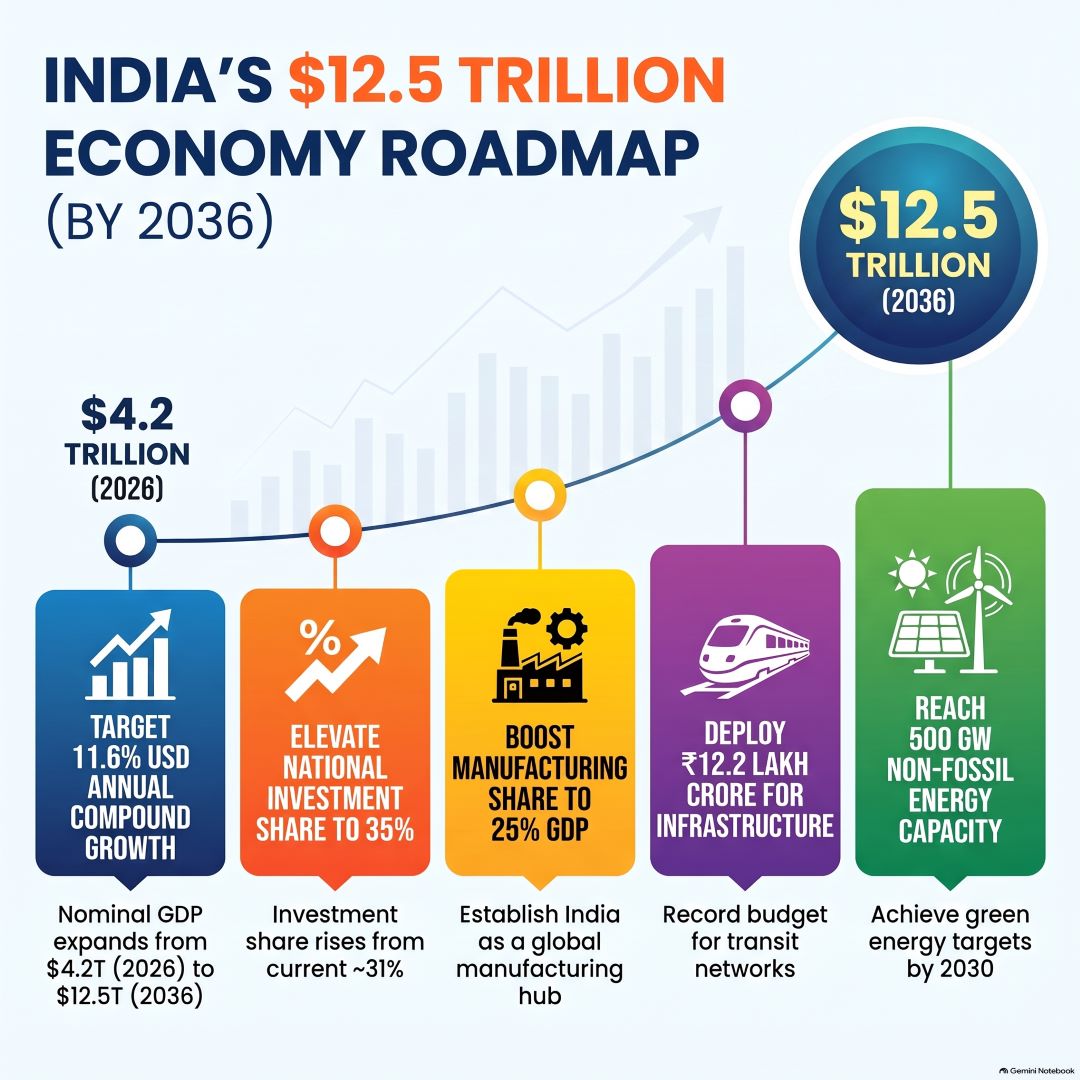
As of late 2026, India's economy is estimated at approximately $4.2 trillion (nominal GDP). To triple this figure to roughly $12.5 trillion by 2036, India would need to sustain a very high growth trajectory, effectively doubling its recent growth pace.
The Growth Mathematics
To achieve a trebling of the GDP within a decade (by 2036), the requirements are mathematically steep:
- USD Terms: India would need a compounded annual growth rate (CAGR) of approximately 11.6% in US dollar terms.
- INR Terms: Given currency fluctuations, the nominal GDP in rupees would need to grow by about 15% annually.
- Investment Ratio: The share of investment in GDP must rise from the current ~31% to at least 35% to support this expansion
Structural Pillars for Transformation
Tripling the economy is not just about numbers; it requires deep structural shifts across multiple sectors:
- Manufacturing Prowess: Moving beyond services to become a global manufacturing hub. The goal is to increase manufacturing’s share of GDP to 25%.
- Infrastructure Scaling: A record capital expenditure of ₹12.2 lakh crore was allocated in the 2026-27 Budget to build highways, high-speed rail, and logistics parks to reduce the cost of doing business.
- Digital Public Infrastructure (DPI): Leveraging the "India Stack" (Aadhaar, UPI, ONDC) to formalize the economy and provide credit to the 63 million MSMEs that form the backbone of Indian employment.
- Energy Transition: Shifting to green energy is no longer optional. India aims for 500 GW of non-fossil capacity by 2030 to ensure energy security without ballooning import bills
Key Challenges & Risks
While the roadmap exists, several "middle-income trap" risks must be navigated:
- Job Creation: Ensuring the demographic dividend (65% of the population under 35) finds high-value employment rather than remaining in low-productivity agriculture.
- Global Headwinds: Geopolitical tensions and shifting trade policies (like tariffs) can impact export-led growth.
- Human Capital: Significant investment is needed in skilling and healthcare to ensure the workforce is capable of high-productivity manufacturing and high-end services
