

Why EU deal is better for farmers than one with US
Indian Express
Key Arguments
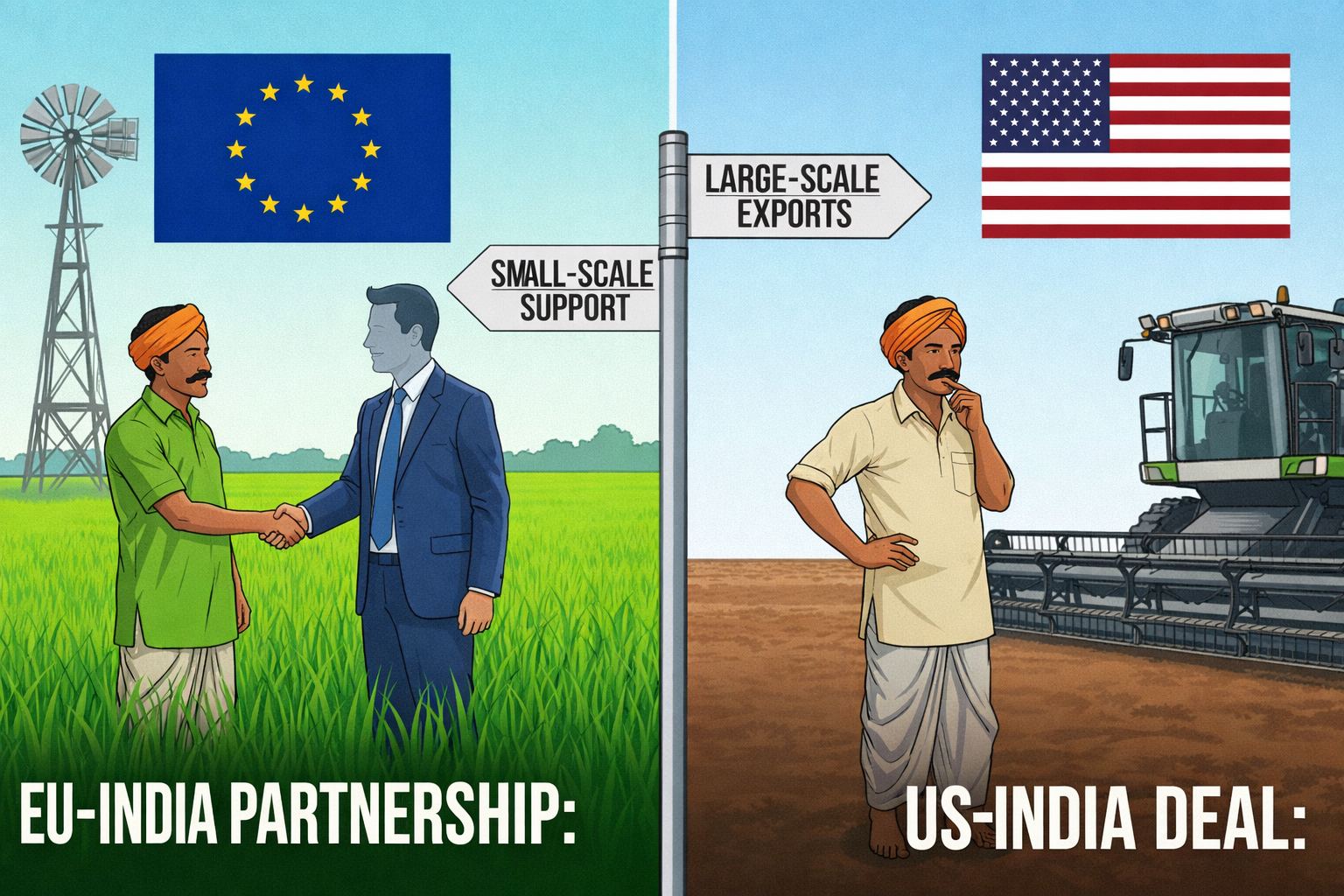
Nature of agricultural support
The EU’s farm subsidies are portrayed as relatively predictable, transparent and less trade-distorting compared to the US, where support is heavily linked to insurance, price-deficiency payments and large agribusiness interests.
Export complementarities
India’s agricultural export basket—rice, spices, marine products, processed foods, fruits and vegetables—aligns better with EU demand patterns than with the US market, which is dominated by its own surplus commodities.
Tariff and non-tariff dynamics
While both markets have stringent standards, EU regulations are presented as rule-based and stable, whereas US trade policy is depicted as more discretionary, protectionist and vulnerable to political swings.
Farm income perspective
The article highlights that Indian farmers are more likely to gain from expanded EU access due to higher unit-value exports rather than volume-based competition with subsidised US producers.
Author’s Stance and Bias
Stance
The author clearly favours an India–EU FTA from an agricultural standpoint, positioning it as the more pragmatic and less disruptive option for India’s farm sector.
Biases
There is an implicit downplaying of EU non-tariff barriers such as sanitary, phytosanitary and environmental standards. Conversely, US farm policies are framed in a more adversarial light, emphasising distortion over opportunity.
Pros Highlighted
Lower competitive pressure on Indian farmers
EU agriculture is less directly competitive with India’s smallholder-dominated farming system than US industrial agriculture.
Better value realisation
EU markets offer higher prices for niche, quality and processed products where India has comparative advantage.
Policy compatibility
EU’s subsidy architecture is seen as more compatible with WTO norms and India’s development-oriented farm policies.
Cons and Limitations
Compliance costs
EU standards on food safety, traceability, environment and labour can raise costs for small farmers and exporters.
Uneven gains
Benefits may accrue disproportionately to export-oriented regions and agribusiness firms rather than marginal farmers.
Negotiation trade-offs
Agricultural gains may come at the cost of concessions in other sectors such as intellectual property or environmental commitments.
Policy Implications
Trade strategy
India’s farm trade policy should prioritise markets that reward diversification and value addition rather than bulk commodity competition.
Domestic reforms
To leverage EU markets, India must invest in quality infrastructure, cold chains, certification systems and farmer collectives.
Negotiating posture
Agriculture should be treated as a strategic sensitivity, not merely a bargaining chip in broader trade talks.
Real-World Impact
For farmers, the argument suggests relatively lower disruption risks and better income prospects under an EU deal than under a US agreement. For policymakers, it reinforces the need to align trade negotiations with domestic agrarian realities rather than headline export figures.
UPSC GS Paper Linkages
GS Paper III – Indian Economy & Agriculture
Agricultural subsidies, farm incomes, MSP vs global prices, agricultural trade.
GS Paper II – International Relations
India–EU relations, trade diplomacy, comparative foreign trade strategies.
GS Paper III – Inclusive Growth
Impact of globalisation and FTAs on small and marginal farmers.
Conclusion and Future Perspective
The article makes a reasoned case that, from an agricultural lens, an India–EU FTA is less risky and potentially more rewarding than a US-focused deal. However, the benefits are not automatic. Without parallel domestic reforms in quality control, logistics and farmer aggregation, even favourable market access may bypass the majority of cultivators. Going forward, India’s trade strategy must integrate external openness with internal capacity-building to ensure farm-sector gains are broad-based and sustainable.
