

Why is India pushing piped gas now?
The Hindu
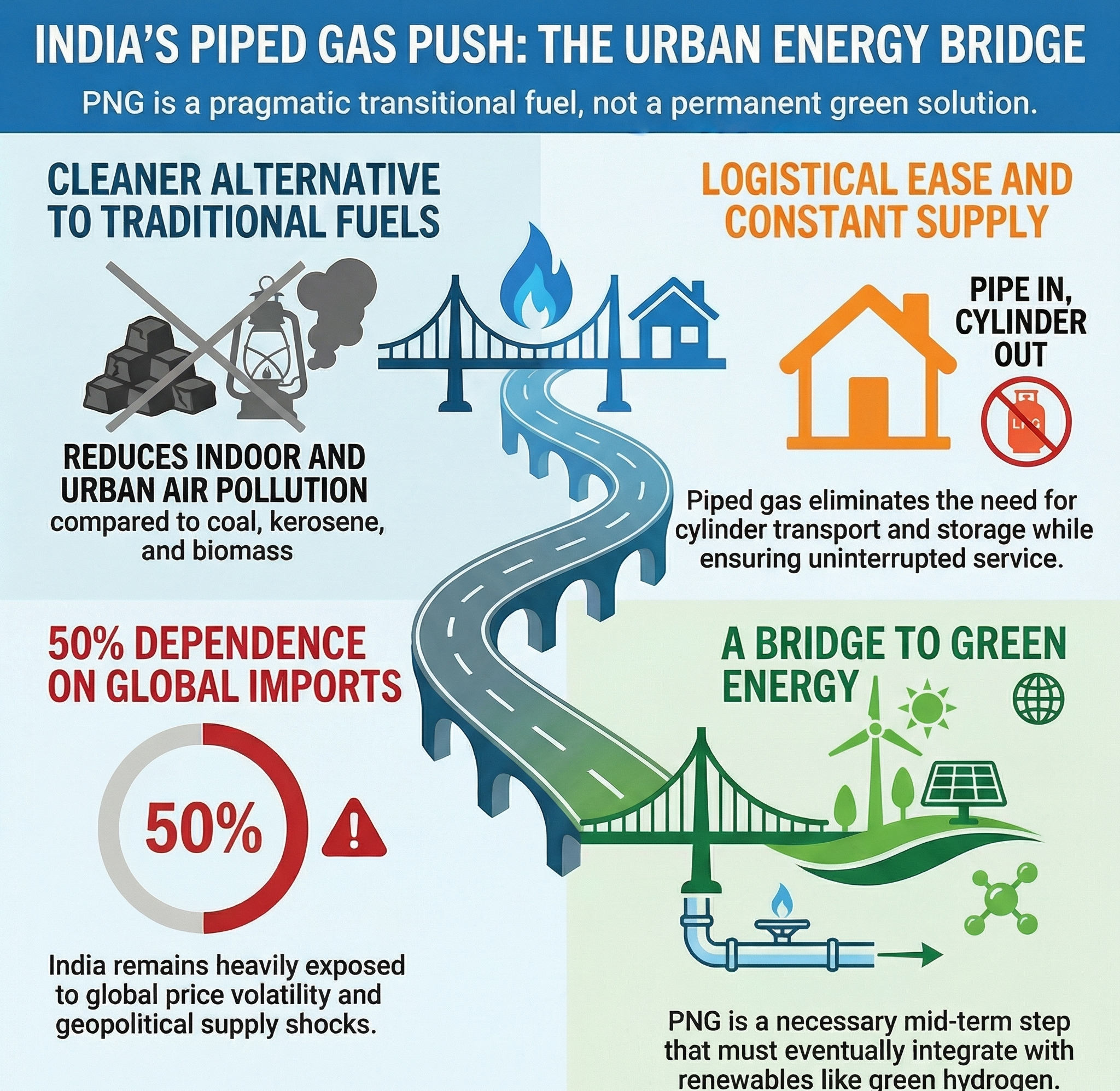
Key Arguments in the Article
1. PNG as a Cleaner and Efficient Alternative
PNG is projected as a cleaner fossil fuel compared to LPG and traditional biomass, contributing to reduced indoor and urban air pollution.
2. Infrastructure Expansion via CGD Network
The expansion of City Gas Distribution (CGD) networks is central. The government aims to increase PNG penetration in urban households and industries.
3. Reducing Import Dependence
PNG is linked to diversification of energy sources and reducing dependence on imported LPG cylinders, although both rely heavily on imports.
4. Economic and Logistical Efficiency
PNG eliminates cylinder logistics (transport, storage), offering uninterrupted supply and convenience.
5. Urban-Centric Energy Transition
The push is largely urban-focused, reflecting infrastructure feasibility and demand concentration.
Author’s Stance
Broadly Supportive but Pragmatic
The author adopts a cautiously supportive stance:
- Recognizes PNG as a transitional fuel in India’s energy mix.
- Acknowledges structural and economic limitations.
- Does not present PNG as a panacea but as a step in incremental transition.
Underlying Biases
1. Urban Bias
- Focus is predominantly on cities; rural energy challenges are underrepresented.
- PNG feasibility in rural India is not critically explored.
2. Transitional Fossil Fuel Bias
- Implicit assumption that natural gas is a “clean solution,” without deeply questioning methane leakage or long-term sustainability.
3. Policy Optimism Bias
- Assumes infrastructure rollout will be smooth, underplaying land acquisition, regulatory bottlenecks, and pricing volatility.
Pros of PNG Expansion
1. Environmental Gains (Relative)
- Lower emissions than coal, kerosene, and biomass.
- Helps reduce particulate pollution in cities.
2. Convenience and Safety
- Continuous supply, no cylinder handling.
- Reduced risk of leakage-related accidents compared to LPG cylinders.
3. Economic Efficiency
- Lower operational logistics cost.
- Potentially cheaper in the long run (subject to gas pricing).
4. Industrial Competitiveness
- Cleaner fuel for MSMEs and industries.
- Improves energy efficiency in manufacturing.
Cons and Challenges
1. Import Dependence Remains
- India imports ~50%+ of its natural gas.
- Exposure to global price volatility (e.g., geopolitical shocks).
2. Infrastructure Constraints
- High capital cost for pipeline networks.
- Limited last-mile connectivity.
3. Pricing and Affordability Issues
- PNG prices linked to global gas markets.
- Not always cheaper than subsidized LPG.
4. Methane Emissions Concern
- Natural gas is cleaner but not “clean”—methane leakage undermines climate benefits.
5. Regional Inequality
- Benefits concentrated in urban and industrial clusters.
- Rural energy access gap persists.
Policy Implications
1. Energy Transition Strategy (GS Paper III)
- PNG is a bridge fuel, not a long-term solution.
- Must be integrated with renewables (solar, green hydrogen).
2. Urban Governance and Infrastructure (GS Paper II)
- CGD expansion requires coordination between:
- Centre (policy)
- States (implementation)
- Urban Local Bodies (permissions)
3. Environmental Sustainability (GS Paper III)
- Aligns with commitments under climate agreements.
- Needs regulation of methane emissions.
4. Social Equity (GS Paper I & II)
- Risk of widening urban-rural divide in energy access.
- LPG (via Ujjwala) remains crucial for inclusivity.
Real-World Impact
1. Households
- Urban middle class benefits most.
- Convenience-driven adoption.
2. Industry
- Cleaner fuel improves compliance with environmental norms.
- Boosts ease of doing business.
3. Energy Market
- Increased demand for natural gas.
- Greater integration with global LNG markets.
4. Climate Commitments
- Helps reduce carbon intensity but not absolute emissions.
- Transitional alignment with net-zero goals.
Linkage with UPSC GS Papers
- GS Paper I: Urbanization and lifestyle transitions
- GS Paper II: Government policies (energy, infrastructure governance)
- GS Paper III: Energy security, environmental conservation, climate change
- Essay Paper: Themes like “Energy transition,” “Sustainable development vs growth”
Balanced Conclusion
India’s push toward piped natural gas reflects a pragmatic approach to energy transition—balancing environmental concerns, economic efficiency, and urban demand. However, it remains a transitional solution rather than a transformative one. Structural issues such as import dependence, infrastructure costs, and inequitable access limit its long-term viability.
Future Perspectives
1. Integrate PNG with Green Energy Pathways
- Combine with green hydrogen and renewable electricity.
2. Strengthen Domestic Gas Production
- Reduce vulnerability to global markets.
3. Expand Inclusive Energy Policies
- Continue LPG support for rural and poor households.
4. Regulatory Framework for Methane Control
- Ensure real environmental benefits.
5. Shift Long-Term Focus
- From fossil-based transition fuels to zero-carbon energy systems.
In sum, PNG is a necessary but insufficient step in India’s journey toward sustainable and secure energy.
