

Why is the Indian Rupee Falling?
The Hindu
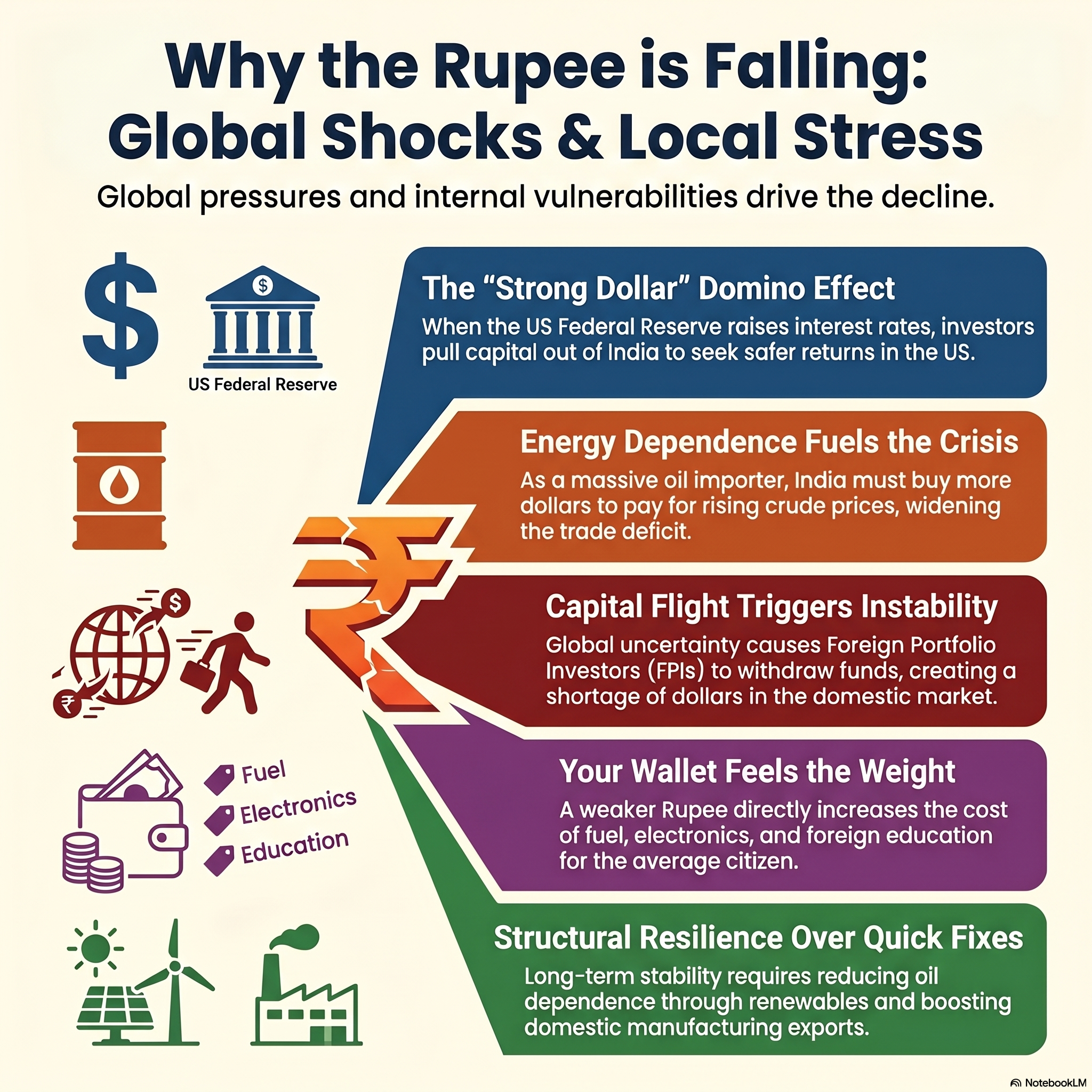
1. Core Arguments of the Article
The rupee is weakening due to external and domestic pressures
The article argues that the rupee’s depreciation is driven by:
- Global uncertainty,
- Higher oil prices,
- Capital outflows,
- Trade imbalances,
- Strong US dollar appreciation.
Crude oil dependency is a major vulnerability
India imports a large share of its energy needs. Therefore:
- Rising oil prices increase dollar demand,
- Widen the current account deficit,
- Put downward pressure on the rupee.
This is one of the article’s central arguments.
Foreign investors are pulling money out
The article highlights that:
- Foreign Portfolio Investors (FPIs) withdraw funds during global uncertainty.
This leads to:
- Dollar outflows,
- Stock market pressure,
- Currency weakening.
US monetary policy affects emerging economies
When the US Federal Reserve raises interest rates:
- Investors move capital toward safer US assets.
This strengthens:
- The US dollar,
while weakening currencies like: - The rupee.
RBI intervention has limits
The article explains that:
- RBI uses forex reserves to stabilise the rupee.
However:
- Reserves cannot indefinitely resist market pressures.
2. Author’s Stance
Macroeconomic and policy-oriented
The article adopts:
- A financial-economic analytical perspective.
The tone is:
- Cautious,
- Data-driven,
- Moderately concerned.
The author appears to advocate:
- Structural economic strengthening,
rather than temporary market intervention alone.
3. Underlying Biases
Market-economy orientation
The article strongly interprets events through:
- Financial market behaviour,
- Investor sentiment,
- Currency flows.
Global finance perspective
The discussion assumes:
- Deep integration with global financial systems is inevitable.
Technocratic policy lens
The article gives greater emphasis to:
- Monetary policy,
- Forex reserves,
- Fiscal management,
rather than: - Socio-political dimensions of economic stress.
4. Economic Dimensions
Current Account Deficit (CAD)
The article highlights:
- India imports more than it exports in several critical sectors.
A widening CAD increases:
- Demand for dollars,
- Pressure on the rupee.
Oil and energy imports
Oil imports are among India’s largest external expenditures.
Higher crude prices worsen:
- Inflation,
- Fiscal burden,
- Trade balance.
Capital flight
Global uncertainty causes:
- Foreign investors to withdraw investments from emerging markets.
This weakens:
- Currency stability,
- Financial confidence.
Dollar dominance
The article implicitly reflects the structural reality that:
- The global economy remains heavily dollar-centric.
5. Role of RBI
Forex reserve intervention
RBI sells dollars to:
- Prevent excessive rupee depreciation.
Interest rate management
Higher interest rates may:
- Stabilise capital flows,
but can: - Slow economic growth.
Managing market confidence
The article highlights:
- Currency stability depends partly on investor psychology.
6. Pros of the Article
Strong macroeconomic explanation
The article effectively simplifies:
- Exchange rate mechanisms,
- Capital flows,
- Trade deficits.
Connects global and domestic economics
It correctly explains how:
- Global events directly influence Indian currency markets.
Useful policy understanding
The article helps readers understand:
- Why exchange rates matter beyond financial markets.
Balanced discussion of RBI
The analysis neither overpraises nor unfairly criticises RBI intervention.
7. Limitations and Weaknesses
Limited focus on structural reforms
The article focuses more on:
- Immediate financial pressures,
than on: - Long-term export competitiveness,
- Industrial productivity.
Social impact discussion is limited
Currency depreciation affects:
- Ordinary consumers,
- Middle-class households,
- Poor populations,
through inflation.
This receives comparatively less attention.
Overemphasis on external causes
Some domestic structural weaknesses deserve deeper attention:
- Manufacturing competitiveness,
- Import dependence,
- Low export diversification.
Exchange rate depreciation can also have benefits
A weaker rupee may sometimes:
- Improve export competitiveness.
This aspect is not deeply explored.
8. Policy Implications
Reducing oil dependency
India must accelerate:
- Renewable energy transition,
- Domestic energy production,
- Electric mobility.
Boosting exports
Long-term currency stability requires:
- Stronger export performance,
- Manufacturing expansion,
- Trade competitiveness.
Deepening domestic industry
Import substitution in strategic sectors becomes important.
Managing capital volatility
India needs:
- Stable financial regulation,
- Strong macroeconomic fundamentals,
- External vulnerability management.
9. Real-World Impact
Inflation rises
A weaker rupee increases:
- Import costs,
especially for: - Fuel,
- Electronics,
- Fertilisers,
- Machinery.
Higher household burden
Consumers face:
- Costlier fuel,
- Higher food prices,
- Increased transportation costs.
Impact on businesses
Import-dependent industries suffer:
- Higher production costs,
- Profit margin pressures.
Impact on students and travellers
Foreign education and travel become:
- More expensive.
10. Geopolitical Dimensions
Global conflicts affect currencies
Wars and geopolitical instability increase:
- Commodity prices,
- Dollar demand,
- Financial uncertainty.
Emerging economies are more vulnerable
Countries dependent on:
- Imports,
- Foreign capital,
face stronger currency pressure.
Dollar hegemony remains dominant
The article indirectly reflects:
- The continued dominance of the US dollar in global finance.
11. UPSC GS Paper Linkages
GS Paper III
Relevant themes:
- Indian economy
- Inflation
- External sector
- Exchange rate
- Monetary policy
- Globalisation
GS Paper II
Relevant themes:
- Global economic institutions
- International economic relations
Essay Topics
Possible themes:
- “Globalisation and economic vulnerability”
- “India’s external sector challenges”
- “Balancing growth and macroeconomic stability”
12. Critical Examination from UPSC Perspective
Economic sovereignty remains constrained
Global capital movements significantly influence:
- Domestic economic stability.
Energy security is linked to currency stability
Oil dependency directly affects:
- Exchange rates,
- Inflation,
- Fiscal health.
India remains vulnerable to external shocks
Despite economic growth, India still depends heavily on:
- Imported energy,
- Foreign investment,
- Global market stability.
Macroeconomic stability requires structural reform
Currency management alone cannot solve:
- Trade imbalance,
- Productivity gaps,
- Import dependence.
13. Balanced Conclusion
The article provides a comprehensive explanation of the reasons behind the weakening Indian rupee and effectively connects:
- Global financial dynamics,
- Energy prices,
- Capital flows,
- Domestic economic vulnerabilities.
Its major strength lies in demonstrating that exchange rate fluctuations are not isolated financial events but reflections of:
- Broader structural economic realities.
The article correctly identifies:
- Oil dependency,
- Capital outflows,
- Strong dollar dominance,
as key drivers of rupee depreciation.
However, a deeper discussion on:
- Export competitiveness,
- Industrial policy,
- Domestic structural reform,
would have strengthened the analysis further.
Ultimately, the article highlights that sustainable currency stability requires:
- Strong economic fundamentals,
- Diversified exports,
- Energy security,
- Long-term structural resilience.
14. Future Perspective
India’s future exchange rate stability will depend on:
- Reducing crude oil dependence,
- Expanding manufacturing,
- Increasing export competitiveness,
- Building stronger forex reserves,
- Enhancing domestic productivity.
The broader lesson is that:
- In an interconnected world economy, currency stability is closely linked to:
- Strategic autonomy,
- Energy security,
- Industrial capability,
- Financial credibility.
As global uncertainties intensify, India will need:
- Careful macroeconomic management,
- Diversified economic partnerships,
- Structural reforms,
to maintain long-term external stability and economic resilience.
