

Why Must People Be Poor in a State Rich with Minerals? Jharkhand's DMFT Failure

Why Must People Be Poor in a State Rich with Minerals? Jharkhand's DMFT Failure
Relevance: GS Paper II (Governance, Federalism) | GS Paper III (Mining, Resource Management, Regional Development)
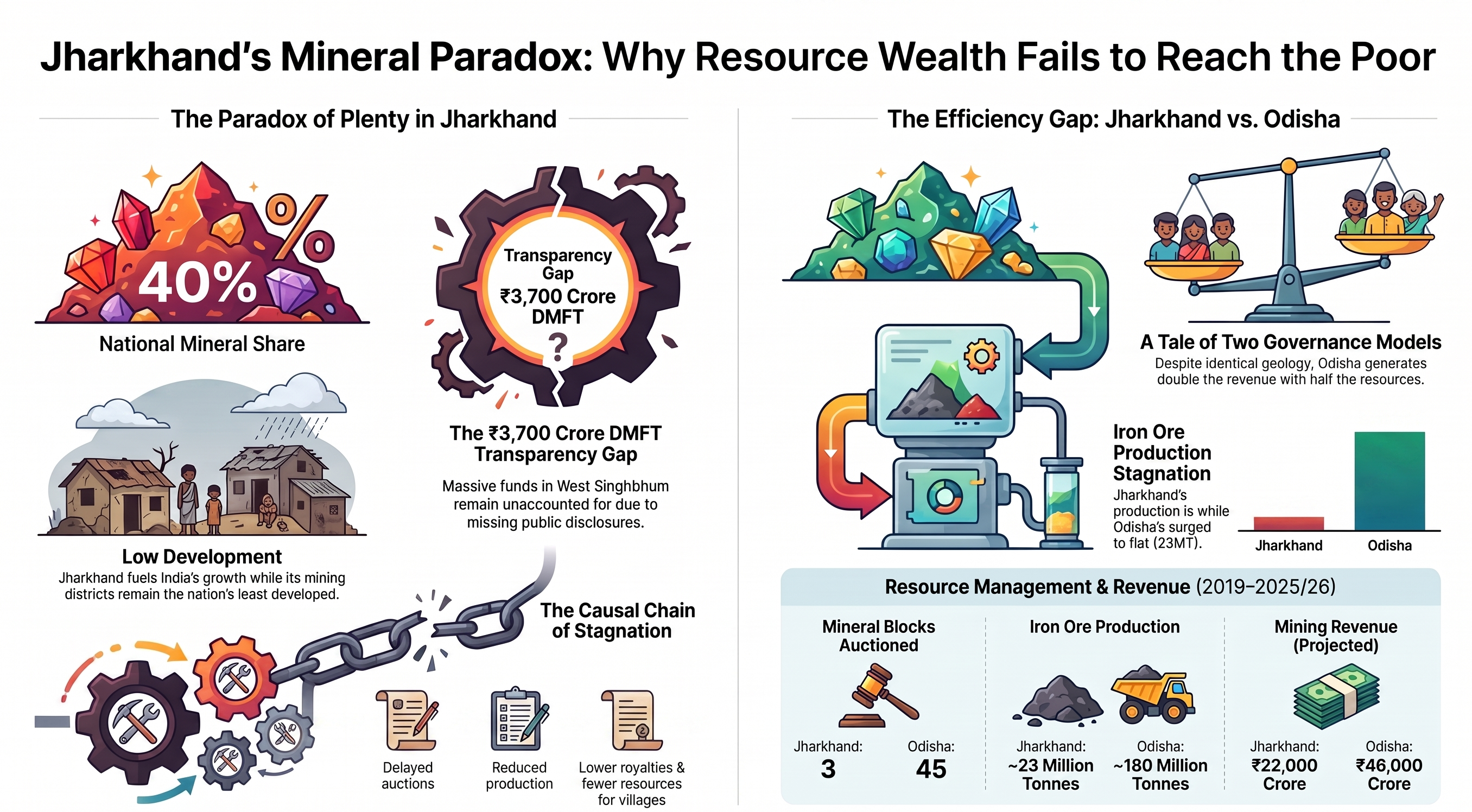
The Core Paradox
- Jharkhand possesses nearly 40% of India's mineral wealth, yet many of its mining districts remain among the country's least developed.
- For decades, coal, iron ore, bauxite, and limestone have fuelled India's economic growth, while communities closest to these resources continue struggling with poor healthcare, inadequate schools, damaged roads, pollution, and shrinking livelihoods.
About the District Mineral Foundation Trust (DMFT)
- Established by the Centre in 2015, based on the argument (made by PM Modi) that mining-affected communities bear the greatest social/environmental costs of extraction but receive the least share of its benefits.
- DMFT aimed to correct this imbalance by ensuring a portion of mining revenues is reinvested in the welfare of mining-affected communities.
- The author argues this promise remains largely unfulfilled.
Ground Reality: West Singhbhum and the Saranda Mining Belt
- West Singhbhum, home to some of India's richest iron ore reserves, "should have been a model of inclusive development."
- Between 2016 and 2026, nearly Rs 3,700 crore accumulated under its DMFT — resources that could have transformed the region through better hospitals, schools, drinking water systems, roads, and livelihood programmes.
- Instead, the author witnessed struggling local markets, shrinking economic activity, unemployed youth, and communities asking: "Where has the money gone?"
The Transparency Gap
- DMFT Rules require every district to publicly disclose annual reports, budgets, approved works, project progress, governing council decisions, and beneficiary details.
- Across Jharkhand, these disclosures are reportedly missing, outdated, or inaccessible — leaving mining-affected communities with little means of knowing how thousands of crores collected in their name have actually been spent.
On-the-Ground Impact: Jamda
- In Jamda, once a bustling mining township, local traders reported declining incomes.
- Several mining leases expired years ago; as mines shut down, employment disappeared.
- Effects rippled outward: transport operators lost business, roadside eateries emptied, shops struggled to survive, and young people increasingly migrated for work.
|
The Odisha Contrast
Auction Numbers
Production Gap
Revenue Gap
|
The Causal Chain the Author Identifies
Delayed auctions → reduced production → lower royalty collections → reduced DMFT contributions → mining-affected villages receiving fewer resources, precisely because the mining economy itself has been allowed to stagnate.
The Author's Core Argument
- The DMFT debate is not merely about financial accounting — it is fundamentally about restoring trust.
- Before organising new investment summits or announcing ambitious industrial plans, the state must first demonstrate it can effectively manage the resources it already possesses.
