

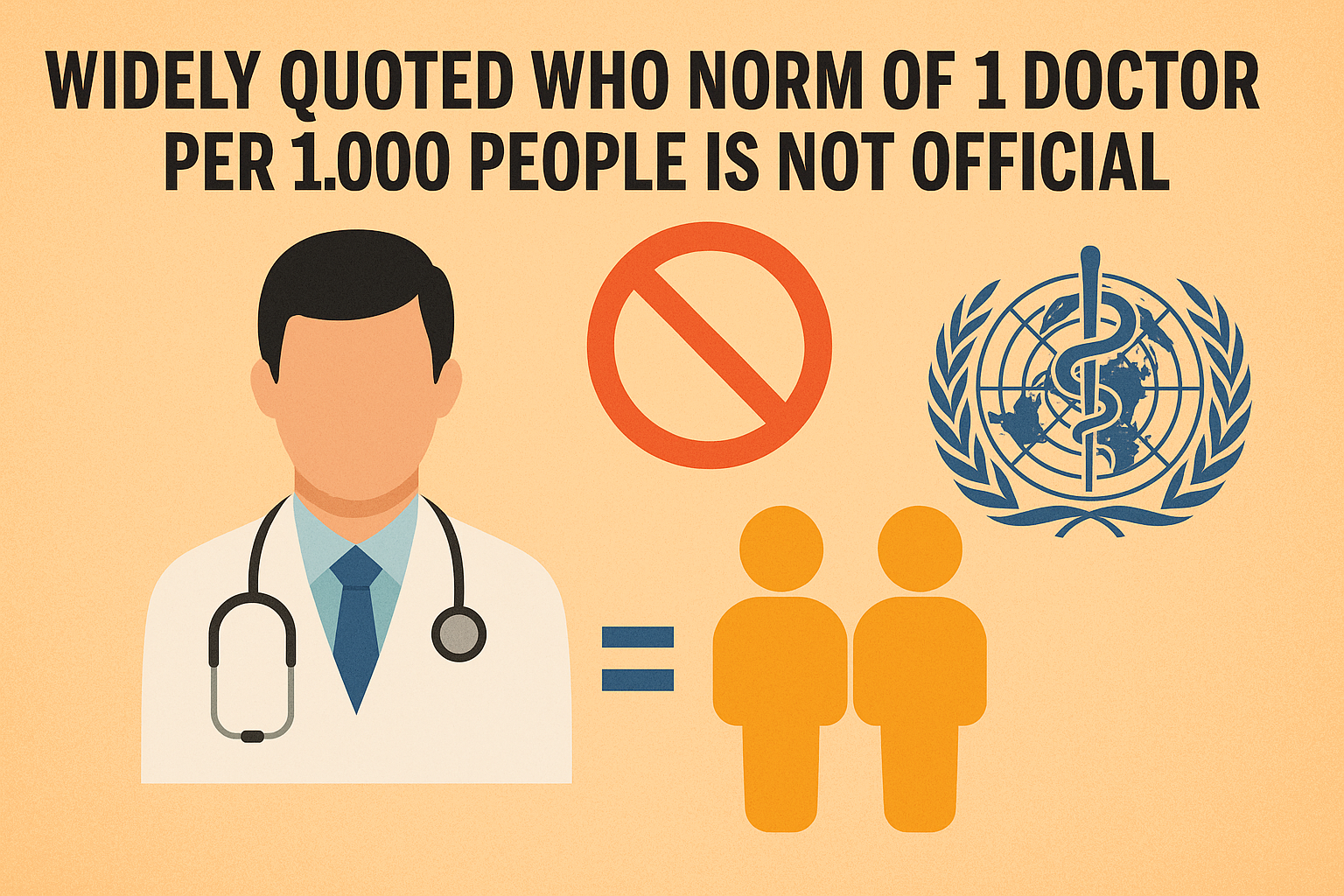
Widely quoted WHO norm of 1 doctor per 1,000 people is not official
The Hindu
Key arguments
- Misattribution: The 1:1,000 ratio has been repeatedly cited by Indian policymakers and media as a WHO recommendation, but WHO has not issued a formal, universal normative threshold.
- Context matters: Health workforce requirements vary by country depending on disease burden, service mix, public health goals, rural–urban distribution, and system capacity; simple numeric targets can be misleading.
- Alternative measures exist: WHO and other organisations use more nuanced metrics (service coverage indices, skill-mix measures, population health outcomes) rather than a single doctor-per-population threshold.
- Policy risk: Over-reliance on a single benchmark can distort planning (e.g., focus on increasing headcount rather than improving distribution, task-shifting, or strengthening primary care and mid-level providers).
- Call for better metrics: The piece urges policymakers to adopt context-sensitive targets and disaggregated planning (regional, urban/rural, public/private).
3. Author’s stance and tone
- Investigative and corrective. The author aims to correct a factual error in public discourse, emphasises technical nuance, and advocates for evidence-based, context-sensitive health workforce planning. Tone is measured, critical of simplistic uses of data, and supportive of more sophisticated policy metrics.
4. Biases, omissions and assumptions
Biases
- Expert/technical bias: The piece privileges WHO/technical expert perspectives and may underemphasise political reasons why simple benchmarks gain traction (communication clarity, electoral messaging, public reassurance).
Omissions
- Operational detail: Limited discussion of how India should operationalise alternative metrics (for example, explicit models, district-level workforce planning tools, financing implications).
- Private sector role: The article notes national headcounts but does not fully analyse private-sector concentration of doctors and its implications for access.
- Interim guidance: No clear short-term practical guidance for states that currently use the 1:1,000 metric.
Assumptions
- Policymakers and public health planners will be able to absorb and act on more complex metrics if the messaging and institutional capacity change accordingly.
5. Pros and cons of the article’s framing
Pros
- Fact-correction: Important corrective journalism that prevents policy misdirection based on a spurious “WHO norm.”
- Nuance in planning: Highlights essential complexities (skill mix, distribution, health outcomes) that must shape workforce policy.
- Policy relevance: Encourages adoption of outcome- and needs-based workforce metrics rather than blind reliance on per-capita doctor ratios.
Cons
- Practicality gap: While advocating nuance, the article offers limited operational alternatives that district/state planners can adopt immediately.
- Communication challenge understated: It underplays why simple metrics gain political traction (easy to communicate to the public and to justify budgets) and how to replace them in public discourse.
6. Policy implications & recommended actions
A. Move from headcount to needs-based planning
- Adopt multi-metric frameworks: Use composite indicators combining physician density, nurse and mid-level provider density, service coverage (e.g., immunisation, institutional delivery), and population health outcomes (maternal mortality, UHC service coverage index).
- District-level workforce needs assessments: Mandate district health authorities to produce local health workforce plans using disease-burden estimates and service-delivery targets.
B. Address distribution and skill-mix
- Incentivise rural deployment: Financial incentives, bonded rural service with supportive supervision, local recruitment and postgraduate seats reserved for rural candidates.
- Invest in task-shifting: Scale up trained mid-level providers (physician assistants, nurse practitioners) with legally defined scopes of practice to augment care in underserved areas.
C. Strengthen data & monitoring
- Health workforce registry: Maintain a live registry disaggregated by cadre, sector (public/private), state/district, and practice location — linked to licensing and continuing education.
- Outcome-linked targets: Tie workforce expansion to measurable service-coverage improvements, not just headcount.
D. Communication & political feasibility
- Simple, policy-accurate messaging: Replace a single “magic number” with communicable narratives (e.g., “targeted increase in primary-care teams per 10,000 people” plus distribution targets) to preserve clarity while remaining accurate.
- Capacity-building: Train state health departments in modelling workforce requirements and translating them into hiring and medical-education decisions.
7. Real-world impact scenarios
If policymakers follow the article’s recommendations
- Better-targeted investments: Resources flow to primary care, rural retention policies, and creation of complementary cadres — improving access and outcomes faster than merely expanding urban doctor numbers.
- Stronger health outcomes: Measurable improvements in service coverage and reductions in avoidable morbidity and mortality where workforce planning is needs-driven.
If reliance on the 1:1,000 myth persists
- Skewed expansion: More medical seats and urban concentration of doctors without substantial gains in rural or primary-care access; persistent inequities.
- Misplaced accountability: Performance measured by counts rather than outcomes, making it harder to track real progress on UHC.
8. Alignment with UPSC GS syllabus (how to use in answers)
- GS Paper 2 (Governance): Health policy and planning, institution-building, Centre–State coordination in health, regulatory frameworks (medical councils, licensing).
- GS Paper 3 (Economy/Health): Public health infrastructure, health indices, human resource planning in healthcare, financing and delivery models (public vs private).
- GS Paper 1 (Society): Social determinants of health, rural–urban disparities, healthcare access and equity.
- GS Paper 4 (Ethics): Professional responsibility of medical professionals, ethical distribution of scarce healthcare resources.
9. Balanced conclusion & future perspectives
The article performs a valuable corrective role by exposing that the oft-quoted “1 doctor per 1,000 people” is not an official WHO normative standard and by warning against simplistic targets. This correction matters: crude benchmarks can misdirect investments and obscure the more pressing problems — maldistribution, inadequate primary care, and deficient mid-level cadres. The policy shift needed is from single-number rhetoric to context-sensitive, multi-dimensional workforce planning (service coverage goals, cadre mix, regional needs and outcome targets).
For India, the practical challenge is twofold: (a) technical — building district- and state-level modelling, registries and metrics that inform hiring and training; and (b) political-communicative — replacing a catchy but misleading headline with policy messages that are both accurate and simple enough for public consumption. Success will require aligning medical education, fiscal incentives, regulatory reform (scope of practice for mid-level providers) and transparent data systems. If executed, India can better align its investments in human resources for health with universal health coverage goals; if not, growth in raw headcounts will continue to produce limited gains in access and outcomes.
