

Will increasing the strength of the SC solve the pendency problem?
The Hindu
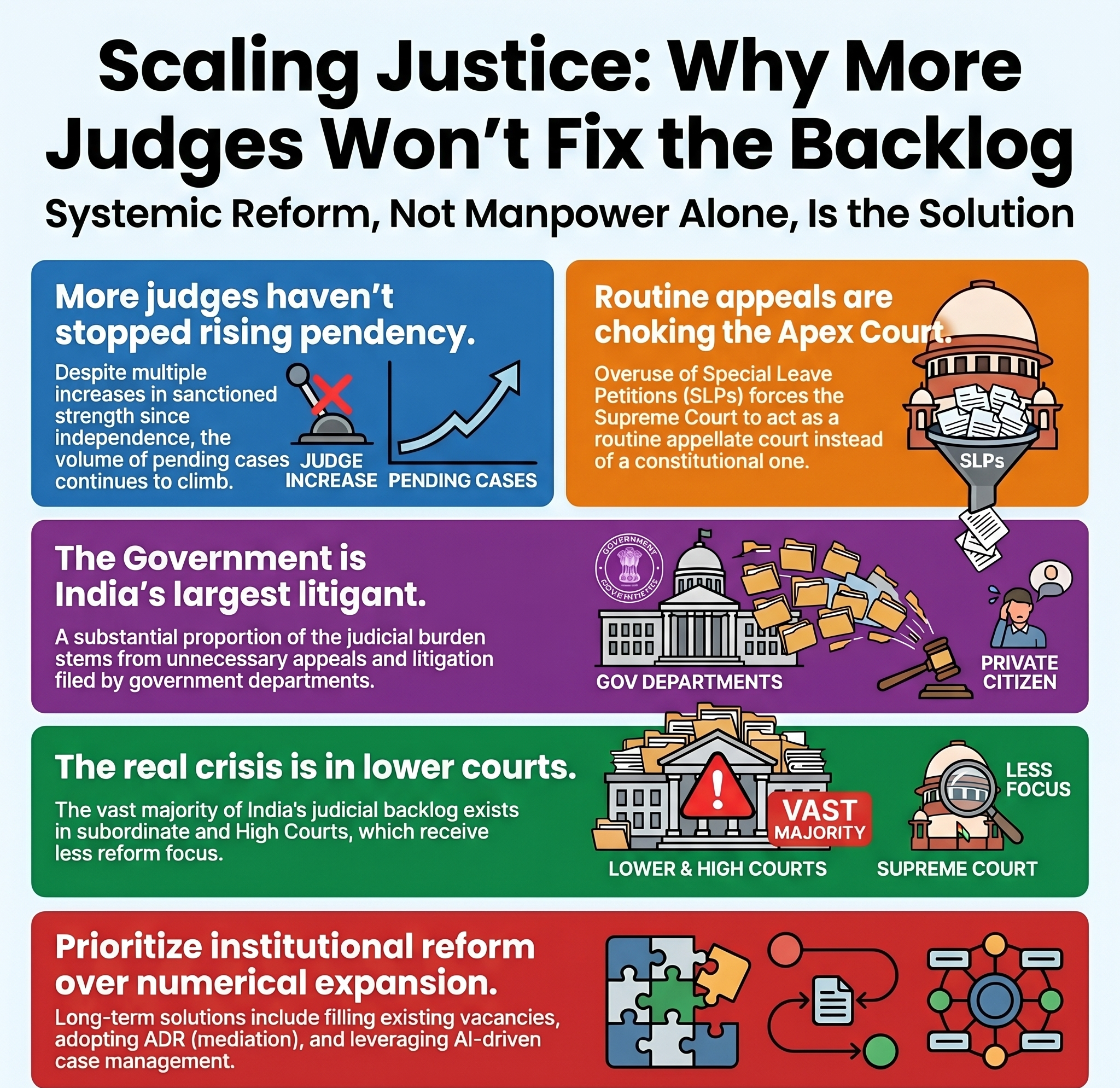
Central Theme
The article seeks to answer:
Can increasing the number of Supreme Court judges significantly reduce judicial pendency?
The broad conclusion emerging from the discussion is:
No, not by itself.
While additional judges may provide short-term relief, long-term reduction of pendency requires systemic reforms across the entire justice delivery system.
Key Arguments Presented
Increasing judge strength may provide only limited relief
The article notes that:
- The sanctioned strength of the Supreme Court has increased multiple times since independence.
- Despite such increases, pendency continues to rise.
This suggests:
- Judge strength alone cannot solve the problem.
The argument challenges the simplistic assumption that:
- More judges automatically lead to faster justice.
The Supreme Court's role has expanded excessively
The article points out that:
- The Supreme Court increasingly functions not only as a constitutional court but also as a regular appellate court.
As a result:
- Thousands of routine appeals reach the Court.
- Constitutional matters compete with ordinary litigation for judicial time.
This creates:
- Institutional overload.
Special Leave Petitions (SLPs) contribute significantly to pendency
The article highlights Article 136 of the Constitution.
Through Special Leave Petitions:
- Litigants can approach the Supreme Court against judgments from almost any court or tribunal.
While intended as an exceptional remedy:
- SLPs have become a routine mechanism.
Consequently:
- The Supreme Court receives an overwhelming number of appeals.
Pendency originates largely outside the Supreme Court
The article argues:
- The bulk of India's judicial backlog exists in subordinate courts and High Courts.
Therefore:
- Focusing only on the Supreme Court addresses only a small part of the larger problem.
Government remains the largest litigant
One of the most significant observations is that:
- Government departments account for a substantial proportion of litigation.
This contributes heavily to:
- Case accumulation,
- Appeals,
- Administrative burden on courts.
Author’s Stance
Reform-oriented rather than judge-centric
The article clearly favours:
- Institutional reform over numerical expansion.
The author believes:
- Structural issues matter more than staffing numbers.
Supportive of judicial efficiency reforms
The discussion endorses:
- Better case management,
- Filtering mechanisms,
- Litigation reduction policies.
Skeptical of quick-fix solutions
The article challenges:
- Political and administrative tendencies to treat judge appointments as the sole solution.
Hidden Assumptions and Biases
Institutional reform bias
The article assumes:
- Governance reforms will yield greater benefits than increasing manpower.
While largely valid, additional judges may still significantly improve disposal rates in some contexts.
Efficiency-oriented perspective
The article focuses heavily on:
- Administrative efficiency.
It pays relatively less attention to:
- Citizens' increasing legal awareness,
- Growth of rights-based litigation,
- Expanding constitutional jurisprudence.
Supreme Court-centric analysis
The discussion concentrates on the apex court and may understate:
- State-level variations,
- Capacity issues in district courts.
Why Judicial Pendency Exists
The article indirectly highlights multiple causes.
Shortage of judges
India's judge-population ratio remains low compared to many developed countries.
Consequences include:
- Delayed hearings,
- Longer case cycles,
- Backlog accumulation.
Vacancies in courts
Many sanctioned positions remain vacant.
This worsens:
- Existing workload pressures.
Excessive litigation
Large volumes of disputes arise from:
- Land issues,
- Taxation,
- Service matters,
- Regulatory disputes.
Government litigation
Government departments often:
- File unnecessary appeals,
- Challenge adverse decisions routinely.
This increases judicial burden.
Procedural delays
Cases often face delays due to:
- Adjournments,
- Poor investigation,
- Delayed evidence collection,
- Inefficient case management.
The Special Leave Petition Debate
Importance of SLPs
Article 136 acts as:
- A constitutional safety valve.
It allows correction of:
- Grave miscarriages of justice.
Problem with overuse
However:
- SLPs are increasingly used as ordinary appeals.
This results in:
- Case overload,
- Diversion from constitutional functions.
Suggested reform
Many legal scholars argue:
- SLPs should return to their exceptional character.
This would:
- Allow the Supreme Court to focus on constitutional interpretation.
Pros of Increasing Supreme Court Strength
Faster disposal of cases
More judges can:
- Hear more cases simultaneously.
Better specialisation
Larger benches may allow:
- Subject-specific expertise,
- Faster adjudication.
Reduced workload per judge
This may improve:
- Judgment quality,
- Judicial efficiency.
Immediate administrative relief
Additional judges provide:
- Short-term backlog reduction.
Limitations of Increasing Judge Strength
Pendency is systemic
More judges do not solve:
- Procedural inefficiencies,
- Government litigation,
- Appeal culture.
Risk of diminishing returns
Beyond a certain point:
- Larger benches may create coordination challenges.
Constitutional court function may weaken
The Supreme Court could become:
- Primarily an appellate court.
This may dilute:
- Its constitutional role.
Backlog may continue growing
If inflow exceeds disposal:
- Pendency will persist regardless of judge strength.
Policy Recommendations Emerging from the Discussion
Strengthen lower judiciary
The article implies that reforms must begin at:
- District courts,
- Trial courts.
Most litigation originates here.
Fill existing vacancies
Before increasing sanctioned strength:
- Existing vacancies should be filled quickly.
Reform government litigation
The government should:
- Reduce unnecessary appeals,
- Adopt responsible litigation policies.
Improve case management
Use of:
- Technology,
- Digital courts,
- AI-assisted scheduling,
- E-filing systems,
can improve efficiency.
Rationalise SLPs
The Supreme Court may need:
- Stricter admission standards.
This can reduce:
- Routine appeals.
Promote Alternative Dispute Resolution (ADR)
Expansion of:
- Mediation,
- Arbitration,
- Lok Adalats,
can reduce court burden.
Real-World Implications
Delayed justice affects economic growth
Judicial delays increase:
- Transaction costs,
- Investment uncertainty,
- Contract enforcement risks.
Impact on citizens
Pendency creates:
- Financial burden,
- Emotional stress,
- Reduced faith in institutions.
Impact on governance
Delayed dispute resolution affects:
- Administrative efficiency,
- Public trust,
- Rule of law.
Constitutional Perspective
The pendency issue directly affects:
Article 21
The Supreme Court has repeatedly interpreted:
- Speedy justice
as part of: - Right to Life and Personal Liberty.
Excessive delays undermine:
- Constitutional rights.
UPSC GS Paper Linkages
GS Paper II
Relevant topics:
- Judiciary
- Judicial reforms
- Separation of powers
- Constitutional governance
GS Paper III
Relevant topics:
- Governance reforms
- Institutional efficiency
- Technology in administration
GS Paper IV (Ethics)
Relevant themes:
- Justice
- Accountability
- Public trust
- Institutional integrity
Arguments Supporting the Article
Recognises complexity of pendency
The article correctly identifies:
- Pendency as a systemic problem.
Focuses on root causes
It moves beyond simplistic solutions.
Highlights structural reforms
The discussion stresses:
- Long-term institutional strengthening.
Defends constitutional role of Supreme Court
It emphasises:
- Constitutional adjudication over routine appeals.
Arguments Against the Article
Underestimates manpower shortage
Judge shortages remain a genuine constraint.
Reform implementation takes time
Structural reforms may require years to yield results.
Immediate relief still matters
Increasing judge strength can provide necessary short-term benefits.
Not all pendency is procedural
Rising litigation also reflects:
- Greater legal awareness,
- Expanding rights consciousness.
UPSC Mains Value Addition
Key Quote
"Justice delayed is justice denied." — William Gladstone
Law Commission View
Repeated Law Commission reports have highlighted:
- Judicial vacancies,
- Infrastructure gaps,
- Government litigation,
as major causes of pendency.
National Judicial Data Grid (NJDG)
The NJDG demonstrates that:
- Most pending cases are concentrated in subordinate courts rather than the Supreme Court.
Balanced Conclusion
The article effectively challenges the simplistic belief that increasing the number of Supreme Court judges alone can resolve India's judicial backlog. While additional judges may provide short-term relief and improve disposal rates, the pendency crisis is fundamentally a structural problem rooted in procedural inefficiencies, excessive appeals, government litigation, and weaknesses in lower courts.
The article's strongest contribution lies in shifting the focus from numerical expansion to institutional reform. It correctly argues that unless systemic bottlenecks are addressed, the backlog will continue to grow irrespective of increases in judicial strength.
At the same time, the article should not be interpreted as opposing additional appointments. India's judiciary undoubtedly needs more judges, but manpower expansion must be accompanied by deeper reforms in case management, technology adoption, dispute resolution mechanisms, and litigation governance.
Future Perspective
India's judicial future will depend on a combination of:
- Filling judicial vacancies,
- Strengthening subordinate courts,
- Limiting frivolous litigation,
- Reforming Special Leave Petitions,
- Expanding mediation and arbitration,
- Leveraging technology and AI-driven court management,
- Reducing government-led litigation.
The ultimate objective should not merely be disposing of more cases, but delivering timely, accessible, affordable, and quality justice, which remains the true foundation of a constitutional democracy and the rule of law.
