

With Israel and broader Middle East, a diplomacy less defensive, more realist
Indian Express
I. Core Context
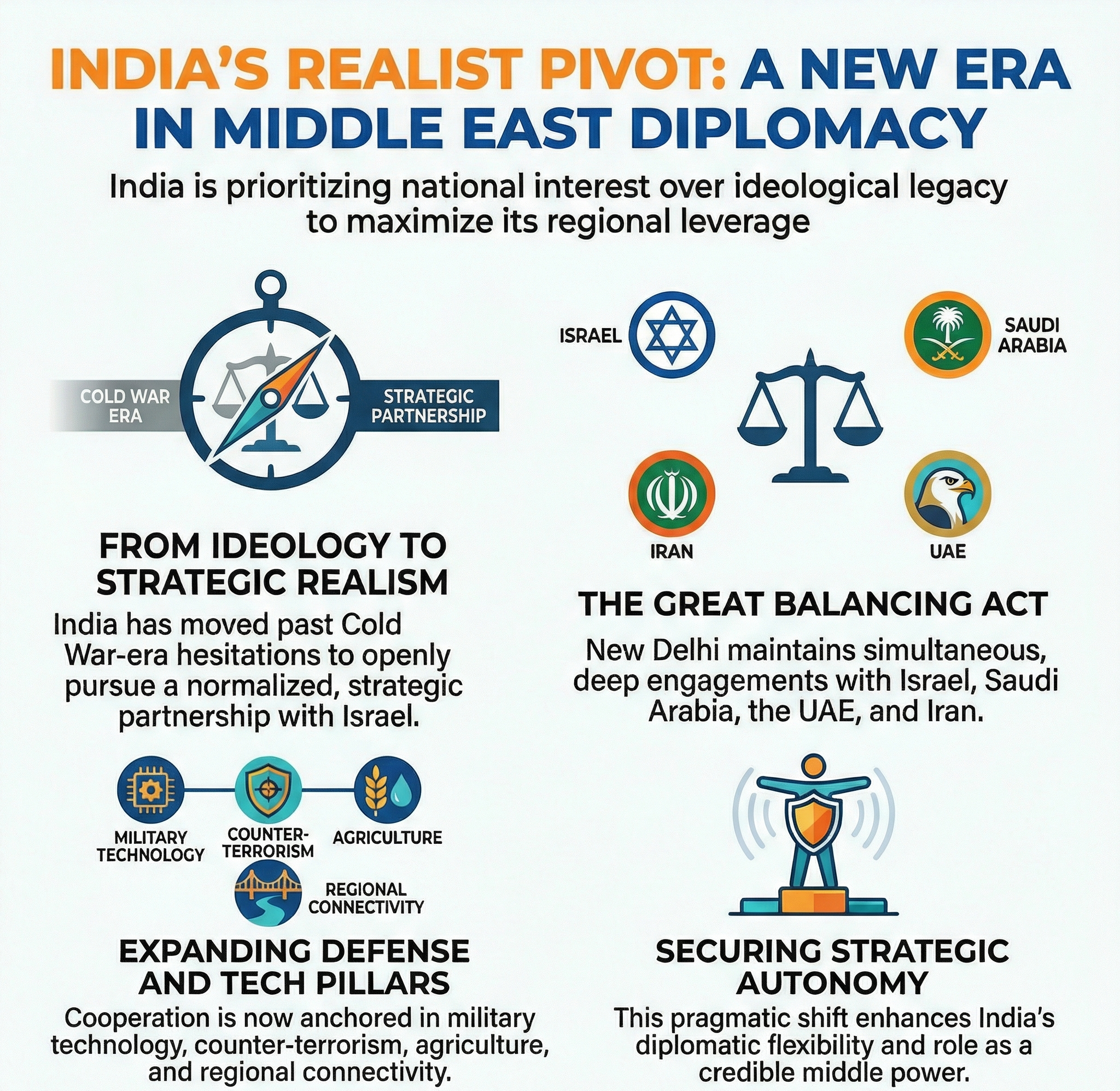
The article analyses India’s evolving diplomatic posture toward Israel and the wider Middle East. It argues that New Delhi has shifted from a historically cautious and defensive approach—largely shaped by domestic and Non-Aligned Movement considerations—to a more pragmatic, interest-driven, and realist strategy.
The context includes:
- Prime Ministerial visits and high-level engagement
- Regional flux following the Gaza crisis and Iran-Israel tensions
- Expanding defence, technology, and connectivity cooperation
- India’s balancing act between Israel and Arab partners
II. Key Arguments Presented
1. From Ideological Hesitation to Strategic Engagement
The article traces India’s earlier reluctance to fully engage Israel due to:
- Domestic political sensitivities
- NAM-era solidarity with Palestine
- Cold War alignments
It argues that India has now moved toward a normalised and openly strategic partnership with Israel.
2. Realist Diplomacy in a Fragmented Region
The author contends that India’s Middle East policy is now:
- Less ideological
- Less reactive
- More anchored in national interest
This includes cooperation with Israel in:
- Defence and military technology
- Counter-terrorism
- Agriculture and innovation
Simultaneously, India maintains ties with:
- Saudi Arabia
- UAE
- Iran
- Other Gulf states
3. Regional Volatility Creates Diplomatic Space
The article suggests that:
- Shifts in U.S. regional engagement
- Iran-Israel confrontation
- Arab-Israeli recalibrations
have created room for India to expand its diplomatic and strategic footprint.
4. Balance Without Moral Posturing
The piece implies that India’s approach prioritises:
- Strategic autonomy
- Security cooperation
- Connectivity initiatives
over overt ideological positioning on regional conflicts.
III. Author’s Stance
The tone is supportive of the realist shift.
The author appears to argue that:
- India’s earlier defensiveness limited strategic options
- Pragmatic engagement strengthens India’s regional leverage
- National interest should guide foreign policy
There is a clear endorsement of interest-based diplomacy.
IV. Possible Biases and Limitations
1. Underplaying Normative Concerns
The article gives limited attention to:
- Humanitarian dimensions of the Gaza crisis
- International law considerations
- Domestic public opinion sensitivity
Realism is foregrounded over ethical discourse.
2. Risk of Overconfidence
The suggestion that India has greater diplomatic manoeuvrability may overlook:
- Energy dependence vulnerabilities
- Diaspora exposure in Gulf countries
- Regional instability spillovers
3. Limited Discussion on Constraints
India’s balancing act must contend with:
- U.S. strategic expectations
- Iran sanctions regimes
- Domestic political pluralism
These structural constraints receive limited emphasis.
V. Pros and Cons of the Realist Shift
Pros
• Enhances strategic autonomy
• Expands defence and technology cooperation
• Strengthens counter-terror capabilities
• Diversifies regional partnerships
• Increases diplomatic flexibility
Cons
• Risk of perceived alignment bias
• Possible strain with Arab public opinion
• Energy security exposure
• Normative credibility questions
VI. Policy Implications
1. Multi-Vector Engagement
India must continue:
- Parallel engagement with Israel and Arab states
- Economic diplomacy with Gulf economies
- Connectivity initiatives such as corridor projects
2. Strategic Communication
Clear messaging is required to:
- Reassure Arab partners
- Maintain domestic cohesion
- Uphold international law commitments
3. Security and Energy Hedging
India must:
- Diversify energy sources
- Strengthen diaspora protection frameworks
- Enhance maritime security in West Asia
4. Institutionalising Regional Strategy
India should move from episodic diplomacy to:
- Structured regional frameworks
- Defence-industrial collaboration
- Technology partnerships
VII. Real-World Impact
Short-term:
- Enhanced defence cooperation with Israel
- Expanded diplomatic presence in Gulf states
Medium-term:
- Increased role in regional connectivity initiatives
- Greater voice in West Asian geopolitical recalibration
Long-term:
- Consolidation of India as a credible middle power in the region
- Strengthened strategic autonomy
Failure to manage balance could:
- Trigger diplomatic backlash
- Expose India to geopolitical crossfire
VIII. UPSC Relevance
GS Paper II
• India’s foreign policy
• West Asia diplomacy
• Strategic autonomy
GS Paper III
• Energy security
• Defence cooperation
• Counter-terrorism
GS Paper IV
• Ethics in foreign policy
• National interest vs moral responsibility
Essay Themes
• Realism vs idealism in foreign policy
• Strategic autonomy in a turbulent region
• Balancing power in multipolar geopolitics
IX. Balanced Conclusion and Future Perspective
India’s evolving Middle East diplomacy reflects maturation from ideological caution to strategic pragmatism. By engaging Israel openly while maintaining strong ties with Arab partners, New Delhi seeks to maximise national interest in a volatile region.
However, realism must be tempered by:
- Sensitivity to humanitarian crises
- Long-term regional stability considerations
- Energy and diaspora vulnerabilities
The durability of this strategy will depend on India’s ability to maintain equilibrium in a region defined by shifting alliances and periodic conflict.
A less defensive diplomacy offers opportunity—but requires calibrated restraint, consistent communication, and strategic foresight.
