

Women live longer but spend more of those years with illness
The Hindu
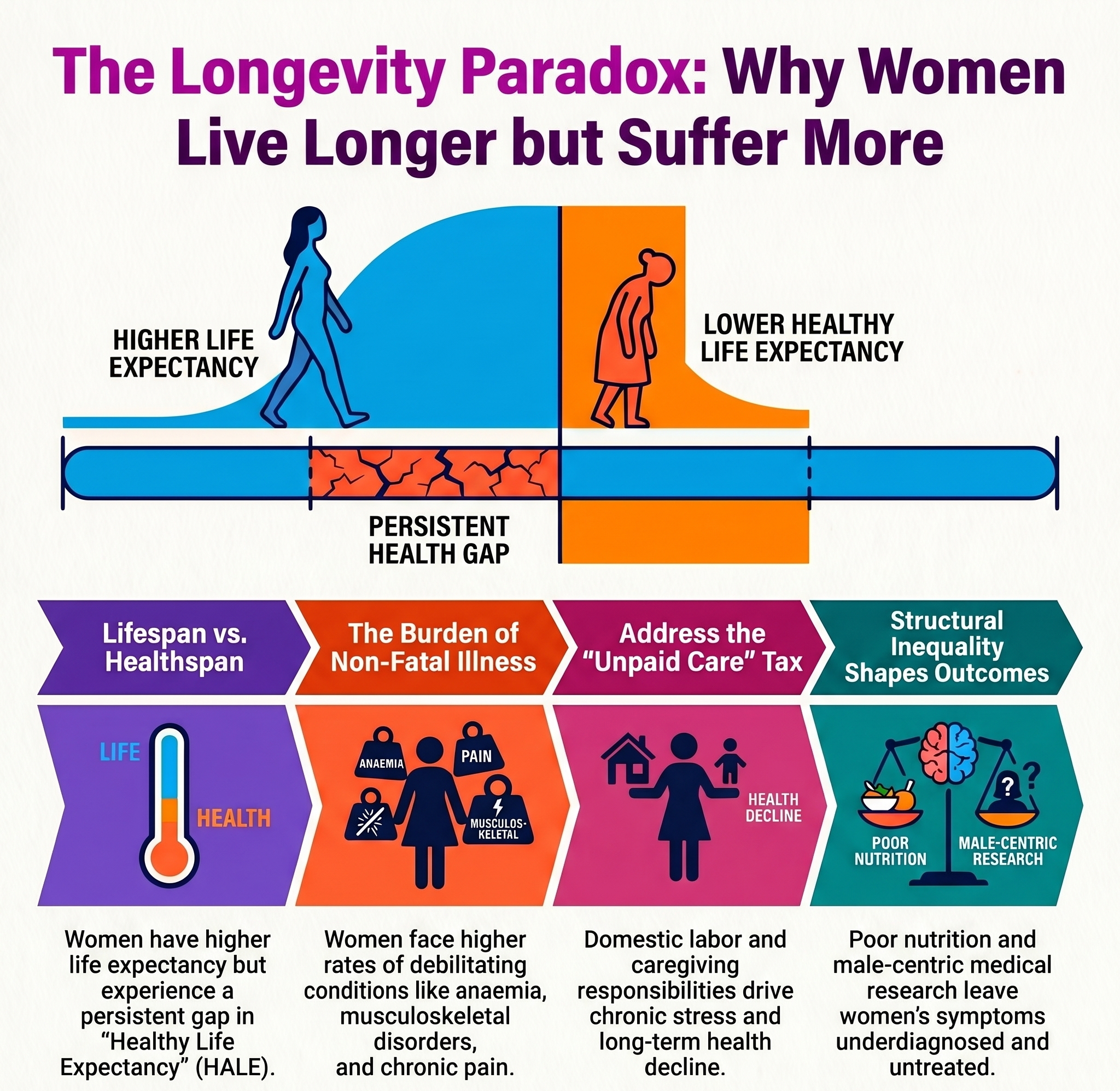
1. Core Argument of the Article
The article’s central argument is:
Women live longer, but not necessarily healthier lives
While women have:
- Higher life expectancy,
they simultaneously experience: - More years with disease,
- Disability,
- Chronic illness,
- Mental health burdens,
- Poor quality of life.
Thus:
- Longevity without health becomes an incomplete developmental achievement.
2. Major Arguments Presented
Healthy Life Expectancy gap remains persistent
The article notes that:
- The gap between female life expectancy and healthy life expectancy has not significantly improved.
This means:
- Women survive longer,
but: - Experience more prolonged morbidity.
Women face higher disease burden from non-fatal illnesses
The article highlights diseases disproportionately affecting women:
- Musculoskeletal disorders,
- Mental health conditions,
- Anaemia,
- Reproductive illnesses,
- Chronic pain disorders.
Many of these:
- Do not immediately increase mortality,
but significantly reduce quality of life.
Gender inequality shapes health outcomes
The article strongly argues:
- Women’s poorer health outcomes are linked to structural discrimination.
Examples include:
- Poor nutrition,
- Lower healthcare access,
- Unequal household priorities,
- Violence,
- Economic dependence.
Medical systems historically neglected women’s health
The article suggests:
- Women’s symptoms are often ignored or underdiagnosed.
This reflects:
- Male-centric medical research traditions.
Women’s unpaid care burden worsens health
The article indirectly highlights:
- Domestic labour,
- Caregiving responsibilities,
- Emotional labour,
as contributors to chronic stress and poor health.
3. Author’s Stance
Strongly gender-sensitive and public-health oriented
The author adopts:
- A feminist public-health framework.
The article sees women’s health not simply as:
- A biological issue,
but as: - A socio-economic and structural issue.
Critical of traditional health metrics
The article questions:
- Mortality-focused health evaluation systems.
Instead:
- It supports quality-of-life-based indicators like HALE.
Supportive of welfare-based interventions
The article implicitly advocates:
- Greater state intervention,
- Public healthcare strengthening,
- Gender-sensitive policies.
4. Hidden Assumptions and Biases
A. Gender structuralism bias
The article strongly attributes women’s health burdens to:
- Patriarchal social structures.
While largely valid, this may underplay:
- Biological and genetic differences.
B. Welfare-state orientation
The article assumes:
- State-led interventions are central to solving women’s health disparities.
C. Public-health lens dominates economic lens
The article prioritises:
- Well-being and equity,
rather than: - Economic productivity implications.
D. Limited male-health discussion
Although focused on women, the article gives less attention to:
- Male mental health,
- Occupational mortality,
- Substance abuse burdens among men.
5. Understanding Healthy Life Expectancy (HALE)
Difference between Life Expectancy and HALE
Life Expectancy:
- Total years a person is expected to live.
Healthy Life Expectancy:
- Years expected to be lived in good health.
The article argues:
- Policy focus should shift from merely increasing lifespan to improving healthy lifespan.
6. Social Determinants of Women’s Health
The article correctly situates women’s health within broader social realities.
A. Nutrition inequality
Women often receive:
- Poorer nutrition,
especially in: - Low-income households.
This contributes to:
- Anaemia,
- Maternal health problems,
- Long-term weakness.
B. Unpaid care work
Women disproportionately perform:
- Domestic labour,
- Childcare,
- Elder care.
This creates:
- Chronic physical and mental stress.
C. Healthcare access barriers
Women frequently delay treatment due to:
- Financial dependence,
- Social restrictions,
- Caregiving obligations.
D. Violence and mental health
Gender-based violence contributes to:
- Depression,
- Anxiety,
- Trauma,
- Chronic psychosomatic illnesses.
7. Public Health Transition in India
The article reflects India’s epidemiological transition:
From:
- Infectious diseases,
Toward:
- Non-communicable diseases (NCDs).
Women increasingly face:
- Diabetes,
- Hypertension,
- Cancer,
- Arthritis,
- Mental illness.
This changes:
- Health policy priorities.
8. Economic Implications
A. Loss of productive potential
Poor women’s health reduces:
- Workforce participation,
- Economic productivity,
- Human capital formation.
B. Rising healthcare burden
Long-term chronic illness increases:
- Household healthcare expenditure,
- Care burdens,
- Public health costs.
C. Intergenerational effects
Women’s health directly affects:
- Child nutrition,
- Maternal outcomes,
- Educational attainment,
- Family well-being.
9. Real-World Policy Concerns
A. India’s anaemia crisis
India continues to face:
- Extremely high anaemia prevalence among women.
This weakens:
- Maternal health,
- Immunity,
- Productivity.
B. Underinvestment in preventive care
India’s healthcare system remains:
- Treatment-oriented rather than prevention-oriented.
C. Mental health invisibility
Women’s mental health issues remain:
- Underreported,
- Stigmatised,
- Poorly treated.
D. Rural-urban disparities
Healthcare access differs sharply across:
- Regions,
- Income groups,
- Social categories.
10. Broader Gender Perspective
The article reflects a critical insight:
Women’s longevity does not automatically imply empowerment.
Longer life may coexist with:
- Poor health,
- Economic dependence,
- Social vulnerability.
Thus:
- Development indicators must become multidimensional.
11. International Context
Globally:
- Women generally outlive men,
but: - Experience more years with disability.
This phenomenon is known as:
- The “male-female health-survival paradox.”
Reasons include:
- Biological resilience,
- Social roles,
- Healthcare access patterns,
- Chronic disease prevalence.
12. Policy Implications
The article indirectly advocates:
A. Gender-sensitive healthcare systems
Including:
- Women-focused diagnostics,
- Preventive screening,
- Maternal and mental healthcare.
B. Strengthening primary healthcare
Particularly:
- Community-level interventions.
C. Nutrition reforms
Especially targeting:
- Adolescent girls,
- Pregnant women,
- Rural women.
D. Recognition of unpaid care work
Policies must acknowledge:
- The health burden of unpaid labour.
E. Better women-centric medical research
Historically:
- Clinical trials disproportionately focused on male subjects.
The article implicitly supports:
- Inclusive biomedical research.
13. UPSC GS Paper Linkages
GS Paper II
Relevant themes:
- Health policy
- Women empowerment
- Welfare schemes
- Social justice
GS Paper III
Relevant themes:
- Human development
- Public health infrastructure
- Demographic transition
- Nutrition
GS Paper I
Relevant themes:
- Role of women
- Social issues
- Population studies
Essay Topics
Potential themes:
- “Health as a dimension of gender justice”
- “Development beyond longevity”
- “Women’s health and inclusive growth”
14. Strengths of the Article
Excellent use of health data
The article effectively combines:
- Statistical evidence,
- Public health interpretation,
- Gender analysis.
Moves beyond simplistic longevity metrics
It correctly emphasises:
- Quality of life.
Highlights structural inequality
The article effectively links:
- Health outcomes with social conditions.
Raises invisible health issues
Especially:
- Chronic pain,
- Mental health,
- Disability,
which are often ignored in policy debates.
15. Weaknesses of the Article
Limited discussion of biological factors
The article focuses heavily on:
- Social determinants,
while comparatively underplaying: - Biological and hormonal differences.
Insufficient focus on healthcare financing
The piece does not deeply analyse:
- Public spending limitations,
- Insurance gaps,
- Health-system capacity.
Urban middle-class framing at places
Some examples may not fully capture:
- Rural and tribal health realities.
16. Broader Developmental Significance
The article ultimately challenges a narrow understanding of development.
It argues:
- True development is not merely about increasing lifespan,
but about: - Increasing healthy, dignified, productive years of life.
This reflects the broader evolution from:
- GDP-centric development,
to: - Human development frameworks.
17. Balanced Conclusion
The article presents
