

Women saw higher wage growth than men across all job types in 2025: Govt
Indian Express
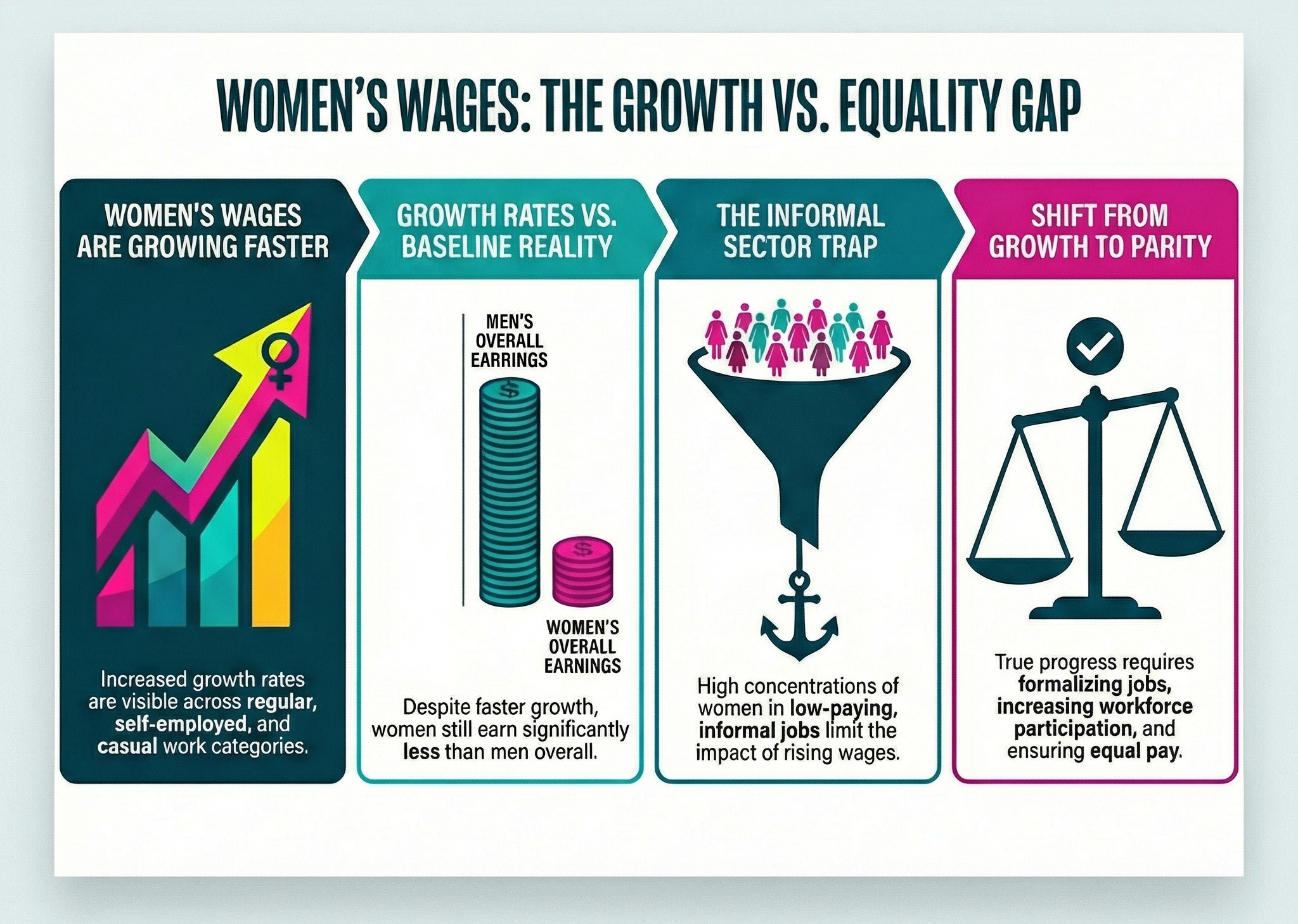
1. Key Arguments
A. Higher Wage Growth for Women
Women’s wages increased at a faster rate across regular, self-employed, and casual work.
This indicates improving labour market dynamics and possible narrowing of gender wage gaps.
B. Sectoral Improvements
Growth observed across employment categories.
Both formal and informal segments show rising earnings for women.
C. Persistent Wage Gap
Women still earn less than men overall.
Higher growth rates do not eliminate the baseline disparity.
D. Employment Structure Challenges
High concentration of women in informal and low-paying jobs.
Limits the impact of wage growth on overall economic empowerment.
E. Labour Force Participation Issues
Women’s workforce participation remains relatively low.
Structural barriers continue to restrict entry and retention.
2. Author’s Stance
Moderately optimistic but realistic
Acknowledges progress
Highlights positive trends in wage growth.
Recognises structural limitations
Emphasises that inequality persists despite improvements.
3. Biases and Limitations
Data-centric bias
Focus on wage growth may overlook qualitative aspects like job security and working conditions.
Short-term trend emphasis
May not capture long-term structural patterns.
Limited intersectional analysis
Caste, region, and education differences are not deeply explored.
4. Strengths (Pros)
Evidence-based reporting
Relies on official data and statistics.
Balanced narrative
Highlights both progress and gaps.
Relevance to gender and economy discourse
Important for policy and academic analysis.
5. Weaknesses (Cons)
Limited causal analysis
Does not explain reasons behind wage growth trends.
Insufficient policy linkage
Government initiatives driving change are not deeply analysed.
Underexplored quality of employment
Focus remains on wages rather than job conditions.
6. Policy Implications
A. Promoting Women’s Employment
Increasing labour force participation
Skill development and job creation.
B. Reducing Wage Gap
Ensuring equal pay for equal work
Strengthening labour laws and enforcement.
C. Formalisation of Employment
Shifting women into formal sector jobs
Improving job security and benefits.
D. Supporting Work-Life Balance
Childcare and flexible work policies
Reducing barriers to employment.
E. Targeted Interventions
Addressing regional and sectoral disparities
Focused policy measures.
7. Real-World Impact
Economic Impact
Improved income levels for women
Potential boost to household welfare.
Social Impact
Greater financial independence
Empowerment and decision-making power.
Labour Market
Gradual narrowing of gender gaps
But structural issues remain.
Challenges
Persistent inequality and informalisation
Limits long-term progress.
8. UPSC GS Paper Linkages
GS Paper I (Society)
- Gender inequality
- Women’s empowerment
GS Paper III (Economy)
- Labour markets
- Employment trends
GS Paper II (Governance)
- Labour policies
- Social justice
GS Paper IV (Ethics)
- Equity and fairness
9. Balanced Conclusion
Rising wage growth for women is a positive signal, but not a definitive indicator of gender equality in the labour market.
Structural constraints and disparities continue to limit the transformative impact.
10. Future Perspective
From growth to parity
Ensuring equal wages and opportunities.
Enhancing participation
Bringing more women into the workforce.
Improving job quality
Focus on formalisation and security.
Holistic policy approach
Addressing social, economic, and institutional barriers.
Final Insight
True progress lies not just in faster wage growth, but in achieving equitable, secure, and meaningful employment for women.
