

Yes SIR, But Also No SIR
Times Of India
1. Central Theme of the Article
The article argues that:
- The Supreme Court partially upheld democratic principles by recognising voting as a constitutional right,
but simultaneously: - Failed to adequately protect citizens from arbitrary exclusion during voter-roll revisions.
The author’s primary criticism is:
- The Election Commission was granted broad discretionary powers without imposing sufficient accountability safeguards.
Thus, the article views the judgment as:
- Constitutionally incomplete,
- Administratively risky,
- Potentially exclusionary.
2. Key Arguments Presented
Voting rights require meaningful inclusion
The article argues:
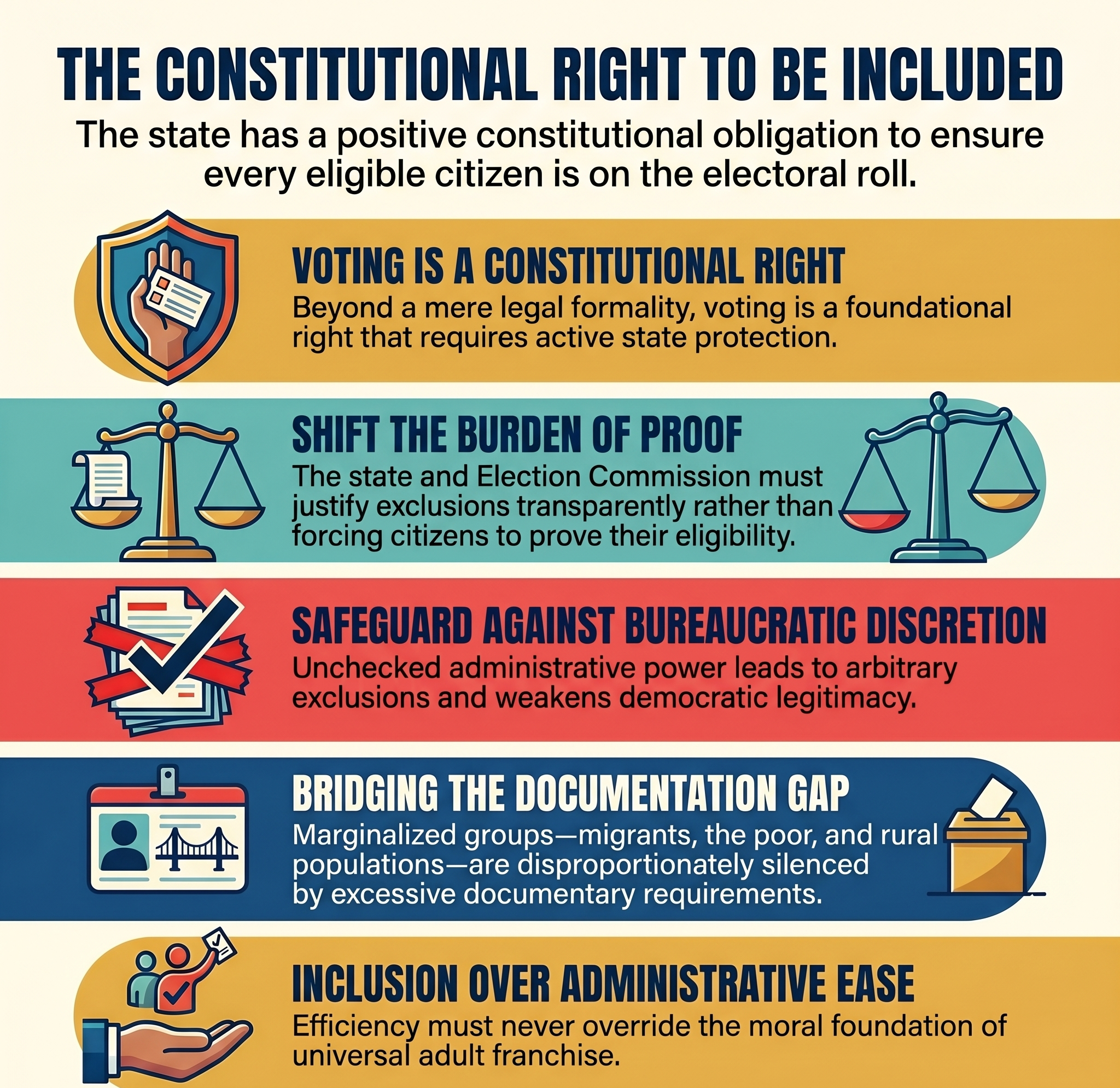
- Merely recognising voting as a constitutional right is insufficient if citizens can be excluded from electoral rolls through bureaucratic processes.
According to the author:
- Inclusion must become the EC’s positive constitutional obligation.
Burden of proof should not fall excessively on citizens
The author strongly argues:
- The burden of proving citizenship should not overwhelmingly rest on individuals.
Instead:
- The state and Election Commission must justify exclusions transparently.
This is the article’s most important constitutional argument.
Election Commission has been granted excessive discretion
The article claims:
- The Court accepted wide EC powers without robust procedural safeguards.
This may lead to:
- Arbitrary exclusion,
- Administrative overreach,
- Selective targeting.
Democratic legitimacy depends on universal franchise
The author repeatedly stresses:
- Universal adult franchise is the moral foundation of Indian democracy.
Any exclusionary electoral process:
- Weakens constitutional democracy itself.
Citizenship verification risks becoming exclusionary
The article warns that:
- Excessive documentary requirements can disproportionately affect:
- Migrants,
- Poor citizens,
- Marginalised communities,
- Informal workers,
- Rural populations.
3. Author’s Stance
Strongly civil-libertarian and democracy-centric
The author clearly prioritises:
- Individual rights,
- Democratic participation,
- Institutional accountability.
Critical of judicial restraint
The article believes:
- The Supreme Court should have imposed stronger safeguards upon the EC.
The tone suggests:
- Judicial deference to administrative discretion was excessive.
Skeptical of centralised bureaucratic authority
The author views:
- State-controlled citizenship verification processes with caution.
This reflects concern over:
- Democratic exclusion through administrative tools.
4. Biases and Underlying Assumptions
A. Rights-centric bias
The article overwhelmingly focuses on:
- Risks of exclusion.
It gives comparatively less attention to:
- Electoral fraud,
- Duplicate entries,
- Illegal voter concerns,
- Integrity of electoral rolls.
Thus, it prioritises:
- Inclusion over procedural strictness.
B. Institutional distrust
The article implicitly assumes:
- Bureaucratic discretion can become coercive or exclusionary.
While historically grounded in some contexts, this perspective may:
- Underestimate the necessity of electoral roll verification.
C. Liberal constitutional bias
The piece reflects:
- A liberal constitutionalist framework,
where: - Individual rights are prioritised over administrative convenience.
D. Historical analogy bias
The article invokes:
- Historical fears of disenfranchisement,
suggesting contemporary processes may repeat exclusionary patterns.
This can strengthen democratic vigilance, but may also:
- Heighten political anxieties.
5. Constitutional Dimensions
A. Right to vote in India
The article highlights an important constitutional debate:
- Voting is not explicitly a Fundamental Right,
but: - It is central to democratic participation.
The Supreme Court has increasingly recognised:
- Free and fair elections as part of the Constitution’s basic structure.
B. Universal Adult Franchise
The article strongly invokes:
- Article 326,
which guarantees: - Universal adult suffrage.
The author sees voter exclusion as:
- A constitutional injury.
C. Due Process Concerns
The article argues:
- Procedural safeguards during voter verification are inadequate.
This raises questions regarding:
- Natural justice,
- Transparency,
- Administrative fairness.
D. Election Commission’s Constitutional Role
Under Article 324:
- The EC has broad powers over elections.
The article questions:
- Whether such powers should remain largely unchecked.
6. Democratic Concerns Raised
Fear of disenfranchisement
The article’s biggest concern is:
- Legitimate citizens may lose voting rights due to documentation gaps.
This concern is particularly serious in India because:
- Large populations lack stable documentary records.
Marginalised groups may suffer disproportionately
Communities at higher risk include:
- Migrant labourers,
- Homeless persons,
- Tribal populations,
- Urban poor,
- Elderly citizens.
Administrative exclusion may become political
The article hints at the possibility that:
- Electoral roll revisions may become politically contentious tools.
7. Counterarguments Missing in the Article
While the article is persuasive, it underplays certain realities:
A. Electoral integrity also matters
Free and fair elections require:
- Accurate voter rolls,
- Removal of duplicates,
- Prevention of fraudulent voting.
B. Citizenship verification is not inherently anti-democratic
Every democracy requires:
- Some mechanism to identify legitimate voters.
C. Administrative updating is necessary
Population mobility and migration require:
- Periodic revision of voter databases.
D. Judicial over-intervention may weaken institutions
Excessive judicial restriction on EC powers could:
- Hamper election management efficiency.
8. Broader Governance Issues
The article reveals a deeper tension in Indian democracy:
Between:
- Administrative efficiency,
and
- Protection of civil liberties.
This tension increasingly appears in:
- Digital governance,
- Welfare databases,
- Citizenship systems,
- Surveillance frameworks.
9. Real-World Implications
A. Electoral legitimacy
If citizens perceive voter-roll exclusions as unfair:
- Trust in elections may decline.
B. Increased litigation
Disputed exclusions may:
- Burden courts and election systems.
C. Political polarisation
Electoral roll revisions often become:
- Politically sensitive controversies.
D. Governance burden
Ensuring accurate and inclusive voter lists requires:
- Administrative capacity,
- Technology,
- Transparency,
- Local verification mechanisms.
10. International Democratic Context
Globally, democracies face similar debates:
- Voter ID laws in the United States,
- Citizenship registers,
- Digital voter verification systems.
The central dilemma everywhere remains:
- Prevent fraud without suppressing participation.
11. Policy Implications
The article indirectly advocates for:
Transparent voter verification mechanisms
Including:
- Public hearings,
- Local verification,
- Notice procedures.
Reduced documentation burden
Particularly for:
- Vulnerable populations.
Independent review mechanisms
To challenge wrongful exclusions quickly.
Technological safeguards
Use of:
- Digital databases,
- Interoperable identity systems,
- Error-detection mechanisms.
But with:
- Privacy protections.
12. UPSC GS Paper Linkages
GS Paper II
Relevant themes:
- Election Commission
- Constitutional bodies
- Electoral reforms
- Democratic governance
- Separation of powers
GS Paper IV (Ethics)
Relevant themes:
- Administrative fairness
- Procedural justice
- Public trust
- Constitutional morality
Essay Topics
Possible themes:
- “Democracy and inclusion”
- “Rights versus administrative efficiency”
- “Electoral integrity in modern democracies”
13. Pros of the Article
Strong constitutional reasoning
The article effectively highlights:
- Democratic inclusion as a constitutional value.
Focus on vulnerable populations
It draws attention to:
- Structural inequalities in documentation access.
Institutional accountability
The article raises legitimate questions regarding:
- EC discretion and procedural safeguards.
Democratic vigilance
It reminds readers that:
- Elections are not merely procedural exercises but foundational democratic processes.
14. Weaknesses of the Article
Limited attention to electoral fraud concerns
The article underplays:
- The necessity of accurate electoral rolls.
Somewhat one-sided
The piece strongly favours:
- Inclusion over administrative enforcement.
Insufficient practical alternatives
While critical of EC powers, the article offers limited operational solutions for:
- Maintaining clean voter databases.
15. Deeper Political Significance
The article reflects a larger contemporary concern:
Modern democracies increasingly rely on:
- Documentation,
- Databases,
- Verification systems,
- Bureaucratic filtering.
This creates risks where:
- Citizenship itself becomes administratively contested.
The article warns that:
- Democracy can weaken not only through authoritarian laws,
but also through: - Routine bureaucratic exclusion.
16. Balanced Conclusion
The article presents a powerful constitutional critique of the Supreme Court’s approach toward electoral roll revision and voter inclusion. Its central strength lies in emphasising that:
- The right to vote becomes meaningful only when the state actively protects democratic inclusion.
The author correctly highlights:
- The dangers of excessive bureaucratic discretion,
- Risks faced by vulnerable populations,
- The constitutional importance of universal adult franchise.
The article serves as an important reminder that:
- Electoral democracy depends not merely on conducting elections, but on ensuring fair participation.
However, the piece adopts a strongly rights-centric approach and gives relatively limited attention to:
- Electoral fraud prevention,
- Administrative practicality,
- The need for accurate voter databases.
In a large democracy like India:
- Both inclusion and integrity are essential.
The real constitutional challenge is:
- Designing electoral systems that prevent fraud without excluding genuine citizens.
17. Future Perspective
India’s electoral governance will increasingly face pressures arising from:
- Migration,
- Urbanisation,
- Digital identity systems,
- Data governance,
- Citizenship verification mechanisms.
Future reforms must therefore focus on:
- Transparent procedures,
- Minimal exclusion,
- Accessible grievance redressal,
- Technological accountability,
- Institutional neutrality.
Ultimately, democratic legitimacy depends not only on:
- Who votes,
but also on: - Who is prevented from voting and why.
A mature constitutional democracy must ensure that:
- Administrative efficiency never overrides democratic inclusion.
