

Young must lead us to Viksit Bharat, Amrit Kaal is the era of hard work
Times Of India
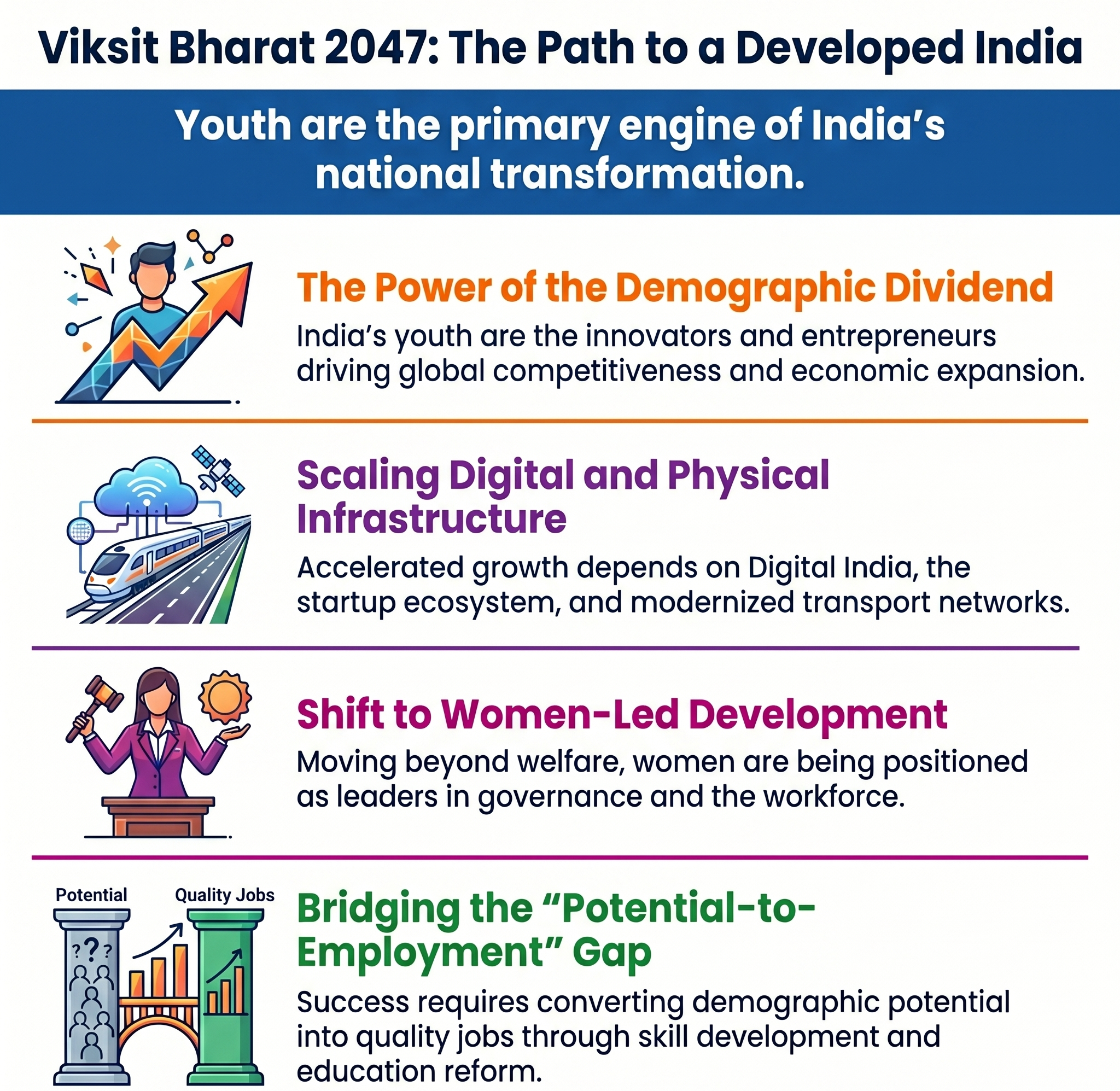
1. Core Arguments of the Article
Youth are central to India’s future
The article argues that:
- India’s young population represents the nation’s greatest strength.
It presents youth as:
- Innovators,
- Entrepreneurs,
- Nation-builders,
- Drivers of economic growth.
The concept of “Amrit Kaal” is framed as:
- A historic phase requiring dedication and hard work.
India is undergoing transformational development
The article highlights achievements in:
- Infrastructure,
- Digital governance,
- Welfare schemes,
- Health services,
- Rural development,
- Startup ecosystem,
- Women empowerment.
The argument suggests:
- India has entered a phase of accelerated development.
Welfare and growth can coexist
The article promotes the idea that:
- Social welfare schemes and economic development are complementary.
Examples mentioned include:
- Ayushman Bharat,
- Housing schemes,
- Women-centric policies,
- Rural welfare programs.
Women-led development is essential
The article stresses:
- Increasing female participation in the workforce and governance.
Women are presented not merely as beneficiaries but as:
- Leaders of development.
Technology and entrepreneurship are engines of growth
The article strongly promotes:
- Digital India,
- Start-up culture,
- Innovation,
- Skill development.
2. Author’s Stance
Strongly developmental-nationalist
The tone is:
- Optimistic,
- Aspirational,
- Promotional.
The author clearly supports:
- The current developmental narrative associated with “Viksit Bharat”.
State-centric optimism
The article presents government initiatives as:
- Transformative,
- Efficient,
- Inclusive.
The overall framing is largely celebratory rather than interrogative.
3. Ideological and Structural Biases
Pro-government orientation
The article strongly reflects:
- Official developmental discourse.
Achievements are highlighted extensively, while:
- Structural failures,
- Policy shortcomings,
- Socio-economic inequalities,
receive limited attention.
Aspirational nationalism bias
The article frames national progress through:
- Collective ambition,
- Patriotism,
- Productivity,
- Hard work.
This creates a motivational tone but may oversimplify deeper systemic issues.
Urban-development bias
Much emphasis is placed on:
- Technology,
- Startups,
- Infrastructure,
- Innovation.
Less attention is given to:
- Agrarian distress,
- Informal labour vulnerabilities,
- Rural inequality.
4. Critical Examination of Key Themes
A. Youth and Demographic Dividend
Positive Dimensions
India possesses:
- One of the world’s largest youth populations.
If properly utilised, this can lead to:
- Economic expansion,
- Innovation,
- Labour-force growth,
- Global competitiveness.
Critical Concerns
The article underplays major concerns such as:
- Rising unemployment,
- Underemployment,
- Skill mismatch,
- Jobless growth,
- Declining labour-force participation.
The real challenge is not merely:
- Having young people,
but: - Creating quality employment opportunities.
B. Hard Work vs Structural Opportunity
Inspirational messaging
The article repeatedly promotes:
- Discipline,
- Dedication,
- Hard work.
Structural critique
Hard work alone cannot guarantee development without:
- Institutional support,
- Equal opportunity,
- Education quality,
- Healthcare access,
- Social mobility.
This is a major limitation in aspirational narratives.
C. Welfare Schemes and Governance
Strengths highlighted
The article correctly points to:
- Expansion of welfare infrastructure,
- Digital service delivery,
- Health insurance,
- Rural housing.
These programs have improved:
- Financial inclusion,
- Basic social protection.
Concerns ignored
The article gives limited attention to:
- Implementation gaps,
- Leakages,
- State capacity constraints,
- Regional inequality,
- Fiscal sustainability.
D. Women-led Development
Positive shift
The article’s emphasis on:
- Women empowerment,
- Women entrepreneurship,
- Political participation,
is significant.
Ground reality concerns
However:
- Female labour-force participation remains relatively low,
- Wage gaps persist,
- Safety concerns continue,
- Informal unpaid labour remains high.
The article simplifies a deeply structural issue.
E. Infrastructure and Growth
Development achievements
The article highlights:
- Highways,
- Railways,
- Airports,
- Digital infrastructure.
These are indeed critical for:
- Economic modernization.
Missing perspective
However, the article underplays:
- Environmental costs,
- Land acquisition conflicts,
- Ecological displacement,
- Urban-rural development imbalance.
5. Real-World Impact
Positive impacts
The developmental focus may:
- Boost investor confidence,
- Inspire youth participation,
- Strengthen national morale,
- Encourage entrepreneurship.
Risks of over-celebration
Excessive optimism may:
- Ignore unemployment realities,
- Mask structural inequality,
- Reduce policy accountability.
6. Policy Implications
Need for employment-intensive growth
India requires:
- Manufacturing expansion,
- MSME growth,
- Labour-intensive industries.
Human capital investment
Achieving Viksit Bharat demands:
- Better schools,
- Higher education reform,
- Public healthcare strengthening,
- Research investment.
Balanced development
Growth must remain:
- Inclusive,
- Sustainable,
- Regionally balanced.
Institutional strengthening
Development requires:
- Strong institutions,
- Transparent governance,
- Cooperative federalism,
- Policy continuity.
7. UPSC GS Paper Linkages
GS Paper II
Relevant themes:
- Welfare schemes
- Governance
- Social justice
- Women empowerment
- Public policy
GS Paper III
Relevant themes:
- Economic development
- Demographic dividend
- Skill development
- Infrastructure
- Inclusive growth
- Employment
GS Paper IV (Ethics)
Relevant ethical dimensions:
- Public service,
- Leadership,
- Nation-building,
- Responsibility,
- Equity in development.
Essay Relevance
Potential themes:
- “Demographic dividend: opportunity or challenge?”
- “Development must be inclusive to be sustainable”
- “Youth as agents of social transformation”
8. Broader Political and Governance Perspective
Narrative-building in governance
The article reflects how modern governance increasingly uses:
- National narratives,
- Aspirational messaging,
- Symbolic targets like “2047”.
Development as political legitimacy
The article demonstrates:
- Development is now a key source of political legitimacy.
Challenge of balancing vision and reality
Vision statements inspire citizens, but:
- Delivery,
- Accountability,
- Institutional efficiency,
remain equally important.
9. Pros of the Article
Inspirational tone
The article successfully creates:
- Optimism,
- Civic motivation,
- National ambition.
Focus on youth participation
It correctly identifies:
- Youth as central to India’s future.
Recognition of women-led development
The emphasis on:
- Women’s participation,
is progressive and relevant.
Development-focused narrative
The article links:
- Infrastructure,
- Welfare,
- Innovation,
into a larger developmental framework.
10. Weaknesses of the Article
Insufficient critical scrutiny
The article largely avoids discussing:
- Unemployment,
- Economic distress,
- Agrarian crisis,
- Educational inequality.
Overdependence on political messaging
The article resembles:
- A governance projection piece,
more than a balanced analytical article.
Limited discussion of inequality
Development outcomes remain highly unequal across:
- Regions,
- Classes,
- Gender,
- Social groups.
Simplistic treatment of “hard work”
The article risks implying that:
- Individual effort alone determines success,
while structural barriers remain substantial.
11. Balanced Conclusion
The article presents an ambitious and optimistic vision of India’s journey toward becoming a developed nation by 2047. Its central message — that India’s youth must drive national transformation through hard work, innovation, and participation — is powerful and politically resonant.
The article effectively highlights:
- Welfare expansion,
- Infrastructure growth,
- Women-led development,
- Digital transformation,
as pillars of modern India’s developmental strategy.
However, the piece also carries a strong pro-government and aspirational bias. It underplays critical structural concerns such as:
- Unemployment,
- Educational quality,
- Regional inequality,
- Agrarian distress,
- Institutional capacity limitations.
While motivational narratives are important for national mobilisation, sustainable development ultimately depends not only on:
- Vision,
- Slogans,
- Aspirations,
but also on: - Inclusive growth,
- Institutional reforms,
- Social justice,
- Human capital development,
- Employment generation.
12. Future Perspective
India’s success in achieving “Viksit Bharat 2047” will depend on whether it can successfully convert:
- Demographic potential into productive employment,
- Welfare expansion into human capability,
- Economic growth into equitable prosperity.
The future challenge is not merely:
- Growing fast,
but: -
comments
